
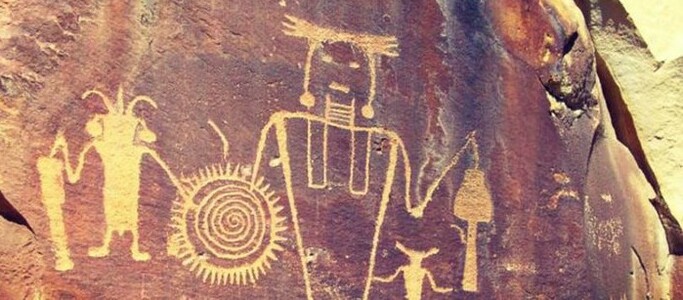
The Hopi people of northeastern Arizona preserve one of the oldest continuous spiritual traditions in North America. Among their teachings, the concept of Koyaanisqatsi stands as a stark warning (Waters, 1963). The word translates directly as "life out of balance." In its complete meaning, it describes a state of moral corruption, chaos, and turmoil that calls for another way of living.
The Bifurcated Path
Near the village of Hotevilla, Arizona, an ancient petroglyph known as the Prophecy Rock depicts the heart of this teaching (Geertz, 1994). The carving shows two paths branching from a single origin. The lower path represents life in harmony with nature and spiritual principles. A figure tends a cornfield, moving gracefully toward a future of balance and continuity. The upper path depicts technological advancement and material accumulation. This line grows erratic, eventually dissolving into chaos.
The Hopi elders teach that humanity stands at this crossroads. The choice between paths determines collective destiny. Those who follow the lower path live as "One-Hearts," maintaining ecological and spiritual balance. Those who choose the upper path pursue material gain at the cost of natural harmony, entering the state called Koyaanisqatsi.
The Stone Tablets and the Pahana
The Hopi tradition includes sacred stone tablets called Tiponi, given by the Great Spirit Massau'u at the beginning of the Fourth World (Lomatuway'ma, 1993). These tablets contain teachings, prophecies, and warnings for maintaining balance with the earth. The tablets were divided among four groups of people. One portion remains with the Hopi. Another was carried away by the Pahana, the "True White Brother," who departed for the east with the pledge to return.
The prophecy states that Pahana will return bearing the missing portion of the sacred tablet. His arrival will mark the beginning of the Fifth World, an era of peace and renewal. The elders recognize signs that the Fourth World is ending. Trees die from the top down. Humans have built a "house in the sky." The climate shifts in ways not seen before. These events align with prophecies passed down through generations.
The Great Purification
The transition between worlds involves what the Hopi call the Great Purification (West & Rubin, 2002). This period of shaking and spiritual conflict tests humanity's relationship with the earth. Those at peace in their hearts will find protection. Those who cling to material excess and technological domination will encounter the consequences of Koyaanisqatsi.
The Hopi do not present this teaching as fatalism. They offer it as a map. The lower path remains open. The choice to live in harmony with natural law remains available to any individual or society ready to make it. The Prophecy Rock does not predict which path humanity will choose. It simply makes visible what has always been true: the path of balance leads to continuity, the path of imbalance leads to dissolution.
A Teaching Beyond Borders
Director Godfrey Reggio brought this concept to global awareness through his 1982 film Koyaanisqatsi, scored by Philip Glass. Reggio learned the word from Hopi elder David Monongye, who served as a spiritual guide for sharing these teachings beyond the mesa villages. The film presented no narration, only images of natural landscapes contrasted with industrial machinery, so viewers could witness the imbalance directly.
Yet the teaching predates any film. The Prophecy Rock has stood for centuries. The Tiponi tablets carry instructions older than recorded Western history. The Hopi preserved this knowledge through oral tradition, stone carving, and sacred ceremony, waiting for the time when humanity would need to hear it most.
That time may be now.
Glossary
Koyaanisqatsi: A Hopi word meaning "life out of balance," combining koyaanis (corrupted, chaotic) with qatsi (life, existence). Describes a state of moral corruption and turmoil calling for another way of living.
Prophecy Rock: An ancient petroglyph near Hotevilla, Arizona, depicting two diverging paths representing humanity's choice between harmony and chaos.
Tiponi: Sacred stone tablets given by the Great Spirit Massau'u, containing teachings and prophecies for maintaining balance with the earth.
Pahana: The "True White Brother" in Hopi prophecy, who departed for the east carrying a portion of the sacred tablet and is expected to return at the dawn of the Fifth World.
Massau'u: The Great Spirit in Hopi tradition who guides humanity and provides instructions for balanced living.
Great Purification: A prophesied period of spiritual conflict and earthly shaking that marks the transition between the Fourth and Fifth Worlds.
Assumptions and Assertions
- Indigenous oral traditions preserve coherent cosmological frameworks that transmit ethical guidance across generations (DiBella, 2026).
- The Hopi concept of Koyaanisqatsi provides a diagnostic framework for evaluating societal relationship with natural systems (DiBella, 2026).
- Prophecy functions not as deterministic prediction but as ethical cartography, mapping consequences of choices (DiBella, 2026).
- The "two paths" structure appears across multiple indigenous traditions, suggesting convergent recognition of fundamental life-strategy options (DiBella, 2026).
- Material and technological advancement without corresponding spiritual development produces systemic instability (DiBella, 2026).
Reference Citations
Geertz, A. W. (1994). The Invention of Prophecy: Continuity and Meaning in Hopi Indian Religion. University of California Press.
Lomatuway'ma, M., Lomatuway'ma, L., & Namingha, S. (1993). Kiqötutuwutsi / Hopi Ruin Legends. University of Arizona Press.
Martineau, L. (1973). The Rocks Begin to Speak. KC Publications.
Reggio, G. (Director). (1982). Koyaanisqatsi: Life Out of Balance [Film]. IRE Productions.
Waters, F. (1963). Book of the Hopi. Viking Press.
West, M. D., & Rubin, J. (2002). "Hopi Prophecy Rock as Boundary Object." Journal of the Southwest, 44(4).
Keys: #Koyaanisqatsi #HopiProphecy #LifeOutOfBalance #ProphecyRock #IndigenousWisdom #NaturalLaw #SpiritualBalance #FourthWorld #FifthWorld #Pahana