
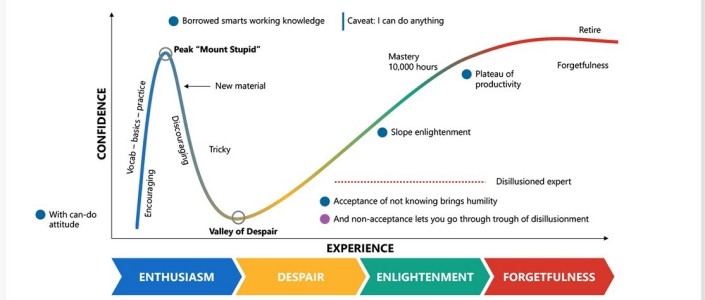
The Dunning-Kruger Effect identifies a cognitive bias where individuals with limited knowledge overestimate personal competence. We perceive this phenomenon as a structural failure of Metacognition. Metacognition exists as the mechanical ability to monitor and judge internal thought processes. To accurately evaluate skill in a difficult task, the individual must possess a baseline level of that same capability. For example, a student failing to solve a math problem also lacks the knowledge to identify the cause of the error. Without this foundation, the actor lacks the tools required to identify personal failures (Kruger & Dunning, 1999).
The Mirror of Ignorance
This deficit generates a state of Meta-ignorance where the person remains unaware of their own deficiencies. They remain blind to the patterns they fail to recognize. This represents more than a simple mistake. It denotes a lack of the "internal mirror" required for self-correction. In any feedback loop, if the sensor cannot perceive the error, the system will continue to drift into instability. We recognize this bias as a biological barrier to accurate situational awareness (Ehrlinger et al., 2008).
The Decay of Trust
This bias significantly impacts the function of collaborative systems. When participants cannot identify personal limitations, the allocation of tasks becomes inefficient. We observe that confidence frequently obscures proficiency in high-entropy environments. Consider a driver who has never encountered ice; they may drive aggressively because they do not know what they do not know about traction loss. Similarly, actors with high confidence but low skill may gain authority over complex operations. This leads to Terminal Systemic Instability.
The Noise of Assertion
Decisions made without a grounded understanding of risk reduce the utility of the institution. We observe that as groups grow in size, the noise generated by meta-ignorance often drowns out the signal of verified competence. High-integrity coordination depends on the ability of the network to accurately map the skills of its nodes. Without this mapping, the group loses the capacity to respond to external shocks. The leadership nodes become populated by those who believe their own illusions of mastery.
The Humility of Skill
Technical training offers a method for resolving this metacognitive deficit. As we gain actual skill in a domain, the capacity for self-assessment increases. We begin to understand the complexities once ignored. A novice chess player might believe they possess grandmaster potential until they face a real opponent and perceive the depth of the game. This shift often leads to a temporary reduction in self-confidence as the individual moves from Meta-ignorance toward a realistic understanding of capability (Ehrlinger et al., 2008).
The Refined Investigator
This transition requires the deliberate cultivation of intellectual humility. We focus on developing the ability to evaluate evidence independently of personal belief. True mastery marks itself not by the loudest assertion, but by the most accurate recognition of uncertainty. By training the mind to identify its own failure points, we improve the structural integrity of internal models. We differentiate between an amateur who fears correction and a professional who seeks it. Education exists as the process of learning how to monitor the mind while it works.
The Standard of Truth
The recognition of this cognitive pattern remains vital for institutional health. We must implement structural safeguards that prioritize verified competence over perceived confidence. Peer review, standardized testing, and data-driven assessments bypass individual bias. By shifting the focus from the actor toward the output, the system more accurately gauges internal capabilities. This approach reduces the influence of participants who appear certain but lack technical grounding.
The Continuous Verification
The study of metacognitive failure identifies the broader mechanics of human error. It highlights the importance of intellectual discipline and the continuous verification of knowledge. Personal agency begins with the understanding of cognitive limitations. We aim for a framework where mastery is valued and accurately identified. Strengthening the links between skill acquisition and self-assessment neutralizes the impact of the Dunning-Kruger Effect. Growth remains the lifelong process of refining the tools used to judge the self and the world.
Glossary
- Dunning-Kruger Effect: A cognitive bias in which people with limited competence in a domain overestimate their abilities.
- Metacognition: The higher-order thinking process that involves active control over the cognitive processes engaged in learning.
- Meta-ignorance: A state where an individual lacks the knowledge required to recognize their own ignorance.
- Intellectual Humility: The recognition that beliefs or opinions might be wrong, combined with a willingness to revise them.
- Terminal Systemic Instability: A condition where the feedback loop between actors and their environment becomes unstable.
- Moral Physics: The mechanical reality where moral and cognitive choices produce predictable and objective consequences.
Assumptions and Assertions
- [Assumption] Accurate self-assessment requires the same skill set as the task being evaluated (Kruger & Dunning, 1999).
- [Assertion] Confidence is an unreliable proxy for competence in low-information environments (Ehrlinger et al., 2008).
- [Assertion] Structural transparency reduces the systemic impact of metacognitive failure (DiBella, 2026).
- [Assertion] Intellectual humility exists as a prerequisite for high-fidelity signal parsing.
Reference Citations
- DiBella, Charles. Moral Physics (2026). Foundational project link.
- Ehrlinger, J., et al. Why the Unskilled are Unaware (2008). Explorations of absent self-insight.
- Kruger, J., & Dunning, D. Unskilled and Unaware of It (1999). Primary identification of the competence bias.
Technical precision enables the transition from signal to institutional asset.
Keys: #Mind #Metacognition #DunningKruger #Psychology #Cognition #Logic #Sovereignty #Systems #Education #MoralPhysics