

A capital reallocation framework that reclaims distressed commercial real estate to create a sustainable pipeline for rehousing individuals experiencing homelessness. Converting vacant structures into Material Dignity Infrastructure neutralizes municipal financial drains and restores public health. This analysis defines homelessness as a solvable engineering deficit.
Key Terms are provided to aid in understanding this framework for addressing the crisis of homelessness.
The Family Safety Net (The Kinship Buffer): The circle of family, relatives, and close community who help a person stay housed when something goes wrong. If you lose your job and your grandmother lets you move in while you recover, that is the Family Safety Net in action. When this net disappears, there is nothing left to catch you.
Energy Drain (Metabolic Deficit): The massive amount of body energy a person burns every day just to survive on the street. Finding water, food, a bathroom, and a safe place to rest takes more physical effort than most jobs. The body runs out of fuel because the street demands constant movement.
Feeling Safe in Your Space (Ontological Security): The deep sense of safety that comes from having a private room with a door that locks. When your brain knows you are safe, it can finally shut down, sleep deeply, and repair itself. Without this feeling, the brain stays on high alert and breaks down over time.
Body Aging (Biological Weathering): Living outside forces the body to fight heat, cold, hunger, and danger every single day. This constant stress makes a 50-year-old person's body look and feel like that of a 75-year-old. The street ages people roughly 20 years faster than normal.
Hiding the Problem (Aesthetic Management): When a city spends money to move homeless people out of sight instead of giving them a real place to live. The sidewalk looks clean for a few days, but nothing changes because the people have nowhere else to go.
The Money Sink (The Infinite Spending Drain): The cycle where a city spends millions of dollars clearing encampments, running emergency shelters, and placing people in apartments that fail, only to start the cycle over again. The money gets spent, but the number of people on the street stays the same or grows.
The Stress Machine (The Trauma Engine): The entire system of encampment sweeps, crowded shelters, and failed housing placements that keeps people trapped in a cycle of stress and sickness instead of helping them recover. The machine runs on tax dollars and produces no long-term results.
The City's Duty to Itself (The Municipal Quarantine): The idea that a city builds housing for the homeless for the same reason it builds sewers and water pipes. It protects the health and economy of the entire city, not as a charity, but because leaving the problem unsolved costs everyone more in the long run.
Material Dignity Infrastructure (Structural Containment): A public utility network of permanent supportive housing designed to physically contain the biological and economic friction of the street. It operates on the same logic as a municipal sewer system, built to protect the health and property of the entire city.
Open Door Policy (Anti-Exclusionary Architecture): A system where a person can walk in and receive a room, food, and a shower without passing any test. No one asks if they have a job, a criminal record, or a substance problem. The help comes first because the body has to heal before the brain can make good decisions.
Introduction
American culture celebrates the idea of the self-made person. The story says that a strong individual can survive anything on their own. This story works only when times are good. When real trouble hits, no one survives alone.
When a family has money in the bank, the members appear independent. They buy their own food, pay their own rent, and handle their own problems. The moment that money disappears, independence disappears with it. A job loss, a medical emergency, or a mental health crisis immediately forces a person to reach out to others for help.
For most of human history, that help came from the Family Safety Net (The Kinship Buffer). Grandparents, aunts, uncles, cousins, and neighbors lived close together. If someone lost their job, a relative would share their home and food until the person got back on their feet. This network absorbed the shock of bad luck the way a sponge absorbs water.
The modern problem is that the sponge is gone. Families have scattered across the country. Many people live alone or in small households with no extended family nearby. When a crisis hits a person who has no money and no Family Safety Net, there is nothing left to catch them. They fall into homelessness.
The encampment is the visible proof of this failure. The person living on the sidewalk is not there because they made one bad decision. They are there because both of their safety systems failed at the same time. Their money ran out, and no family network existed to absorb the fall. Blaming the individual ignores the reality that continuous survival requires continuous support. When the support structure vanishes, the street is the result.
The Small Family Trap
Before World War II, most American families lived in large, multi-generational households. Grandparents, parents, adult children, and cousins all lived near each other, often in the same house or on the same block. This operated as a survival system. When someone got hurt, lost their job, or became ill, the surrounding family absorbed the impact by sharing food, housing, and money. The extended family operated as the original Family Safety Net.
After World War II, the United States government encouraged families to spread out. New highways, suburban housing developments, and government-backed home loans encouraged people to move away from their extended families and start fresh in small, isolated households. By 1980, only about 12 percent of Americans still lived in multi-generational homes. The culture replaced the large family network with the small nuclear family: two parents and their children, standing alone.
The small nuclear family looks stable during good economic times. When jobs are plentiful and wages are rising, a small household can pay the bills without outside help. The problem surfaces the moment the economy contracts. A household of two adults has almost zero ability to absorb a major financial shock. If one adult loses their job or gets a serious illness, the entire household faces immediate financial collapse. There is no one down the hall to share rent. There is no one across the street to bring groceries. The small family operates as a fragile unit with no backup.
The modern tent encampment is the direct result of this fragility. When the strong post-war economy weakened in the late 1970s and 1980s, small families began breaking apart under financial pressure. The individuals who fell out of these households found no larger safety net waiting for them because the extended family structure had already been dismantled. The government expected tiny families to perform the shock-absorbing job of entire communities. The math did not work. The people on the street today are the visible output of a society that replaced a strong, wide net with a thin, fragile one.
The Math Behind the Crisis
The explosion of tent encampments in American cities began in the early 1980s. This occurred as the predictable result of three failures happening at the same time.
Failure One: Affordable Housing Disappeared. Cities across the country destroyed thousands of low-cost single-room apartments through zoning changes and building regulations. These small, affordable rooms had been the last line of affordable housing for people with very low incomes. When the rooms disappeared, there was nothing left at the bottom of the housing ladder.
Failure Two: Government Support Was Reduced. The federal government drastically reduced funding for welfare programs and public assistance. People who previously had a thin financial lifeline from the state lost that support during the exact period when housing costs were rising.
Failure Three: The Family Safety Net Collapsed. As described in the small family trap, the extended family networks that historically caught falling individuals had been dismantled by decades of geographic scattering. The small nuclear family could not absorb the pressure.
When all three failures occurred simultaneously, the result was a mathematical certainty. People who lost their income had no affordable housing to fall back on, no government assistance to bridge the gap, and no family network to take them in. They ended up on the street.
Instead of recognizing this as a structural collapse, politicians blamed the victims. They called homelessness a consequence of addiction and mental illness. This framing allowed the government to treat a system-wide engineering failure as a collection of individual behavioral problems. It transferred the burden of recovery onto people who had already been stripped of every resource needed to recover.
The biological reality of poverty does not care about political narratives. A human body without shelter and food cannot generate stability through willpower alone. The tent encampment is the collection point for people whose structural supports collapsed. Arresting or lecturing these people does not rebuild the supports. The city cannot police its way out of a math problem.
The Street as a Trauma Machine
Most people assume that living on the street takes very little energy. They see someone sitting on a sidewalk and think the person is idle. The reality is the opposite. The street demands more physical effort than most indoor jobs.
Consider what a housed person takes for granted. You turn a faucet and clean water flows. You flip a switch and the room warms up. You walk ten steps to a private bathroom. These basic survival tasks require almost zero physical effort inside a home because the infrastructure is automated. For a person living on the street, every one of these tasks becomes a difficult, time-consuming, and sometimes dangerous mission.
Finding clean water might mean walking a mile to a public fountain. Locating a bathroom might require negotiating access to a business or finding a public restroom that is open. Getting a single meal might take hours of walking, waiting in line, or searching through discarded food. Every calorie the person eats is partially burned off by the effort required to find the next one. The street replaces automated survival with constant physical labor.
This creates the Energy Drain (Metabolic Deficit). The body burns fuel at an accelerated rate because it must fight heat, cold, hunger, and danger around the clock. At night, the body works overtime to stay warm. During the day, it fights dehydration and exhaustion. The person's muscles begin to break down because the body starts consuming its own tissue to keep the engine running.
The city makes this worse. When police sweep a tent camp, the person living there must pick up everything they own and carry it across town to start over. This forced relocation multiplies the Energy Drain because it burns a massive number of calories while producing zero forward progress. The person ends up in the same situation, just in a different location, with less energy than before.
A city cannot expect that people in this condition get jobs, keep appointments, or follow complex rules. Their bodies are running on empty. The street drains the fuel needed to do anything other than survive until tomorrow.
Why Sleep Is Everything
Your brain performs its most critical maintenance while you sleep. During a phase called REM (Rapid Eye Movement) sleep, the brain consolidates memories, processes emotions, and repairs the circuits responsible for planning, decision-making, and self-control. This maintenance cycle requires one condition above all others: the brain must feel safe.
When you sleep in your own bed, behind a locked door, in a room that belongs to you, your brain achieves Feeling Safe in Your Space (Ontological Security). It recognizes that no immediate physical threat exists and allows itself to fully shut down for repair. This is not a luxury. It is the biological mechanism that keeps your mind functioning.
A person living on the street never achieves this state. They sleep in parks, on sidewalks, or in doorways where anyone can approach them at any time. The threat of assault, robbery, or police sweeps never stops. Because the brain interprets this environment as dangerous, it refuses to enter deep sleep. It keeps the body on high alert, ready to wake up and respond to danger at any moment. The street enforces permanent sleep deprivation.
When the brain is denied deep sleep for weeks and months, the consequences are severe. The person loses the ability to control their emotions. Small frustrations trigger extreme reactions. The ability to plan ahead, weigh options, and make careful decisions disappears. The brain operates in pure survival mode, running on adrenaline and instinct, because the repair cycle that produces higher thinking never completes.
Government programs frequently require homeless people to show up at specific times, fill out long forms, and maintain strict sobriety in order to qualify for housing. These requirements demand high-level brain function from a population whose brains have been physically prevented from performing the repair cycle that produces high-level brain function. The requirement defeats itself. The state is asking for the output of a machine whose power supply the state has allowed to be destroyed. Sleep must be restored first. Compliance follows recovery, not the other way around.
How the Street Ages the Body
The human body is built to operate within a narrow set of conditions. It needs stable temperature, consistent nutrition, clean water, and rest. When these conditions are met, the body repairs itself daily. Cells regenerate, the immune system fights off infections, and the organs maintain steady function. A housed person receives these conditions automatically through the infrastructure of their home.
A person living on the street loses all of these protections. Freezing nights force the body to burn enormous amounts of energy just to stay warm. Hot days cause dehydration and heat exhaustion. Without regular meals, the body runs on starvation reserves. Without shelter from wind, rain, and sun, the skin and organs take constant damage. The body cannot repair itself because the damage never stops arriving.
This process is called Body Aging (Biological Weathering). The body interprets the street as a continuous physical emergency. In response, the immune system shifts into a permanent state of high alert, releasing inflammation chemicals around the clock. This chronic inflammation destroys healthy tissue, weakens the heart, and damages the brain. The street functions like a time machine that pushes the body forward through decades of aging in just a few years.
The medical evidence confirms this effect with stark numbers. Doctors classify unhoused people in their early fifties as geriatric patients. Their bodies exhibit the same frailty, chronic diseases, and cognitive decline typically seen in housed people in their mid-to-late seventies. The street shears roughly twenty years of healthy life from the human body. Unsheltered individuals die, on average, twenty to thirty years earlier than housed people.
Despite this reality, government programs treat tent encampments as a zoning issue, like an illegally parked car that needs to be towed. The clinical reality is that the encampment is a site of accelerating biological collapse. Asking people whose bodies have been aged by decades of street exposure to navigate complex bureaucratic systems to earn their way into housing ignores the physical state of the population. The body must be stabilized before the person can be expected to function independently.
Where the Money Goes
Every major American city spends enormous amounts of money on homelessness every year. Very little of that money goes toward solving the problem. Most of it goes toward Hiding the Problem (Aesthetic Management).
A tent encampment appears on a public sidewalk. Business owners complain. The city sends police officers to issue warnings and secure the area. Sanitation crews arrive with trucks and heavy equipment to remove tents, tarps, and personal belongings. Storage facilities process the confiscated property. Street-cleaning vehicles wash the sidewalk. The entire operation can cost millions of dollars for a large encampment.
The sidewalk is clean. The problem appears to be gone. Within days, the displaced people regroup two blocks away and rebuild the same encampment because they have nowhere else to go. They have no permanent housing, no Family Safety Net, and no program that can absorb them permanently. The clearance operation forced a geographic shuffle. The crisis remains identical.
This cycle of repeated encampment sweeps is the Money Sink (The Infinite Spending Drain). The city allocates operating dollars to a process that guarantees its own repetition. Because the underlying Energy Drain and Family Safety Net collapse receive zero structural intervention, the displaced population has no alternative destination. The tents clear. The tents return. The budget resets. This cycle repeats.
Taxpayers fund this cycle indefinitely. The political incentive for Hiding the Problem is stronger than the incentive for fixing it because a cleared sidewalk is visible evidence of action. A politician can point to a clean block and claim progress. They cannot point out that the population has reassembled around the corner. The Money Sink persists because it produces short-term visual results while requiring zero long-term accountability. The city purchases appearances with taxpayer money, generating a zero percent return on the public's investment.
Why Shelters Make It Worse
The large group shelter is the most common government response to homelessness in the United States. Cities spend billions of taxpayer dollars every year to operate buildings where hundreds of people sleep in open rooms on rows of cots or mats. The public is told these shelters represent compassion in action. The biological evidence shows they function as an extension of the street.
Consider what happens when a person enters a typical shelter. They must give up any belongings that do not fit into a small bin. They are assigned a sleeping spot in an open room alongside dozens or hundreds of strangers. There are no walls between beds. There are no private bathrooms. There are no locks on any doors. The person must leave the building at a set time in the morning and cannot return until evening check-in. They have zero control over their environment.
This is the key problem. As the analysis of sleep mechanics showed, the brain requires Feeling Safe in Your Space to enter deep sleep and perform its repair cycle. A crowded dormitory with no walls, no locks, and no privacy provides the brain with exactly the same threat signals as the open sidewalk. The brain cannot tell the difference between sleeping in a room full of strangers and sleeping on the street. Both environments trigger permanent high alert. Both environments block the deep sleep needed for neurological repair.
The shelter does not heal the damage caused by the street. It continues the damage inside a different building. Clinical research confirms that people who cycle through shelter systems show no improvement in their psychiatric conditions. The constant disruption of daily forced departures and shared facilities prevent the environmental stability needed for recovery. A person who needs six to twelve months of private, stable shelter to recover from street exposure instead receives a stressful institutional environment.
The taxpayer funds this machinery at a cost of billions of dollars per year. The system consumes massive amounts of public money while extending the crisis it was built to end. The shelter operates as the Stress Machine (The Trauma Engine) indoors.
The Housing First Trap
The government's preferred long-term solution for chronic homelessness is housing first scattered-site housing. The program works like this: the state signs a lease for a regular apartment somewhere in the city, gives the keys to a formerly homeless person, assigns a social worker to check in periodically, and counts the placement as a success. On paper, the person is housed. In practice, the placement has set a timer on the next eviction.
The person receiving the keys has spent months or years living on the street. The analysis of sleep mechanics established that chronic sleep deprivation destroys the brain's ability to plan ahead, manage schedules, and make complex decisions. This person has been biologically damaged by the very environment they are escaping. Handing them an apartment does not repair that damage. It relocates a damaged person into a new container.
The apartment is isolated. The person has no Family Safety Net nearby. They have no neighbors who know them. They have no support community within walking distance. They must independently manage rent payments, utility bills, lease rules, and landlord communications. These tasks require the exact executive functions that street exposure has destroyed. The apartment demands high performance from a brain that has not had a stable environment to repair itself.
The failure unfolds with mechanical predictability. The person may not miss a rent payment because they cannot manage the schedule. They violate a lease term because they cannot track the rules. Complaints accumulate. Eviction proceedings begin. Within a year, the person returns to the street, re-entering the Stress Machine in the same biological condition they were in before the apartment was offered.
The scattered-site model produces a revolving door. The government spends public money on a lease, counts the placement as a win, and then absorbs the cost of eviction and re-entry into the system. The program generates temporary paperwork results while achieving zero net reduction in the number of people on the street. The state has purchased an administrative outcome and labeled it a structural solution.
The Sewer Argument
In the 1800s, cholera epidemics killed thousands of people in London, Paris, and New York. The disease spread through contaminated water and open sewage in the streets. City governments did not respond by debating whether the sick people deserved help. They did not set up panels to determine the moral character of the victims. They built sewers.
Cities deployed massive amounts of money to construct underground pipe systems that physically removed biological waste from the streets. They did this because the alternative was economic and social collapse. Businesses could not operate. Property values dropped. Disease spread from poor neighborhoods into wealthy ones. The sewer functioned as an act of municipal self-preservation, illustrating The City's Duty to Itself (The Municipal Quarantine).
This historical precedent provides the exact blueprint for solving modern homelessness. The city builds public infrastructure to protect its own economic survival. Sewer pipes do not exist because politicians care about the dignity of human waste. They exist because uncontrolled contamination destroys property values, spreads disease into the housed population, and generates hospital costs that far exceed the price of the pipes. The infrastructure pays for itself by preventing larger damage.
Modern tent encampments create the same economic equation. The unsheltered population generates public health risks, drives down surrounding property values, and inflicts sustained costs on commercial districts. The city currently responds with the Money Sink of tent sweeps and shelter cycling. This response purchases temporary displacement at a zero percent fix rate. The city keeps funding a cleanup process that sewers eliminated over 150 years ago: indefinite biological management instead of structural containment.
The Material Dignity Infrastructure (Structural Containment) operates as the modern sewer. It classifies permanent supportive housing as a mandatory public utility, built to physically contain the biological and economic friction of the street. The political argument requires no moral component. Taxpayers already fund sewer lines, electrical grids, and water systems without requiring the beneficiaries to pass a behavior test. They fund this infrastructure because the alternative threatens their own health and property. The same logic applies here. The city builds the infrastructure to protect itself.
The Empty Buildings
The physical infrastructure needed to solve this crisis already exists in Los Angeles. It is sitting empty, losing value every month, and costing its owners money. The COVID-19 pandemic permanently changed the way people work, and the commercial real estate market has not recovered.
By 2024, approximately twenty-five percent of the office space in Los Angeles was vacant. Market analysts estimated that up to half of the older office buildings in the city would never attract enough tenants to remain financially viable. The shift to remote and hybrid work is permanent. Corporate tenants are shrinking their physical office space by fifteen to twenty percent every time a lease expires. The demand that once filled these buildings has evaporated and will not return.
These buildings are not temporarily between tenants. They are structurally obsolete for their original purpose. The owners face a difficult choice: spend enormous sums to retrofit the building for a new use, or sell at a steep loss. The market is creating exactly the conditions that make large-scale city purchases possible at a fraction of the original price.
One example demonstrates the financial mechanics clearly. The Gas Company Tower in Downtown Los Angeles sold in 2024 for approximately two hundred million dollars. That building had been valued at over six hundred million dollars just four years earlier. This single transaction represents a loss of more than four hundred million dollars. This level of devaluation is occurring across dozens of buildings throughout the city.
The 38-tower Material Dignity Infrastructure network requires approximately nineteen million square feet of vertical space distributed across the Los Angeles area. The distressed commercial market provides this space. The city currently spends hundreds of millions of dollars per year on the Money Sink of tent sweeps and failed placements. Redirecting a fraction of this spending toward acquiring devalued buildings purchases a permanent public asset instead of a temporary clean sidewalk.
The window of opportunity will not stay open indefinitely. As interest rates stabilize and the broader economy adjusts, building prices will correct upward. The city has a narrow period to convert a commercial real estate collapse into the physical foundation of a permanent public utility.
Help First, No Questions Asked
Every existing housing program in the United States puts conditions on entry. To qualify, a person must prove they are sober. They must pass a criminal background check. They must show proof of income or agree to follow a structured treatment plan. These rules exist because the government treats housing as a reward for good behavior.
Human metabolic biology proves that this approach is doomed to fail. The analysis of biological weathering and sleep deprivation established that the street destroys the brain's ability to plan, manage impulses, and maintain self-control. The government demands behavioral achievement as the price of admission to the recovery environment that produces behavioral achievement. The requirement is circular. It asks for the output before it can be biologically produced. Without stability, the brain cannot recover its function to achieve stability. This creates a self-defeating trap that keeps people on the street.
The Open Door Policy (Anti-Exclusionary Architecture) abandons this gate. It treats basic survival, a private room, a locking door, access to a bathroom, and a reliable source of food, as an industrial supply, the same way a city treats the water flowing through a public pipe. The city does not require a citizen to demonstrate sobriety before they can drink from the tap. The infrastructure delivers the resource without conditions because the alternative creates a public health crisis for everyone.
This model has a historical precedent. For centuries, monasteries across Europe operated as unconditional shelters. They provided food, rest, and a private space to travelers and displaced people. They imposed no means test. They required no proof of moral character. The institution absorbed the population because the alternative was visible human suffering at its gates. The Material Dignity Infrastructure replicates this logic at the scale of a modern city.
The result of unconditional entry is physiological recovery. When a person receives a private room with a locking door, their brain begins to recognize safety. The high-alert survival mode described in the analysis of sleep mechanics starts to deactivate. Over weeks and months of stable, private shelter, the neurological repair cycle resumes. The person who was biologically incapable of keeping an appointment six months ago gradually recovers the brain function needed for planning and decision-making.
Good behavior is not the price of admission. It is the product of recovery. The Open Door Policy does not reward behavior. It creates the biological conditions from which functional behavior can emerge.
Building the Fix
The argument reduces to a single choice. The city currently funds the Stress Machine by operating a Trauma Engine that spends hundreds of millions of dollars on Hiding the Problem through Aesthetic Management. We have proven that the physical Energy Drain enforces a Metabolic Deficit, whereas the deprivation of Feeling Safe in Your Space destroys Ontological Security. Consequently, the street accelerates Body Aging through Biological Weathering. This approach guarantees systemic failure.
The street population will not resolve itself. The Family Safety Net that historically served as the Kinship Buffer against economic displacement no longer exists. Since government welfare lacks the operational logic to contain this crisis, The Money Sink functions as an Infinite Spending Drain. The budget resets, the tents return, and the cycle repeats until the city replaces the broken machine.
The Material Dignity Infrastructure provides Structural Containment through a strict capital redirection. The 38-tower network shifts funds from an operating cost that produces zero structural return toward a permanent asset that removes the friction of the street from the urban environment. The city builds the sewer to protect itself, which executes The City's Duty to Itself through a Municipal Quarantine that isolates biological and economic damage. The voting public currently tolerates the Infinite Spending Drain because the alternative is framed as a moral obligation. This analysis reframes the choice as a strict financial calculation.
The infrastructure required to execute this solution exists today. The empty office buildings provide the physical space. The Open Door Policy establishes the Anti-Exclusionary Architecture required for immediate operational intake. The clinical data provides the biological rationale. The city possesses the space, the science, and the operational protocol. The only remaining variable is the public will to reclassify this crisis from a moral burden to an engineering project and build the correct machine.
The Cost of Doing Nothing
Every city has a baseline cost of keeping the street population contained. This is the amount of money the city spends every single year to push the problem out of sight. It includes the budgets for police departments, sanitation crews that sweep tents, shelters that house people for short periods, and emergency services that respond to crises. In Los Angeles, this baseline cost runs between eight hundred million and one billion dollars annually. This is the ongoing operating budget required just to manage the symptoms of the homelessness crisis. This is the baseline cost of the Money Sink. This is the cost of the Trauma Engine. This is the cost of doing nothing.
This money disappears every year without creating a permanent structural solution. Police do not solve the underlying issue by arresting people. Sanitation crews clean the sidewalks only to have the encampments reform days later. Temporary shelters provide a pause but not a sustainable transition. This spending creates the illusion of action while allowing the biological and economic damage of the street to continue compounding. The city pays this billion-dollar bill year after year as a pure operating cost that never turns into a capital asset.
What This Money Could Purchase
The billion-dollar annual budget for street management represents a massive concentration of capital. The question this paper asks is simple: What if the city redirected this money away from failed operations and toward a permanent physical solution? The economic logic is similar to a municipal sewer system. In the nineteenth century, cities paid to clean up disease outbreaks caused by poor sanitation. At a certain point, engineers convinced policymakers that the long-term savings from building a permanent sewer system outweighed the upfront cost. This operates as a capital investment. The Material Dignity Infrastructure operates on this same financial principle.
The analysis identifies thirty-eight large office buildings in downtown Los Angeles that are currently vacant or underutilized due to post-pandemic market shifts. These buildings provide approximately nineteen million square feet of vertical space. Converting these structures into permanent micro-unit housing units is economically feasible. An independent analysis estimated that converting an office building into housing units costs between one hundred and two hundred dollars per square foot depending on the depth of the required renovation. This includes structural work to add kitchens and bathrooms within the existing floor plans. For a thirty-eight tower network, the total capital investment required is roughly one point nine billion dollars spread over a three to five year period depending on the construction schedule.
Comparing the Investments
When the city spends one billion dollars on annual street management, that money is gone the following year. It is an endless cycle of treating symptoms. The Material Dignity Infrastructure proposes a one-time capital investment of approximately two billion dollars that solves the problem permanently. This functions as a direct purchase of city infrastructure. The city builds the sewer to protect itself. The Material Dignity Infrastructure builds housing to protect the city. The city spends the money in both scenarios. In the first case, the money purchases nothing permanent. In the second case, it purchases a lasting physical asset that removes the economic and biological friction of the street from the urban environment.
To understand the long-term financial advantage, the city needs to compare the costs over a ten-year period. In the current model, the city spends ten billion dollars over ten years managing the symptoms of street homelessness. The problem remains unsolved. The city pays the billion-dollar bill year after year because the Money Sink has no outlet. The economic analysis demonstrates that the Material Dignity Infrastructure solves the same problem for roughly two billion dollars. The city saves eight billion dollars over ten years while permanently removing the visible poverty and dysfunction from the downtown core. The public transit systems, tourism, and local businesses benefit from the restored economic vitality of the city.
Real-World Economic Leverage
Los Angeles County currently spends between three billion and five billion dollars per year on homelessness through its Department of Health Services and County Supervisors. The city's one billion dollar portion is already allocated and currently being spent on failed strategies. This executes a redirection of existing spending. The evidence shows that the current spending produces zero return on investment. The Material Dignity Infrastructure provides a permanent structural return.
The Gas Company Tower in Downtown Los Angeles sold in 2024 for approximately two hundred million dollars. This building was valued at over six hundred million dollars just four years earlier. This single transaction represents a four hundred million dollar loss in market value. That loss is not contained to a balance sheet. It is reflected in the lost economic activity of an entire district. The Material Dignity Infrastructure addresses this devaluation by converting underutilized or distressed assets into functional permanent housing. The city removes the negative externality of visible poverty while simultaneously preserving and enhancing the economic value of the downtown core. The financial logic is irrefutable. The city is already spending the money. The only variable is whether that money purchases another year of temporary cleanup or a permanent working solution.
Public Safety and Health Return
The economic case for the Material Dignity Infrastructure is undeniable. The most significant returns are measured in the restoration of public health and safety. The street encampments operate as biohazard zones that degrade the operating environment of the city. The Material Dignity Infrastructure eliminates these zones by removing the population from the sidewalk and placing them into a controlled environment where sanitation and medical care are provided on-site.
The physical degradation of the sidewalk is the most immediate problem. In the absence of regular sanitation, human waste accumulates on the streets. Studies have shown that a single encampment can produce significant quantities of hazardous waste daily. The city is forced to deploy sanitation crews to clean these areas. This cleaning process is not only expensive but also ineffective in the long term because the population relocates to a new area. The result is a continuous cycle of degradation and cleanup. This cycle creates a public health crisis that affects everyone. Residents, business owners, and tourists are all exposed to the health risks associated with poor sanitation.
The psychological degradation of the population is a more insidious problem. When a person lives on the street, they lose their basic sense of dignity. Without a private space to sleep, bathe, or store their belongings, they exist in a state of constant vulnerability. This chronic stress affects their mental and physical health. Research has shown that homelessness significantly increases the risk of various diseases. Individuals on the street are more likely to suffer from respiratory infections, skin conditions, and gastrointestinal illnesses. This makes them more dependent on emergency medical services.
The Material Dignity Infrastructure transforms this dynamic. By providing secure micro-units, the infrastructure gives individuals a place where they can maintain their dignity. They have a private space that they can secure with a lock. They have access to sanitation facilities. They have a stable environment where they can store their belongings. This restoration of dignity has immediate health benefits. It reduces their stress levels and improves their mental health. It also reduces their exposure to environmental hazards.
Beyond the immediate health benefits, the Material Dignity Infrastructure also reduces the burden on public health systems. The presence of encampments leads to increased emergency room visits. People experiencing acute medical issues associated with street living often seek treatment at hospitals. This places a significant strain on hospital resources. Furthermore, the spread of infectious diseases from encampments can affect the broader community. Public health departments spend considerable resources trying to contain these outbreaks. By providing a clean and controlled environment for the homeless population, the Material Dignity Infrastructure reduces the incidence of these diseases. This frees up public health resources to focus on other priorities.
The Operational Model
While the financial and public health arguments for the Material Dignity Infrastructure are compelling, its success depends on a sound operational model. The infrastructure operates as an integrated system designed to provide long-term support for the homeless population while minimizing costs to the city.
The operational model is built on three pillars: phased implementation, modular construction, and sustainable operations. The city does not need to build all ten thousand units at once. It can begin with a pilot project of five hundred to one thousand units. This allows the city to refine its operational model and demonstrate success before committing significant resources. The modular construction approach allows for rapid deployment of housing units. Since the units are prefabricated, they can be assembled on-site in a matter of weeks. This reduces construction time and costs.
The sustainable operations pillar focuses on long-term cost reduction. By providing a stable environment for the homeless population, the city can reduce its reliance on emergency services. The Material Dignity Infrastructure is designed to be self-sustaining. The costs of operations are offset by the savings in public health and safety expenditures. This creates a virtuous cycle where the infrastructure pays for itself over time.
The operational model also incorporates a strong community engagement component. The Material Dignity Infrastructure provides a pathway to stability. The infrastructure includes community centers, job training facilities, and support services to help residents reintegrate into society. This approach ensures that the infrastructure is a benefit to the entire community, not just the homeless population.
The Bottom Line: An Unprecedented Return on Investment
The Material Dignity Infrastructure represents a paradigm shift in how cities address homelessness. Instead of managing symptoms, the infrastructure addresses the root cause of the problem by providing permanent housing and support services. The financial analysis demonstrates that the infrastructure is a sound investment, providing a return of five to one over ten years. The public health benefits are undeniable, reducing disease transmission and improving the quality of life for both the homeless population and the broader community. The operational model is designed for long-term sustainability, ensuring that the infrastructure provides benefits for years to come.
The Technical Specifications
The implementation science underlying this analysis is published as a working paper through the Social Science Research Network. It specifies the five-population clinical pipeline, the legal instruments appropriate to each clinical condition, the governance structure required to coordinate acquisition and operations, the fiscal model including prototype capital costs and verified Efficiency Surplus projections, and the eight binary verification metrics that constitute the Singular Prototype Threshold: the pass/fail gate that determines whether the proposed alternative scales or stops. Researchers, administrators, and policymakers who require the full clinical and fiscal specifications can access the foundational manuscript at:
eBook Release - June 2026
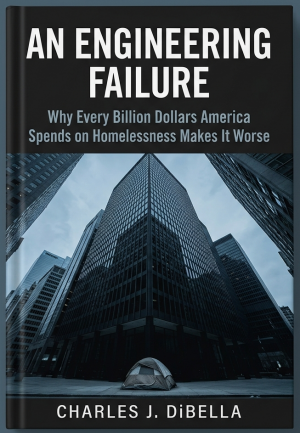
Most books on American homelessness ask the reader to feel more. They document the human cost with precision and moral force, and they are right to do so. Some identify what the current system costs and why its metrics are inadequate. A smaller number prescribe changes, though almost always within the architecture of the existing machine rather than replacing it. None of them begins with the solution. None of them contains a falsifiable prediction with a defined measurement threshold. None of them traces the failure to its biological root, through the neuroscience of sleep deprivation and the anthropology of social scale, and then specifies the precise engineering correction those findings require.
AN ENGINEERING FAILURE operates as a capital reallocation argument derived from implementation science, written in the language of the electorate that funds the failure, addressed to the only audience with the authority to end it. The money is already being spent. The infrastructure already exists. The peer-reviewed specification is already published. The only missing variable is a voting public that understands what its city is purchasing and demands something different.
AN ENGINEERING FAILURE: Why Every Billion Dollars America Spends on Homelessness Makes It Worse, by Charles J. DiBella, presents the full structural analysis for a general reading public: why the system currently funded mathematically guarantees its own failure, why the infrastructure to resolve the crisis already exists and is currently vacant and depreciating, and what the voting public can do to redirect the money already flowing toward the machine that works.
Keywords: Health, Public Investment, pipeline engineering, population taxonomy, ontological security, Dunbar Pod, CARE Court, Assertive Community Treatment, Housing First, Los Angeles Metropolitan Stabilization, Measure Alpha, homelessness stabilization, adaptive reuse, Material Dignity Infrastructure