
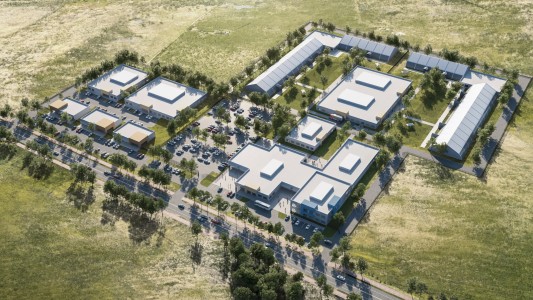
In September 2025, Utah announced plans for a 1,300-bed facility near the Salt Lake City International Airport to serve as the state's primary homelessness response. Governor Spencer Cox called it a "transformation." The Cicero Institute, a Texas-based think tank that has advised more than a dozen state legislatures, provided the policy framework and named it an "accountability center." Three hundred to four hundred beds are designated for involuntary civil commitment and court-ordered treatment. The remaining capacity operates under work-conditioned housing, meaning residents must demonstrate behavioral compliance and participate in employment programs to keep their beds. Those who refuse voluntary shelter or violate public camping ordinances face sanctions of approximately ninety days.
The state's official construction estimate was $75 million. An independent fiscal analysis published in April 2026 by researchers Kimbley Burnett and Samuel Dastrup placed the actual figure at at least $142 million, with annual operating costs of $47 million or more against the state's $34 million projection. The Utah Legislature did not appropriate a line-item for the full facility during the 2026 session.
The facility will fail. This prediction is not a moral critique of its architects. It is a mechanical forecast derived from the same biological and social science evidence that explains every prior failure in American homelessness policy.
The Workhouse Is Not a New Idea
The British Poor Law Amendment Act of 1834 established the same operational logic under the name "less eligibility." Workhouse conditions were deliberately engineered to be harsher than the life of the poorest independent laborer, so that only the genuinely desperate would seek entry. Admission required performing labor: breaking stones, picking oakum from rope fibers, crushing bones for fertilizer. The workhouse ran for nearly a century. By its final decades, its population had shifted overwhelmingly to the elderly, the sick, and the disabled, because the able-bodied poor the system targeted were not behaviorally deficient. They were economically displaced, and punitive confinement cannot resolve economic displacement. Britain abolished the workhouse formally in 1930.
Utah's accountability center reproduces the same architecture. "Accountability" replaces "less eligibility" as the framing. Court-ordered treatment replaces stone-breaking as the labor requirement. The airport location, geographically isolated from transit corridors, existing service networks, and the social geography where the unsheltered population actually lives, replicates the workhouse's deliberate severance from community. The mechanism is updated. The predicted outcome is the same.
The Biology of Work Conditioning
Work-conditioned housing demands behavioral performance as the precondition for stable residence. The neuroscience of chronic sleep deprivation establishes why this sequencing is biologically incoherent.
The human brain requires Rapid Eye Movement sleep to consolidate memory, regulate emotional responses, and repair executive function. Achieving REM sleep requires the brain's recognition that the immediate environment is physically safe, which allows it to disengage from continuous threat-monitoring. A person sleeping on a street, or rotating through a shelter that cannot guarantee the same bed from night to night, cannot achieve this state. REM does not occur. Executive function degrades.
Simultaneously, the street environment imposes what implementation scientists term a metabolic deficit: the continuous caloric expenditure required to stay warm, acquire water, and maintain basic sanitation, consuming energy reserves that in a housed person are available for decision-making, planning, and compliance. Research from the National Health Care for the Homeless Council documents a related process called biological weathering, the accelerated cellular aging produced by chronic environmental stress, which advances the body's biological age fifteen to twenty years beyond chronological age in long-term street-resident populations.
Work-conditioned housing demands behavioral output that this population's neurobiology cannot currently generate. The precondition forecloses the physiological recovery that would make compliance possible. The individual fails the requirement not from lack of motivation but because the biological substrate that generates motivation has been dismantled by the environment the policy is responding to.
The Scale Problem
A 1,300-bed facility violates a finding from anthropology with direct architectural consequences. The British anthropologist Robin Dunbar established that the human brain maintains stable, trust-based social relationships with a maximum of approximately 150 people. Beyond that threshold, anonymity replaces recognition, mutual accountability dissolves, and individuals lose the experience of being known. Every institutional environment that has failed the unhoused population operates at scales that obliterate this limit: the mass congregate shelter, the jail ward, the emergency room.
Recovery requires being known. A 1,300-bed anonymous facility cannot produce the social architecture in which recovery occurs. It produces managed detention at a scale that guarantees anonymity. The clinical services available inside the building cannot compensate for the social architecture the building's scale destroys.
What the AOT Evidence Actually Shows
The Cicero Institute cites Assisted Outpatient Treatment research to justify the accountability center model. The citation is selectively applied. A 2025 multisite evaluation across six AOT programs, published in Psychiatric Research and Clinical Practice, documents genuine effects: psychiatric hospitalizations fell by more than 40 percent, arrest rates decreased by over 19 percent, and homelessness decreased by 12 percent in the six months following entry. These findings are real. The paper's critical finding is the mechanism: participants who remained under AOT orders for at least six months, with individualized treatment plans and sustained service intensity, produced significantly greater improvements than those under shorter orders.
A ninety-day sanction at a geographically isolated 1,300-bed campus is not a six-month individually supervised AOT order. The research instrument the Cicero Institute is citing requires clinical assessment of a specific psychiatric condition, a documented history of voluntary engagement failure, an individualized treatment plan, and sustained service delivery. Utah's model applies population-wide coercive intake as a response to camping ordinance violations, regardless of the individual's clinical profile. The research supports the surgical instrument. It does not support its application as a general-admission policy.
What California's Statewide Data Shows
California's CARE Court program, statewide since December 2024, provides the most direct available evidence of what a coercive legal pathway produces at scale. The state projected 7,000 to 12,000 annual qualifiers. By July 2025, approximately 2,421 petitions had been filed statewide. Of those, only 528 resulted in formal treatment agreements. Approximately 45 percent of petitions were dismissed outright. More than 4,000 individuals were connected to voluntary services through diversions before any court order was issued.
The data establishes a conclusion the coercive model's advocates have not absorbed: the compelled pathway's primary measurable output was identifying people who accepted voluntary services when someone paid sustained attention to them. The court was not the mechanism of change. The contact was. The administrative apparatus of the court order added cost and legal complexity to a process that assertive community outreach accomplishes without it.
The Classification Error
Utah's model, and the Cicero Institute framework behind it, treats the entire unsheltered population as a single behavioral category requiring a single coercive intervention. The implementation science disagrees. The unsheltered population divides into distinct groups with different clinical profiles and different resolution mechanisms. One segment is economic displacement: individuals whose housing became unaffordable after job loss, illness, or family dissolution. Another is returning citizens released from incarceration into the absence of housing. Another is families in dissolution.
None of these populations require coercive treatment. They require housing with adequate support density. The coercive architecture designed for individuals with severe, documented psychiatric conditions who cannot self-advocate into voluntary services, which is a real and clinically distinct population warranting a specific legal instrument, is being applied to everyone who sleeps on a sidewalk. That application simultaneously over-reaches on populations who do not need compulsion and under-serves those who do, by placing them in a 1,300-bed anonymous facility rather than an individualized clinical environment.
The Falsifiable Prediction
Utah's accountability center will cycle its population. Individuals placed into a geographically isolated 1,300-bed congregate facility under work conditioning requirements will fail those requirements because the biological substrate for compliance has not been restored. Ninety-day sanctions will expire and individuals will return to the street at the same biological state they occupied before entry. The state will report bed occupancy as its outcome metric. The street population will not structurally decrease.
This prediction is falsifiable, and Utah should be held to it. If, eighteen months after full operation, the accountability center produces a documented, sustained reduction in the unsheltered street population of the Salt Lake City metropolitan area, measured by point-in-time count methodology, this analysis is wrong and the evidence should update the model. The accountability center's architects should be asked to specify, in advance, the measurable output that would constitute success or failure for their machine. They have not done so. Every prior iteration of the coercive model, from the nineteenth-century workhouse to the twentieth-century vagrancy law, also failed to specify in advance the condition under which it would be judged a failure. The absence of a falsifiability clause is not a policy design feature. It is what allows the Infinite Spending Drain, the billions allocated annually to interventions that produce zero structural reduction in the street population, to continue indefinitely under new names.
The Technical Specifications
The implementation science underlying this analysis is published as a working paper through the Social Science Research Network. It specifies the five-population clinical pipeline, the legal instruments appropriate to each clinical condition, the governance structure required to coordinate acquisition and operations, the fiscal model including prototype capital costs and verified Efficiency Surplus projections, and the eight binary verification metrics that constitute the Singular Prototype Threshold: the pass/fail gate that determines whether the proposed alternative scales or stops. Researchers, administrators, and policymakers who require the full clinical and fiscal specifications can access the foundational manuscript at:
eBook Release - June 2026
Most books on American homelessness ask the reader to feel more. They document the human cost with precision and moral force, and they are right to do so. Some identify what the current system costs and why its metrics are inadequate. A smaller number prescribe changes, though almost always within the architecture of the existing machine rather than replacing it. None of them begins with the solution. None of them contains a falsifiable prediction with a defined measurement threshold. None of them traces the failure to its biological root, through the neuroscience of sleep deprivation and the anthropology of social scale, and then specifies the precise engineering correction those findings require.
AN ENGINEERING FAILURE is not a call to compassion. It is not a policy critique. It is a capital reallocation argument derived from implementation science, written in the language of the electorate that funds the failure, addressed to the only audience with the authority to end it. The money is already being spent. The infrastructure already exists. The peer-reviewed specification is already published. The only missing variable is a voting public that understands what its city is purchasing and demands something different.
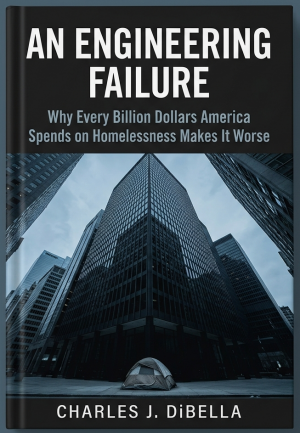
AN ENGINEERING FAILURE: Why Every Billion Dollars America Spends on Homelessness Makes It Worse, by Charles J. DiBella, presents the full structural analysis for a general reading public: why the system currently funded mathematically guarantees its own failure, why the infrastructure to resolve the crisis already exists and is currently vacant and depreciating, and what the voting public can do to redirect the money already flowing toward the machine that works. The book releases on Amazon soon. Follow this site for the release date.
Keywords: Health, Public Investment, pipeline engineering, population taxonomy, ontological security, Dunbar Pod, CARE Court, Assertive Community Treatment, Housing First, Los Angeles Metropolitan Stabilization, Measure Alpha, homelessness stabilization, adaptive reuse, Material Dignity Infrastructure