
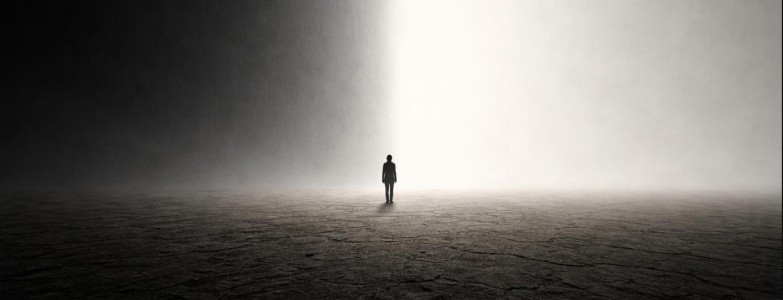
The world does not arrive in black and white. It arrives in shades of gray. Yet something inside the human mind resists that truth. The mind wants categories. It wants borders. It wants to know which side a person stands on before it decides whether to trust them.
In America today, that need for categories has built a wall. The wall runs down the center of every conversation, every dinner table, every election. People on each side cannot see what lies beyond it. So they imagine. Some imagine something ugly. Others imagine something beautiful. Almost nobody climbs the wall to check.
Where the Labels Came From
The words "left" and "right" as political categories did not come from ancient wisdom. They came from a single room. In 1789, during the French National Assembly, supporters of the king sat to the right of the presiding officer and supporters of revolution sat to the left (Britannica). That seating arrangement, born inside one of history's most violent convulsions, became the template the entire modern world inherited.
France was burning. People were losing their heads. And from that fire, humanity borrowed its political vocabulary.
Heraclitus, the Greek philosopher writing around 500 BCE, observed something that predates the labels entirely. In Fragment B51, he wrote: "They do not understand how that which differs with itself is in agreement: harmony consists of opposing tension, like that of the bow and the lyre." He saw opposition as natural. He did not see it as a reason for hatred.
The labels came later. The hatred came later still.
The Machine That Feeds the Wall
For most of American history, the wall existed but remained crossable. In 1958, 73% of Americans trusted the federal government to do the right thing (Pew Research Center, 2019). Neighbors disagreed. They still shared fences and food.
Then the machine changed.
In 1983, fifty corporations controlled the majority of American media (Bagdikian, The Media Monopoly). By 2004, five corporations controlled what fifty once did. In 1987, the Federal Communications Commission repealed the Fairness Doctrine, the rule that required broadcasters to present opposing viewpoints. From that point forward, a media outlet could build an entire world out of one color and never show its audience another shade.
Carroll Quigley, the historian and Georgetown professor, wrote in Tragedy and Hope (1966) that America's two parties were designed to appear in opposition while serving aligned interests. The appearance of conflict, he argued, was itself a management tool. The wall, in other words, may have had architects.
By 2022, only 11% of Americans trusted television news and 16% trusted newspapers (Gallup). Yet most Americans still consumed both daily. People stopped trusting the machine. They could not stop feeding it.
The Mirror of Presidents
Nothing measures the wall's growth more precisely than how Americans view their presidents. When Dwight Eisenhower served in the 1950s, 49% of Democrats approved of him (Gallup). Opposition party citizens still saw a human being in the office.
By Barack Obama's presidency, the average approval gap between Republicans and Democrats reached 70 points (Gallup). During Donald Trump's first term, that gap hit 81 points, the largest ever recorded (Gallup). The president did not change in nature. The wall simply grew taller.
What Disappeared With the Joy
Robert Putnam documented something quieter in Bowling Alone (2000). Civic clubs, neighborhood associations, church groups, parent organizations: all declined sharply after the 1960s. Americans stopped gathering in neutral spaces. When people stop sharing physical space with those who differ from them, the imagination fills the gap. And imagination, without contact, grows fear.
Social trust among Americans, the simple willingness to trust a stranger, stood at 56% in 1967 (Pew Research Center). Today it sits at 34%. That number is not a political statistic. It is a loneliness statistic.
The joy did not vanish in one moment. It leaked out slowly through a thousand small withdrawals.
2026: Anniversary or Battleground
This year America turns 250 years old. Benjamin Franklin, leaving the Constitutional Convention in 1787, was asked what form of government had been created. He said: "A republic, if you can keep it."
The keeping requires something the wall makes difficult. It requires citizens who can see each other as neighbors first and opponents second. It requires the ability to hold two truths at once, which is precisely what shades of gray demand of the human eye.
The young generation arriving now did not build the wall. They inherited it. Many of them look at the institutions their parents trusted and find little reason to trust them either. That skepticism is honest. What they build in place of those institutions remains an open question, and perhaps the most important one of this century.
A Note From Outside
From outside America, the view carries its own clarity. The wall looks different when you do not live beside it. It looks smaller than the people inside it believe. It looks more like a habit than a destiny.
Every person inside that noise is still a neighbor to someone. Every shade of gray still contains both black and white. The center is not a wall. It is the place where people remember that.
What each person does with that memory is entirely their own choice.