
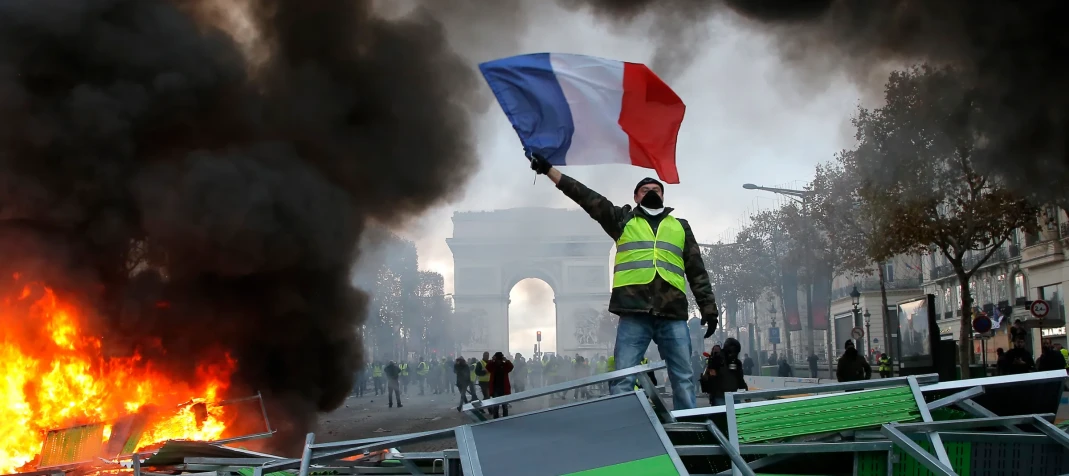
In October 2026, thousands of French high school students walked out of classrooms in Lyon, Bordeaux, and the outer arrondissements of Paris. The grievances were not abstract. Thirty-five students sat in rooms built for twenty. Teachers were missing from 12 percent of classes across the public lycée network because the national education ministry had not hired replacements fast enough for retirements filed the previous spring. The French government had known about the shortfall for eighteen months. No funds arrived in time. So the students left.
Within three days, the protests at several schools had absorbed a second group. The casseurs, Black Bloc contingents, and unaffiliated young men from surrounding neighborhoods arrived and began breaking things. Bus shelters, bank windows, a municipal maintenance garage, and the glass front of the local tax office in the 93rd department north of Paris all sustained damage. By the end of the first week, municipal authorities in Seine-Saint-Denis had tallied over 2.1 million euros in repair costs. That number is important.
Seine-Saint-Denis is the poorest department in metropolitan France. Its median household income runs roughly 40 percent below the Paris average. Its schools are among the most overcrowded in the country. And 2.1 million euros equals the annual operating budget for three additional teaching positions in a mid-size lycée.
The students who walked out to demand better schools had just watched the destruction around their protest consume the money that might have paid for those schools.
The Invoice Nobody Sent
Political disruption creates costs that the formal economy does not record cleanly. The smashed bus shelter in Seine-Saint-Denis does not show up in any political analysis of the protest. It shows up in a municipal maintenance ledger six weeks later, drawn from a repair fund that every local administrator already knew was running thin. The vandalized tax office gets patched with emergency funds redirected from somewhere else. The maintenance garage gets its windows replaced on a contract paid for by the department, which borrowed against next year's infrastructure line.
None of these costs land on the politicians whose failures triggered the protest. They land on the municipal budget. And the municipal budget is the only financial instrument standing between working-class residents and a crumbling public infrastructure.
This is the hidden invoice. When the civic machinery fails and people respond by damaging the surrounding physical environment, the cost of that damage flows downward through the tax base and settles on the shoulders of the people who depend on public services the most. Wealthy residents in gated subdivisions or in central arrondissements with private schooling, private medical practices, and private security patrols feel almost none of it. Their daily lives do not run through the municipal maintenance garage or the local lycée. The working-class resident whose child sits in an overcrowded classroom and who relies on the public bus to reach work pays for the broken windows twice. They pay once as a taxpayer funding the repair, and once as the person still waiting for the classroom to be fixed when the repair budget runs out.
What the Machinery Looks Like When It Stops
France is not an isolated case. Venezuela's public hospital network collapsed progressively between 2015 and 2023 as the government failed to fund maintenance, staffing, or pharmaceutical procurement. Protests against the health system's deterioration repeatedly turned destructive in Caracas and Maracaibo. Each cycle of damage to public clinics and administrative buildings deepened the repair backlog that the government could not address even before the protests began. By 2023, the Pan American Health Organization estimated that 76 percent of Venezuela's public hospitals were operating without consistent access to running water. The destruction during protests did not produce that number. But it worsened the conditions that number describes.
In Sri Lanka in 2022, the government's economic collapse triggered protests that culminated in demonstrators storming and occupying the presidential residence in Colombo. The images traveled globally. What traveled less far was the damage tallied to government buildings, vehicles, and municipal infrastructure across the country during the preceding months of disorder. The repair burden fell on a state treasury that was already so depleted it had suspended fuel imports. Working-class Sri Lankans absorbed that cost through reduced public services, longer queues at government offices, and hospitals that ran short of basic medicines long after the political crisis nominally resolved.
The pattern holds across income levels and geographic regions because it flows from a structural logic, not a cultural one. When the state fails to deliver basic services, the people most harmed are those who have no private substitute. And when the response to that failure produces physical damage to public infrastructure, the cost of that damage compounds the original failure.
The Class Architecture of the Invoice
The concept of a hidden tax on political disorder is not new. What is rarely stated plainly is who pays it and who escapes.
In a functioning civic economy, public infrastructure serves as the equalizing layer. Roads, schools, hospitals, transit, courts, and parks allow a person with limited private wealth to access services that a wealthy person can also purchase privately. When that infrastructure degrades through underfunding, the equalizing layer erodes. When protests damage it further, the erosion accelerates. And because the repair budget is finite and comes from the same pool as the original service budget, fixing the windows postpones fixing the classrooms.
The wealthy resident has four options in this environment that the working-class resident does not. The first option is exit. They move to a jurisdiction where the civic machinery still works. French families with resources have been accelerating their departure from Seine-Saint-Denis for twenty years. The department's population has shifted steadily toward households with fewer outside alternatives. The second option is substitution. They buy a private version of the failing public service. Private lycées in France charge between 3,000 and 10,000 euros per year per student, placing them out of reach for the median household in the 93rd department. The third option is voice. They hire lawyers, lobby municipalities, fund advocacy organizations, and shape policy from above rather than the street. The fourth option is exit at a larger scale. They emigrate. France lost an estimated 220,000 working-age residents to emigration in 2024, many of them citing deteriorating public services and tax burden as primary factors.
The Four Responses
People caught in a civic machinery failure respond in one of four ways, and the response available to a given person depends on how much private capital they hold.
The first response is buying an elite exit. Private schools replace failing public ones. Private clinics replace degraded public hospitals. Private security replaces thinly stretched police coverage. This option requires sustained income in the top two or three income deciles of the local economy, and it insulates its buyers from the cost of continuing public failure.
The second response is geographic migration. Leaving a failing jurisdiction for a functioning one is available to people with savings, portable skills, and passports that allow them to move. The French and British professional classes have exercised this option aggressively over the past decade. The people who depart take their tax contribution with them, further depleting the revenue base that might fund repairs.
The third response is decentralization. Off-grid communities, informal mutual aid networks, local food production, and neighborhood-level security arrangements represent attempts to exit the failing public system without leaving the geography. This option is available to people with time, community trust, and physical land. It does not scale easily to urban apartment blocks or mobile working populations.
The fourth response is absorption and reconstruction. Some residents, with few other options or with deep roots in place, stay and work to repair local institutions from inside. This is the hardest path. It requires sustained effort against systems that are failing in real time, and it produces results measured in years rather than weeks. The people who take this path absorb the hidden invoice in full. They pay it in missed classroom hours, in longer hospital waits, in damaged transit infrastructure, and in the years they spend volunteering at school boards and neighborhood associations while their higher-income neighbors exercise the first three options.
The Invoice Arrives Regardless
The students in Lyon and Bordeaux who walked out of overcrowded classrooms in October 2026 were describing a real failure. The teachers were absent. The rooms were full past any reasonable standard. The ministry had let the problem grow for eighteen months. The anger was accurate.
The destruction that followed was also real, and it sent a real bill to the very people who needed the education system fixed. This does not demand patience with failing institutions. It describes the wiring. When the civic machinery breaks down and the response damages the surrounding infrastructure, the cost settles on the households who depend on that infrastructure to function. The political class that failed to fund the classrooms does not pay that bill. The working-class parent whose child is still in an overcrowded room in November, while the municipal repair budget recovers, pays it.
The machinery was already broken. The invoice just got larger.