
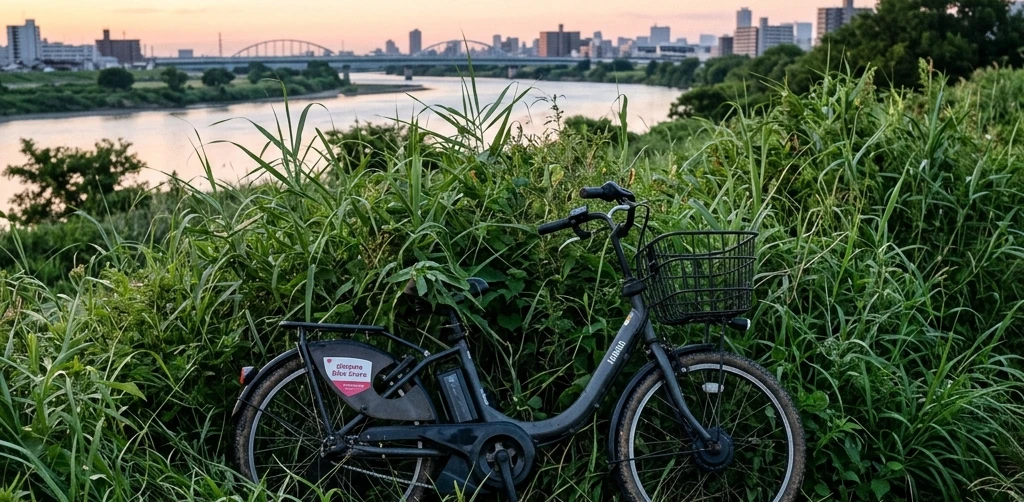
Tokyo is a city where a traveler can arrive with a twenty-liter backpack, pay eleven dollars a day for transportation, and sleep for free under open sky with no physical threat from other people. This reality emerges from the intersection of three independent urban systems that align with the needs of a minimalist long-distance rider. These systems are a budget airline industry that rewards disciplined packing, a public electric bicycle grid with no speed governor, and a vast network of green riverbanks that fall silent after dark.
The Constraint That Defines Everything
Before a rider reaches Tokyo, they face a hard physical boundary set by the airline industry. Global budget airlines enforce a bag dimension ceiling of forty centimeters wide, twenty-five centimeters tall, and twenty centimeters deep, which equals twenty liters of usable volume. A standard kitchen milk jug holds about four liters, so the traveler has the equivalent of five milk jugs to pack for an extended trip. Ryanair, which enforces the strictest common denominator of any major European carrier, treats any bag exceeding these dimensions as checked luggage and charges accordingly.
A bag like the Kono underseat travel backpack hits these dimensions with less than a centimeter of margin. Its clamshell opening allows flat packing, which means a lightweight sleeping bag, a bivouac sack, a thin alpine air mattress, and a single change of clothes can be arranged in dense horizontal layers rather than a jumbled mass. The alpine air mattress earns its place in the pack through a specific thermal property. Cold earth pulls heat from a human body through direct contact, a process that can lower core temperature even on a mild night. The air mattress creates a sealed layer of insulated air between the sleeper and the ground, blocking the conductive drain. A thin three-season sleeping bag becomes sufficient when the sleeper is lifted off the earth. The mattress weighs roughly four hundred grams, compresses to the size of a water bottle, and replaces what would otherwise require a heavier, bulkier winter bag that could never fit the volume constraint.
To carry dense electronics, the rider straps a secondary multi-pouch MOLLE belt around their waist. Smart phone, battery bank, charging cables, passport and wallet ride against the human body rather than inside the bag. Airlines weigh the primary bag, not what a passenger is wearing or carrying on their person, so the electronics never appear on the scale. The rider clears the check-in desk without fees and boards with everything they need. This configuration is the optimal packing strategy for an ultra-budget trip to Tokyo.
The Electric Grid That Powers the City
An unassisted bicycle rider pedaling across Tokyo for eight hours burns through several thousand calories and arrives exhausted. The city is not flat. Coastal basins in districts like Koto and Edogawa give way to steep urban ridges in areas like Shinjuku and Shibuya, and a heavily loaded rider climbing those grades without assistance will cover perhaps twenty kilometers before the legs give out.
Tokyo's Docomo Bike Share and Hello Cycling networks eliminate that physical ceiling. Both systems run electric-assist drivetrains governed by Japanese law, which strictly limits motor assistance to twenty-four kilometers per hour before the assist fades out. Instead of a single continuous rental, the system operates as a multi-port network. A twelve-hour pass costs roughly 2,480 Yen, which converts to approximately fifteen dollars and eighty cents. For context, a single subway ride in Tokyo costs roughly two dollars and fifty cents. A rider can cover fifty kilometers in a day by linking multiple short rides between official ports, rather than keeping one bicycle undocked continuously.
Because the system requires the rider to return the bicycle to a docking station when a ride ends, the rider carries no lock, no spare tubes, and no pump. Mechanical problems become the network operator's problem rather than the rider's.
Finding the Dead Zone
Every major city has a peripheral geography that falls completely silent after midnight. In Tokyo, that geography runs along the embankments of the Tama, the Edogawa, and the Arakawa rivers. These waterways cut wide corridors through the metropolitan fabric, and their upper banks are lined with thick grass, dense brush, and stands of reeds that grow tall enough to fully conceal a person lying flat at ground level. By ten o'clock at night, the joggers and dog walkers who use these paths during daylight hours have gone home. The embankments belong to no one for the next seven hours.
Sleeping in the river area is treated as unlawful occupation under the Japanese River Act, and camping outside of designated municipal park zones officially requires a temporary-use notification to the Ministry of Land, Infrastructure, Transport and Tourism. Furthermore, camping is explicitly banned in ecological preserve zones, and sudden river rises present a severe, stated physical hazard. To bypass these restrictions, the rider relies entirely on visual evasion. Pitching a tent is a visible, permanent-looking act that signals an intention to occupy space. It draws complaints from neighbors and prompts police to intervene. Sliding a dark-colored bivouac sack into a gap in tall riverbank grass operates differently. A person lying flat in vegetation at two in the morning is invisible to anyone walking a path fifteen meters away.
The vast scale of Tokyo's river system provides deep pockets of isolation far removed from paved cycle tracks and pedestrian paths. A rider pushes deep into the stands of tall grass and wooded stretches lining the upper embankments, carefully avoiding ecological preserves and monitoring flood warnings. By locating high ground disconnected from human transit corridors, they establish a bivouac where discovery becomes functionally impossible until they pack out before dawn, leaving no evidence behind.
The City as a Logistics Network
Carrying food and water for multiple days adds weight that defeats the twenty-liter constraint. Tokyo removes that requirement entirely. Konbini, which are small convenience stores run by chains like 7-Eleven, Lawson, and FamilyMart, sit on nearly every city block and operate around the clock without closing for holidays. They sell hot meals, rice dishes, protein bars, bottled water, and fresh produce at prices lower than comparable items in Western supermarkets. A full day of eating from konbini costs roughly 800 to 1,200 Yen, or five to eight dollars. The stores provide trash disposal and sometimes have seating, making them practical rest points during a long riding day.
Hygiene is the remaining variable that separates a successful multi-day operation from one that draws unwanted attention. A rider who looks disheveled or smells strongly of sweat stands out in a city where personal presentation carries social weight. Public bathhouses called sento address this directly. For roughly five hundred Yen, about three and a half dollars, the rider gains access to hot soaking tubs and individual shower stations. A single change of clothing washed by hand and dried overnight preserves the appearance of an ordinary tourist, which is the most reliable counter to scrutiny in any dense urban environment.
The Season That Makes It Work
All of these systems depend on a specific temperature window. Summer humidity in Japan averages above eighty percent from June through August, creating wet, oppressive nights along the riverways where mosquitoes breed in the standing water at the base of the embankments. Winter drops Tokyo's nighttime temperature to between two and five degrees Celsius, which defeats a thin sleeping bag even with the air mattress providing ground insulation.
The autumn transition, running from mid-October through late November, brings a gradual cooling, with nighttime lows falling from roughly sixteen degrees Celsius in October down to ten degrees Celsius by late November. A rider must also navigate the tail end of typhoon season, which can extend into October. Despite these factors, a lightweight three-season bivouac sack paired with the alpine air mattress provides sufficient warmth without forcing the rider to carry anything heavier, provided they prepare for the November chill. The viable window lasts roughly six weeks, which is long enough for an extended exploration trip across the full metropolitan grid.
A rider who times the trip correctly, packs the bag within the airline ceiling, rents the electric bicycle for eleven dollars a day, sleeps in the deep vegetation along the river embankments, eats from convenience stores, and washes at a sento is running one of the most resource-efficient urban exploration configurations available anywhere in the world. The operation depends on the alignment of Tokyo's low crime rate, its dense transit infrastructure, its all-hours retail network, and the six-week autumn window when the weather allows a lightweight kit to function.
The Deep-Discount Route In
Getting to Tokyo cheaply follows the same logic as the pack itself. ZIPAIR flies nonstop between Los Angeles and Narita in a little under twelve hours, and its base fare already assumes the same minimalist baggage this trip is built around, offering seven kilograms of carry on included and nothing more, with checked bags, seat selection, and meals sold separately on top. One way fares on the route have priced as low as $258 to $314 on flexible date searches, and round trip totals have bottomed out between roughly $600 and $761 when the departure falls midweek rather than over a weekend. Tuesday departures undercut weekend fares by the widest margin observed on the route. The airline also runs periodic flash sales that drop one way tickets to near $259 for months at a stretch, so a rider willing to watch fares rather than lock a single date can often catch the corridor near its floor without needing to chase a particular season for the airfare itself.
Thirty Days, Priced Out
At current exchange rates, with the dollar buying roughly 157 yen, the daily costs described throughout this piece compress into a predictable monthly number, though fare and exchange volatility means these figures constantly shift. The bike share alone runs close to $15.80 a day if used every day of the month. Konbini food adds another $5 to $7.50 a day depending on appetite. Sento visits every two or three days work out to roughly a dollar a day once spread across the month, and a handful of manga cafe nights during a stretch of bad weather, five or six over four weeks, add a bit over two and a half dollars a day on average. A month long prepaid data SIM runs well under a dollar a day once amortized, and a modest daily buffer for laundry and small incidentals rounds the number out. Add all of it together and ground costs settle between $25 and $30 a day depending on how often the higher end options get used, which works out to somewhere between $750 and $900 for the full thirty days before airfare. Layer in a deep discount round trip fare of $600 to $760 and the entire month, door to door, lands somewhere between $1,350 and $1,660. That is less than a single week at most Western hostels for a full month in one of the most expensive cities on earth, and none of it needs to absorb a visa cost, since ninety day visa free entry covers a US passport for the whole stay.