
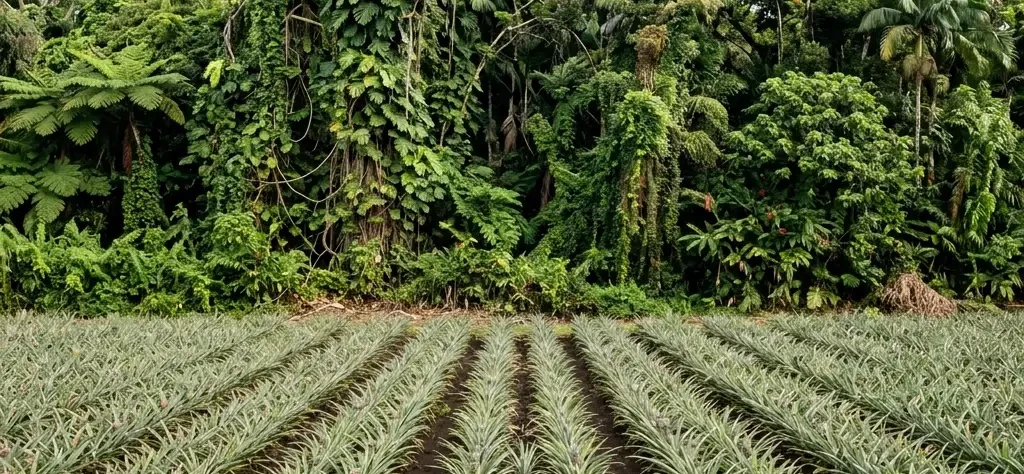
A cleared field is an unnatural condition. It requires daily labor to hold back the wild edges. The wilderness never sleeps, and when the workers stop swinging the machete, the surrounding vegetation encroaches in a matter of months. Modern civilization runs by the same physical law. People often assume that society is a permanent structure built of concrete, steel, and law, but the observable truth is much more fragile. Human progress is a garden surrounded by deep vegetation, and humanity's oldest tribal instincts are always waiting at the jungle edge.
The contradiction is visible in the news every day. A crew of six different nationalities can share a laboratory orbiting 250 miles above the Earth, eating meals together and passing tools between hands that speak four different languages. On the ground at the same moment, a militia in Sudan burns down a hospital in a territorial dispute over land no larger than a city park. Both events come from the same species expressing two different survival strategies, and the gap between them reveals something important about what holds civilization upright and what tears it apart.
The human brain did not evolve for the world it now inhabits. For most of human history, survival depended on rapid threat assessment and fierce loyalty to a small local group. People who hesitated when danger appeared did not pass their genes forward. People who trusted strangers unconditionally did not last long either. So the architecture of the human mind arrived at a compromise, becoming extremely fast at identifying threats, extremely loyal to its own group, and extremely suspicious of outsiders. That cognitive wiring worked very well for tens of thousands of years on the African savanna. In the modern world, it works like a smoke detector that goes off every time someone burns toast. The alarm fires, but there is no fire, and the house is usually fine.
What keeps this wiring from consuming everything is institutional labor. Hospitals, courts, international agreements, professional standards, public health systems, none of them are natural outgrowths of human instinct. They are constructed, maintained, and repaired by continuous organized effort, the same way a farm requires weeding, irrigation, and seasonal replanting. The moment that effort slackens, the old instincts find their way back in. This is why Transparency International's 2023 Corruption Perceptions Index showed that 125 of the 180 nations it surveyed scored below 50 out of 100, meaning that the majority of the world's governments were rated as significantly corrupt. The institutional weeding never fully caught up with the growth pushing back from the edges.
This pattern of fragility becomes sharp when the scale of human ambition is put against the actual record of human behavior. In 1996, Norway, Russia, and 40 other nations signed the Svalbard Treaty, agreeing to cooperate on a remote Arctic archipelago to preserve the genetic heritage of the world's food supply. The Svalbard Global Seed Vault now holds more than 1.3 million seed samples from 98 percent of all countries on Earth, buried in permafrost on an island 800 miles from the North Pole. It represents a decision to protect something for people who have not been born yet. It is an act of deliberate, institutionalized restraint in the face of immediate short-term pressure.
Turn the map south and the contrast is stark. The Brazilian Amazon lost more than 11,500 square kilometers of forest cover in 2022 alone, an area roughly the size of the state of Connecticut, cleared primarily for cattle pasture and soybean fields. The people making those decisions are responding to economic pressure, land ownership structures, and market incentives that make short-term extraction more rewarding than long-term preservation. The jungle is being cleared by the same survival instinct that drove human beings to protect their own resources at the expense of their neighbors for a hundred thousand years. The institutional labor required to counteract that pressure, environmental law, land tenure reform, and international trade standards, has not kept pace with the chainsaws.
The same pressure plays out inside societies as much as between them. The archive of global news from any given week shows citizens in India, France, and the United States protesting their governments over different issues but making the same fundamental demand. They want the institutions that govern their lives to be worthy of the trust placed in them. When those institutions visibly fail, the tribal instinct finds a replacement. People reach for a strongman, a movement, a slogan that promises to restore order. The replacement rarely seems to make the underlying problem better, because tribal loyalty and institutional integrity pull in opposite directions. A leader whose power rests on group allegiance cannot afford to apply rules impartially, yet impartial rules are what institutions are built to do.
None of this means that progress is an illusion. The life expectancy of a child born in sub-Saharan Africa in 2023 is nearly 20 years longer than it was for a child born there in 1960. That gap represents vaccines, clean water infrastructure, mosquito nets, and oral rehydration therapy, all of them products of organized international cooperation that required sustained institutional labor across decades. The field was cleared and the crop grew. The point is that the clearing is only temporary, and the jungle never stops pressing at the fence line.
Our species is as it has always been, sitting between the mud and the stars. The hunger for grace and the appetite for destruction both live in the same brain, and neither one goes away. What changes is the quality of the institutions built to hold us in balance. That balance requires constant, daily labor to maintain. Like a cleared field, it is one abandoned season away from being swallowed whole.