
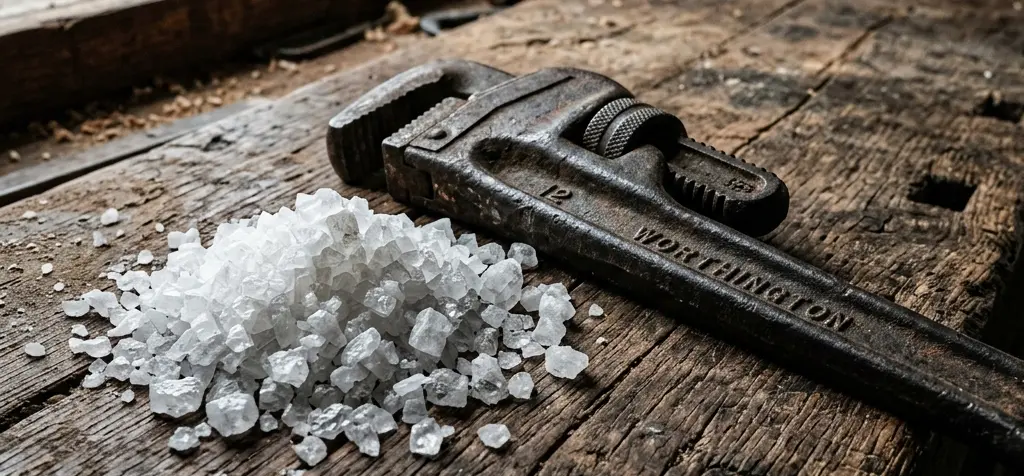
Salt is a rock. Most people today walk past it on a grocery store shelf without thinking about it. But for most of human history, a small bag of salt was the difference between eating through winter and starving before spring arrived.
The science behind it is simple. When you pack raw meat or fish in salt, something happens at the level of the cells. The salt pulls moisture out through the walls of the food, and it pulls moisture out of the bacteria living inside it too. This process is called osmosis, and it works because the concentration of salt outside the food is higher than the concentration of water inside, so the water moves toward the salt until everything reaches a balance. The bacteria that cause rot need that moisture to survive and multiply, and without it, they die or go dormant. The food stays preserved for weeks or months without any electricity at all, without any technology beyond a wooden barrel and a handful of mineral rock.
This is why salt was so valuable in the ancient world that it shaped the entire structure of human economies.
Roman soldiers, for example, were given a specific money allowance so they could purchase salt and other basic supplies while on campaign. This allowance was called a salarium, from the Latin word sal, meaning salt. Over centuries, as the Roman Empire faded and Latin transformed into French and Italian and eventually English, that word salarium slowly became the word "salary." Every time a person today talks about their annual salary or asks for a pay raise, they are unknowingly reaching back two thousand years to the Roman army's daily need for a mineral rock to keep their food from going bad.
The phrase "salt of the earth" comes from the same world. In Matthew 5:13, people were called the salt of the earth as a deep compliment, because the audience listening already understood exactly what salt did for the physical world. Salt stopped things from rotting. Salt preserved what was good so it could survive through difficult conditions. Calling someone the salt of the earth meant calling them the kind of person whose presence keeps the community around them from falling apart.
That idea has not changed. The form of the decay has.
In 2026, the biggest threat to daily life is not spoiled food. Most people in wealthy countries have not worried about that problem in their lifetimes. The threat today is a different kind of rot, and it moves through a different kind of infrastructure.
Modern society runs almost completely on connected computer systems. The power grid, the water supply, the banking network, the supply chain that moves food from farms to stores: all of it depends on software that is talking to other software, which is running on servers that need electricity, which needs the grid to stay up. These systems are extraordinary. They can process enormous amounts of information faster than any human being could, and they have made daily life vastly more comfortable and convenient for the people who can access them.
But they cannot fix a broken water pipe. They cannot grow a potato. When a major storm knocks out power for a region, or when a flood cuts off the roads, or when a cyber attack takes down a regional grid, the digital world does not slow down. It stops. Instantly. And what is left is the physical world, the pipes and fields and roads and buildings, which still needs people who know how to work with their hands.
The real danger is that most people in modern societies have slowly forgotten how to do that. A generation raised on screens and delivery apps has lost the practical knowledge that used to be common. Fewer people know how to preserve their own food, repair their own vehicles, or manage their own water supply when the municipal system fails. The modern decay is not about bacteria in a barrel of fish. It is about a society that has quietly lost its ability to take care of itself when the power goes off.
So who are the salt of the earth in 2026?
They are the people who hold the physical baseline of the world in place while everyone else is looking at a screen. The electrician who drives out at two in the morning to restore power to a neighborhood after a storm is not doing glamorous work. Nobody is making a podcast about it. But when the lights come back on, every digital system in that neighborhood comes back to life with them, and the food in the refrigerators does not go bad, and the hospital equipment starts working again. That electrician was the thing between normal life and a real crisis.
The mechanic who understands how an older truck engine works without computer diagnostics, the farmer who knows how to manage soil through a dry season without automated irrigation systems, the carpenter who can repair a roof with basic tools before the rain gets in: these are the people who hold the physical layer of civilization together. When something breaks in the real world, in the world of pipes and wires and wood and engines, they are the ones who can fix it. Software cannot do that work.
And a society rots from the bottom up.
The people who are pushed furthest to the outside edges of a community, the ones without stable housing, the ones living under threat because of who they are or what they believe, the ones that the larger system has quietly stopped paying attention to: when these people are left behind without anyone to help them, something goes wrong in the whole social fabric, and it spreads. A community that leaves its most vulnerable members outside in the cold is one that has stopped doing the basic work of preservation. The people who show up to do that work directly, who run the shelters and sit with the frightened and bring food to the people who have none, are performing exactly the same function that salt performs in a barrel of cured meat.
They are slowing the rot. They are keeping what is good from falling apart.
The tools available to the modern world are remarkable. Artificial intelligence can process medical data at a scale no doctor could manage alone. Satellite imaging can help farmers track soil conditions across thousands of acres. Digital networks can connect people across continents in seconds. These tools are real and they are useful, and dismissing them would be foolish.
But none of them work without the physical foundation beneath them. And none of them replace the human beings who maintain that foundation, the ones who show up in the freezing rain to fix the generator, the ones who grow the food, the ones who sit with the person who has lost everything and make sure they get through the night.
In any era, the world needs people who do the slow, unglamorous work of keeping things from going bad. In 2026, with systems more fragile and more interconnected than at any point in history, that need is larger than it has ever been. The salary that every working person draws still carries the memory of the salt in its name. The question worth sitting with is whether the society paying those salaries still understands what it is actually paying for.