
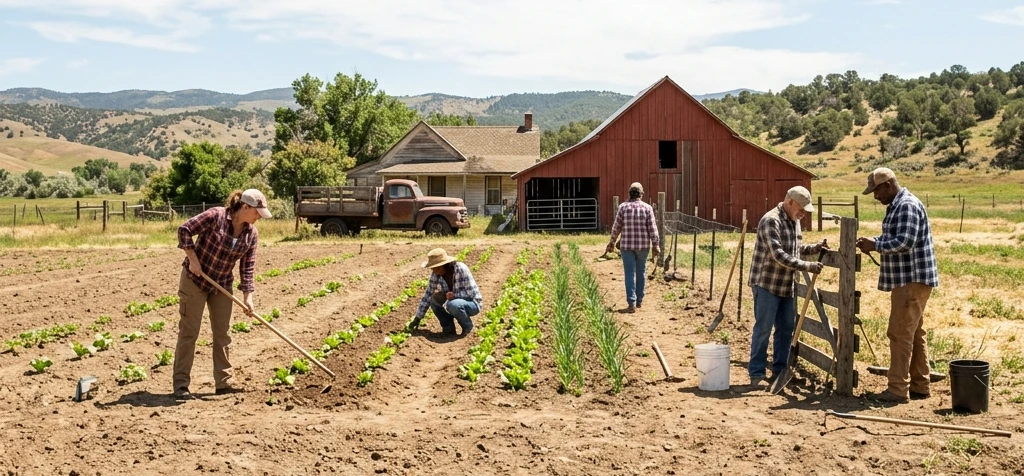
A community begins to fall apart the moment its members stop working the land beneath their feet and stop relying on the people living beside them. Modern apartment blocks and factory food quietly replace the old knowledge that once bound neighbors together, and without that knowledge, the group grows fragile. Healing a broken community, then, always starts with healing the ground beneath it.
Consider what happens to land that has been abandoned. When rain falls on bare soil with no plant roots to hold it, the water carries the soil away into the rivers. The sun then hardens whatever remains into a pale crust where nothing grows and where animals no longer come to feed. Between 2001 and 2020, Cambodia lost roughly two million hectares of forest, an area larger than the whole country of El Salvador. When local communities decide to repair this damage, they dig long channels to catch rainwater and plant young trees whose roots grip the loose earth. As those trees grow tall, their fallen leaves rot into rich, dark compost, so the land drinks water again and the air around it cools. Working together on these physical tasks is what scientists call ecological restoration, but villages simply call it coming home.
This work genuinely cannot be done alone. No single person plants thousands of trees or digs enough channels to hold a season's worth of rain. Older members of the community carry years of knowledge about local weather patterns and traditional building methods, while younger people bring satellite apps on their phones and small solar power systems. They work shoulder to shoulder through the long hot hours, and when the sun drops, they share meals made from the vegetables they harvested that morning. Sweating together and eating together builds a kind of friendship that no social media group can copy.
How Working Together Changes People
A community farm is also a kind of social meeting place, where neighbors gather to talk, solve problems, and make decisions about their shared future. Growing food is not a task you complete once and walk away from, as it asks for daily attention from many different hands. One person carries water to thirsty rows of seedlings, another pulls weeds from between the young plants, and a third watches the sky to decide when the harvest should begin. When the harvest finally comes and everyone takes their share, each person learns through physical experience that their neighbors are dependable, which is a lesson no classroom fully teaches.
The same pattern appears across the world. In the Sahel region of West Africa, along the border of Burkina Faso, farmers practice an ancient method called zai, where they carve small pits into the baked earth, fill each pit with compost and seeds, and wait for rain to do its work. This deceptively plain technique has restored 300,000 hectares of what was once useless land while pulling neighbouring villages into a network of shared seeds, shared tools, and shared celebration. Repairing the ground forces the community to repair its relationships, and the harvest that follows rewards both the soil and the people who tended it.
What makes these projects last is the way they weave old knowledge together with new tools. A group of farmers might rely on their grandparents' understanding of the local soil while also reading satellite weather data on a phone screen to plan their planting calendar. They might shape walls from local bamboo and clay, then mount solar panels on the roof so the family has clean electricity at night. Communities that blend the wisdom of the past with the practical tools of the present build systems strong enough to survive drought, flood, and economic pressure.
Building Strength Inside Yourself
Strong communities are made of strong individuals, and personal strength always begins with self-knowledge. A leader who does not understand their own energy levels, emotions, and blind spots will exhaust the people around them. Learning to notice when your body is tired, when your mind is clear, and when fear is pushing you toward a bad decision is the quiet foundation on which good leadership is built.
Growing as a person often means setting down a weight you have carried for so long that you stopped noticing it, in the same way a traveler crossing a mountain pass might carry a heavy stone in their pack without ever asking why. The stone costs real energy at every step, and it slows the journey without offering anything useful in return. When the traveler finally stops, pulls the stone out, and leaves it on the path, their whole body feels lighter, and the summit comes faster than they expected. Old fears and habits work the same way. Releasing them keeps the path just as steep, and yet you arrive at the top with enough energy left to do something meaningful when you get there.
A person who understands their own reactions becomes far more useful to the people around them. They listen with patience when someone is frustrated, they speak clearly without adding extra anger to a difficult situation, and when something breaks they stop, look at the pieces, and find a repair instead of an argument. That calm steadiness spreads through a group the way warmth spreads from a fire, and a community where people practice this kind of self-awareness handles setbacks without losing its direction.
How the Forest Heals the Body
The environment a person lives in shapes their body in ways they rarely notice. City air carries exhaust smoke, fine industrial particles, and a constant wall of mechanical noise that the human nervous system reads as low-level danger. The body responds by releasing stress chemicals, keeping the heart beating a little too fast, and reducing the quality of sleep night after night. Over months and years, this background tension accumulates into fatigue, poor concentration, and a shorter temper.
A forest works the opposite way. Trees filter the air and produce fresh oxygen, birdsong replaces engine noise, and the nervous system finally receives the signal that the threat has passed. The heart slows, the breath deepens, and the body begins the repair work it cannot do in a noisy city. Researchers in Kyoto, Japan, measured the stress chemicals in people's blood after a quiet walk through forest paths and found those levels dropped by 16 percent compared to people who walked the same distance through city streets. The forest is medicine that does not come in a package.
Food grown in living soil carries a different nutritional profile than food manufactured in a factory. Soil full of organic matter feeds the plant with dozens of minerals and compounds that a plant growing in depleted ground simply cannot access. When a person eats a vegetable pulled that morning from rich earth, those nutrients go to work repairing cells, steadying energy levels, and supporting the immune system in ways that processed food cannot match. Growing your own food, even a small garden on a balcony, reconnects the body to the seasonal rhythm of the land.
Fixing the Ground to Fix the World
When all these ideas are brought together, a clear picture emerges. Repairing degraded land requires community cooperation, which in turn requires individuals who are self-aware, healthy, and capable of sustained effort. The work itself, done outdoors in clean air while eating food grown from the same soil, strengthens the very people doing it. Each part of the system feeds the others.
This approach does not need a large government budget or a complicated plan written by experts in a distant city. It needs a group of people willing to walk outside together, put their hands in the earth, and commit to showing up tomorrow as well. A tree planted in the ground is a real and lasting fact. A vegetable shared among neighbors is a real act of trust. These are the materials from which durable communities are made.
The world is losing forests faster than it is planting them, and many people feel more isolated today than their grandparents ever did, even though those grandparents had fewer devices to connect them. Both problems share a single root cause, which is the disconnection of people from the land and from each other. Turning that disconnection around is slow work, and the hands doing it will get dirty every day. That is precisely what makes it worth doing.