
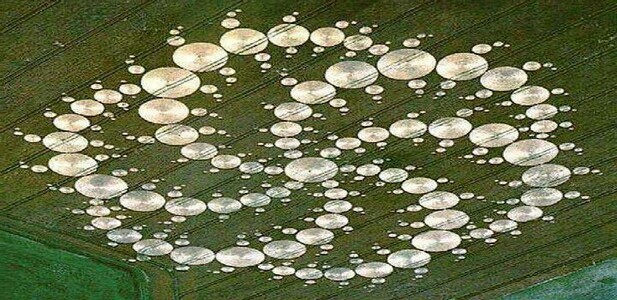
On the morning of August 12, 2001, a pilot flying over Milk Hill in Wiltshire, England discovered something that should not exist. Stretching 780 feet across sloping farmland lay a formation of 409 perfect circles, woven together in three interlocking spirals. The pattern was a triskelion, an ancient six-armed design, but executed with a precision that made engineers shake their heads.
The mathematics alone presented problems. If someone had created this during the night, working continuously in complete darkness, they would have needed to place one new circle every thirty seconds. But these were not circles stamped randomly into flat ground. Each one required geometric adjustment because the field sloped at varying angles. To maintain the pattern's perfection, every circle had to be calculated as an ellipse, compensating for the terrain beneath it. The formation covered an area equivalent to three football fields.
No one reported seeing lights on the hill that night. No one heard machinery. When researchers examined the wheat, they found the stalks bent at their growth nodes rather than broken, as if something had softened the plant tissue from within. Under microscopes, the nodes showed elongation and cell wall changes consistent with sudden internal heating. Tiny iron particles were found fused to the wheat, as though exposed to intense electromagnetic energy.
The Language of Pi
Seven years later, on June 1, 2008, another formation appeared at Barbury Castle. This one was smaller (150 feet across) but carried a different kind of impossibility. The design was a coded wheel, and within hours, mathematicians had decoded it. The formation spelled out the first ten digits of pi: 3.141592654. Not an approximation. Not close enough. Exact to the tenth decimal place, including proper rounding.
Lucy Pringle, who had studied crop formations for decades, stated the obvious problem: "You can do it on a computer, but try putting that in a field achieving that degree of mathematical accuracy." Astrophysicist Michael Reed was more direct about his bewilderment: "The fact that the pi decimal point is included and rounding up to 10 decimal places is mind boggling."
This was not a simple geometric shape that might emerge from compass and rope. This was encoded information, rendered in a symbolic language that required understanding both the mathematical constant and how to represent it spatially. Whoever or whatever created this formation knew advanced mathematics and possessed the means to translate abstract numbers into precise physical form, in darkness, in hours.
A Reply from the Fields
Between the Milk Hill spiral and the pi circle, something else appeared that raised different questions entirely. In August 2001, two formations materialized next to the Chilbolton Radio Observatory in Hampshire, a facility involved in the Search for Extraterrestrial Intelligence. The first, appearing on August 14, was a face. Not abstract geometry, but a recognizable humanoid face rendered in 160 feet of standing and flattened wheat, created using different stalk heights like dot-matrix newsprint to produce shading and depth.
Six days later, on August 20, a second formation appeared in the adjacent field. This one was a grid of binary code, 200 feet long and 85 feet wide. Researchers immediately recognized the format: it was structurally identical to the Arecibo message, a radio transmission deliberately sent into space by humanity 27 years earlier, in 1974.
The original Arecibo message was composed by Carl Sagan and Frank Drake, broadcast from the Arecibo Radio Telescope in Puerto Rico toward the globular star cluster M13. It contained information about humanity encoded in binary: human DNA structure, human appearance, global population, the planetary system, and the dimensions of the telescope that sent the message. The transmission used a 23 by 73 grid, chosen because these prime numbers would suggest intelligent design to any recipient capable of decoding it.
The Chilbolton formation used the exact same 23 by 73 grid structure. But the information encoded within it had been altered in nine specific ways. Where the original listed the elements essential to human life (carbon, hydrogen, nitrogen, oxygen, phosphorus), the response added silicon. Where the original showed human DNA as a double helix, the response depicted a triple helix configuration. Where the original presented a human figure approximately 5 feet 9 inches tall, the response showed a being 3 feet 4 inches tall with a significantly larger cranial structure.
The planetary system was different. Instead of emphasizing Earth (the third planet), the response emphasized the third, fourth, and fifth planets, with particular focus on the fourth. The transmission source was no longer a single radio telescope but something resembling the crop formation itself, a pattern suggesting distributed transmission rather than a centralized antenna.
The precision was remarkable. Binary encoding allows no approximation. Each position in the grid must be exactly correct or the entire message becomes nonsense. The formation contained hundreds of individual elements, each one either standing or flattened to create the pattern. Under magnification, researchers found the same node elongation and cellular changes seen in other complex formations, the wheat bent rather than broken, responding to something other than mechanical pressure.
What made this formation particularly unsettling was not merely its technical accuracy but its conceptual sophistication. This was not simply mathematics or geometry. This was communication using humanity's own symbolic language, sent to a location associated with listening for exactly this kind of signal, arriving 27 years after the original message with the precise amount of time required for a radio signal to travel a certain distance and return. It was either an extraordinarily informed human creation or something responding to human attempts at cosmic conversation, using human grammar but writing its own sentence.
The Physics Problem
The challenge was never whether humans could create patterns in wheat fields. People can and do. The challenge was whether humans could create these specific patterns, with these specific characteristics, in the time available, without detection.
Consider the timeline. Complex formations appear between dusk and dawn in the English countryside during summer, when nights are short. Many appear in fields visible from roads or nearby houses. The 1996 Julia Set formation (a 915-foot spiral of 151 circles) appeared within 45 minutes on a busy road opposite Stonehenge. A pilot flew over the field and saw nothing. Forty-five minutes later, another pilot saw the completed formation.
One eyewitness, Ray Barnes, described watching an invisible force move across a field at roughly 50 miles per hour, creating a 75-foot circle in approximately four seconds while producing a high-pitched hissing sound. The wheat bent in real-time as he watched, responding to something he could not see.
BLT Research, a team that analyzed plant samples from hundreds of formations, reported that fewer than 10 percent of the 350 formations they examined showed evidence of human creation. The remaining 90 percent displayed changes to plant biochemistry and biophysics that could not be explained by mechanical flattening. The node changes followed known physics principles (the Beer-Lambert Law), suggesting exposure to microwave-range electromagnetic energy. Cell wall pits were enlarged. In formations with brittle rape plants (which snap rather than bend), stems were somehow curved without breaking, which researchers considered physically impossible to hoax.
What Remains Unknown
The temptation is to declare certainty. Either humans made these with clever techniques not yet discovered, or some other agency created them through means not currently understood. But certainty requires evidence that fully explains both the precision and the speed, the mathematical sophistication and the physical anomalies, the eyewitness accounts and the laboratory findings.
The established facts are these: someone or something placed 409 geometrically perfect circles on sloping terrain in one night, adjusting each for the elliptical distortion required by the angle of the ground. Someone or something encoded ten digits of pi into a 150-foot formation with perfect accuracy. Someone or something replicated the exact 23 by 73 grid structure of the Arecibo message, altered nine specific data fields with internal consistency, and placed it next to a radio observatory 27 years after the original transmission. The wheat in these formations showed cellular changes consistent with energy exposure, not mechanical pressing.
These formations speak a language of mathematics and geometry. They appear in darkness without announcement. They leave physical traces that resist simple explanation. Whether they represent human capability pushed to astonishing extremes or something else entirely, they stand as demonstrations of precision that challenges assumptions about what is possible in a wheat field between sunset and dawn.
The fields have been harvested. The formations are gone. But the questions they posed remain, written in the documented measurements, the laboratory analyses, the decoded binary messages, and the simple fact that no one has yet created formations matching the complexity of Milk Hill, the mathematical accuracy of the pi circle, or the informational sophistication of the Chilbolton response under similar conditions, despite decades of trying.
What made them? The answer matters less than the fact that they existed at all, perfect and unexplained, preserved now only in photographs and measurements that continue to resist simple explanation.