
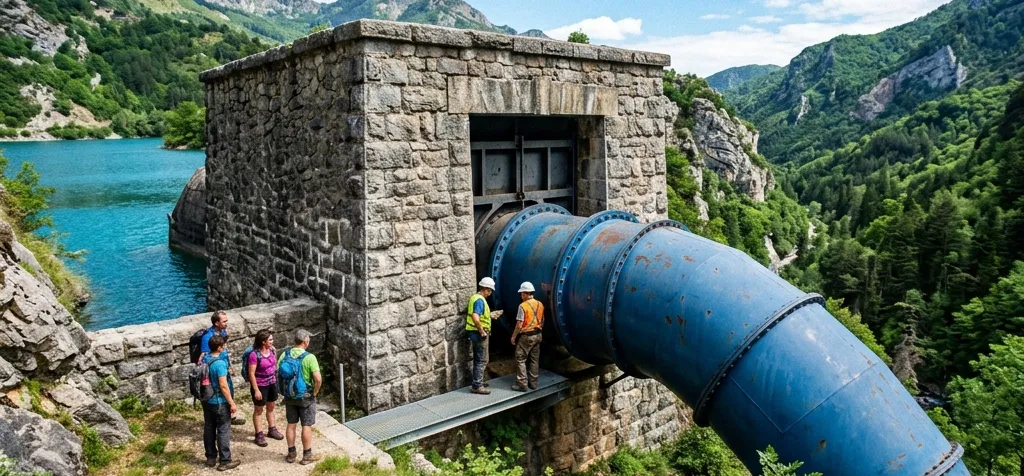
Imagine a farming village situated at the bottom of a large mountain. For hundreds of years, every family in the village carries stones up the mountain path to build a massive reservoir. Grandparents carry stones. Their children carry stones. The reservoir collects rain that falls across the entire valley, and the water belongs to the village because every family contributed the labor to build the stone walls holding the water in place.
One day, a private engineering firm arrives. The engineers build a high-speed pipe from the reservoir down to the valley floor, a genuine feat of modern engineering that delivers water faster and more efficiently than any bucket or canal the villagers ever used. Then the engineers place a meter on the pipe and begin charging the villagers for every gallon of water that comes through. The firm claims ownership over the water because they built the pipe that delivers it.
The villagers realize they are now paying for the same water they collected with their own hands over generations.
This situation describes the current trajectory of artificial intelligence. Machine learning models require an enormous volume of raw data to function. The computers do not invent this data out of thin air. Every book ever written, every photograph ever published, every public conversation captured on the internet, every medical record anonymized into a training dataset, every legal filing digitized into a searchable archive feeds the reservoir. The models rely on the collective knowledge and the recorded behavior of the entire human population, and the companies building these models did not create any of that foundational material.
The Pipe and the Reservoir
The companies building machine intelligence are constructing a very efficient pipe. They invest billions of dollars into data centers filled with specialized computer processors, and they hire talented engineers to write the software algorithms that process the information stored in the public reservoir. This technology is genuinely impressive. The capital investment is real. The engineering talent is real.
The conflict begins when these companies claim total ownership over the economic output generated by their pipe while ignoring the public origin of the raw material flowing through it. A pipe without water is an empty tube. The value of the pipe depends on the water, and the water belongs to the village.
In 2024, the combined annual revenue of the five largest artificial intelligence companies exceeded 400 billion dollars. These corporations harvested the primary input powering that revenue from outside their own walls. That input consists of the accumulated written, spoken, and visual output of billions of human beings across thousands of years of civilization. The companies built the processing infrastructure while the raw material arrived from the public commons.
Private Extraction
The prevailing model in 2026 treats the wealth generated by machine intelligence as private property. Under this model, the technology companies harvest the collective output of humanity for free, process it through their proprietary software, and sell the resulting intelligence back to the same public that provided the raw material. The companies capture all of the financial gains. The population that built the reservoir receives nothing.
This pattern has historical precedent. During the 19th century, private railroad companies in the United States received enormous land grants from the federal government, land that had been taken from indigenous populations and surveyed at public expense. The railroad companies built tracks across this publicly provided land and then charged the public for every ton of freight and every passenger ticket. The infrastructure investment was real, but the underlying resource was public.
Machine intelligence follows the same extraction pattern at a far larger scale. The "land" in this case is the totality of human knowledge. The "railroad" is the software model. The companies building the model are claiming ownership over the output of the land while having contributed nothing to the creation of the land itself.
What Happens When the Machine Replaces the Worker
When machine intelligence replaces a human worker, the private extraction model creates a very specific transfer of wealth. The company that deploys the software captures the entire wage that previously went to the human being doing the job. The worker loses both the income and the ability to earn a replacement income, because the same software is replacing workers across the entire economy at the same time.
A factory that replaces 200 assembly workers with a robotic system powered by machine learning saves the total annual payroll of those 200 people. Under the private extraction model, that savings flows into corporate profit. The 200 displaced workers receive nothing from the system that replaced them, even though the machine learning model that powers the robotic system was trained on data that those same workers and millions of people like them contributed to the public commons throughout their lives.
The math compounds over time. As machine intelligence improves and replaces workers across more industries, the total share of national income flowing to labor shrinks while the share flowing to capital grows. This is already visible in the economic data. In the United States, the share of gross domestic product going to worker compensation has declined from roughly 65 percent in the mid-1970s to approximately 56 percent in 2025, and the introduction of large-scale machine intelligence is accelerating that decline.
The Social Dividend Alternative
The alternative treats the gains from machine intelligence as a social dividend. Under this approach, society recognizes that the foundational data feeding every machine learning model belongs to the public. The machine cannot function without the collective knowledge of humanity, meaning a portion of the wealth generated by the machine must flow back to the population that made the system possible. The technology companies receive fair compensation for building and maintaining the pipe, and the remaining profit is distributed to the public through a structured dividend.
This is not a theoretical concept. Alaska has operated a version of this model since 1982 through the Alaska Permanent Fund. The state recognized that the oil beneath its land belonged to all Alaskans, not just the companies drilling the wells. A portion of the oil revenue flows into a permanent fund, and every resident of Alaska receives an annual dividend check. The oil companies still profit. The drilling still happens. The difference is that the population sharing the land also shares the wealth extracted from it.
Machine intelligence presents the same structural opportunity at a global scale. The "oil" is human knowledge. The "wells" are data centers. The question is whether the population that produced the knowledge receives any share of the wealth it generates, or whether the companies drilling into that knowledge keep everything.
The Fork in the Road
Two possible futures sit in front of us. In the first future, machine intelligence continues along its current path of private extraction. A small number of technology companies accumulate unprecedented concentrations of wealth and power while the broader population experiences wage stagnation and job displacement on a scale never before seen in industrial history. The companies own the pipe, claim the water, and charge the village for drinking from its own reservoir.
In the second future, society recognizes the public origin of the raw material and structures the distribution of wealth accordingly. The technology companies still build, still innovate, still profit. The engineers and investors receive fair returns for their capital and labor. The difference is that the population providing the foundational data also receives a share of the output, and the efficiency gains from machine intelligence improve the standard of living for the broader population rather than concentrating wealth at the top.
The reservoir took thousands of years to fill. Every generation contributed. The question now is whether the people who built it will be charged for their own water, or whether they will share in the wealth that flows from it.