
This story is written for children, but adults may find it uncomfortably familiar. Read the fable first, then read the explanation at the end.
The Whisper-Phones and the Schoolyard
The children at Valley School loved a game called Kick-the-Can. For a long time, the game ran on a very simple engine. Everyone followed the same rules, which were carved into a wooden sign by the schoolyard fence, and every player could read them before the match started. If a defender tagged your shoulder, you sat on the sidelines until someone kicked the can, and when the can got kicked, every captured player ran free. Disagreements were rare, because everyone could see what happened with their own eyes, and the wooden sign settled any argument that the eyes could not.
One spring, everything changed because of a new invention called the Whisper-Phones.
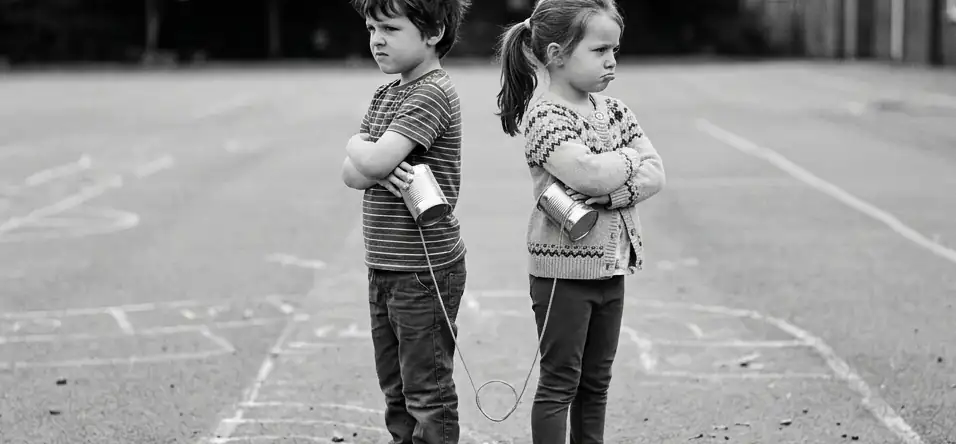
The Whisper-Phones were shiny metallic cans connected by long, invisible strings. A group of older children, who called themselves the Gadget Makers, handed them out to the entire school without asking for any payment. The Gadget Makers told the younger children that these devices would make the game better, because players could now talk to teammates on the far side of the field.
What the younger children never learned was that the Gadget Makers had a hidden business. Every time a child pressed a Whisper-Phone against their ear and kept listening, the Gadget Makers earned a shiny silver token. The longer a child listened, and the angrier or more frightened the message made them feel, the more tokens flowed into the Gadget Makers' collection jar. Because of this, the Gadget Makers tuned the invisible strings so that only the loudest and angriest whispers traveled through them, while calm and boring messages faded away to nothing.
Two children named Leo and Mara quickly became the most popular voices on the network. Neither one started out wanting to cause harm. They noticed, though, that whenever they whispered something ordinary like "Good game today," nobody listened, and the Gadget Makers ignored them. But whenever they whispered a shocking rumor, the phones buzzed wildly, crowds of listeners gathered, and the Gadget Makers poured silver tokens into their hands. So Leo and Mara learned, without anyone telling them, that anger paid and honesty did not.
One afternoon during a big match, a young player named Sam tripped and fell near the can. In the old days, every child on the field would have jogged over to check on Sam's knee. On this afternoon, every child was staring down into a Whisper-Phone.
Leo grabbed his can and whispered to all the children on the West Side of the valley that Mara's team had pushed Sam on purpose to steal the game.
At the very same moment, Mara grabbed her can and whispered to all the children on the East Side that Sam was faking his fall to make her team look bad.
Both messages were lies. Both messages made children furious. Because the fury kept children glued to their cans, the Gadget Makers harvested thousands of tokens in a single afternoon, and they rewarded Leo and Mara by making their whispers louder than anyone else's.
Within a week, the playground had cracked in half. West Side children wore blue hats they bought with their tokens, and East Side children wore red hats, and neither group would sit at the same lunch table as the other. Because each side was hearing a different version of every event through their Whisper-Phones, they could no longer agree on basic facts, even when something happened right in front of them. The shared truth that once held the community together had vanished, replaced by two competing stories that grew angrier with every passing day.
The cruelest change was invisible. Children who had shared sandwiches the previous year now crossed the hallway to avoid each other. If an East Side student sat at a West Side table, the West Side children would point their cans and chant insults until the visitor left in tears. The Whisper-Phones had not changed who these children were. The phones had changed what they could see, and when people can only see reasons to be afraid, they begin to treat their neighbors like enemies.
Despite all of this, a very large group of children refused to pick a side. They called themselves the Quiet Kids. They liked Leo and they liked Mara, and they just wanted to play Kick-the-Can by the rules carved into the wooden sign.
One afternoon, a Quiet Kid named Clara climbed onto a bench in the middle of the yard. She cupped her hands around her mouth and shouted as loud as she could that everyone should forget the phones, look at the sign, and play by the rules they already had.
A few children near the bench looked up. Some of them nodded. But the Whisper-Phones were buzzing so loudly that Clara's voice carried only a few meters. The Gadget Makers had never given Clara any tokens, because calm voices do not generate profit, so her message had no amplification behind it. The noise swallowed her words before they could reach the far side of the yard.
The game of Kick-the-Can stopped happening after that. The playground became a silent, lonely place where small groups of children sat in separate corners, staring into their tin cans, feeling angry at the very same people they had been sharing their toys with only a few months earlier. The community was deeply sick, and the sickness had nothing to do with bad children. It came from a tiny mechanical toy that had been given the power to decide which voices got heard and which voices got erased.
What the story is really about:
Every object in the fable maps to something in the real world. The Whisper-Phones are social media platforms. The invisible strings are the algorithms that decide which posts appear in a person's feed. The Gadget Makers are the companies that own those platforms. The silver tokens are advertising revenue, which increases when users stay on the platform longer and engage with content that triggers strong emotional reactions.
The fable demonstrates three specific processes. First, when a platform's revenue depends on sustained attention, the algorithm learns to promote outrage over accuracy, because outrage holds attention longer than calm reporting does. Second, when two groups receive different algorithmically curated versions of the same event, they lose the ability to agree on shared facts, and without shared facts, cooperation becomes impossible. Third, moderate voices like Clara's get suppressed by the system's own economics, because content that calms people down reduces the time they spend on the platform, which reduces revenue.
The wooden sign at the playground fence represents the idea of shared rules and shared truth that existed before algorithmic curation. The story asks a question that has no easy answer, because once the Whisper-Phones are already in everyone's hands, nobody knows how a community gets back to the wooden sign.