
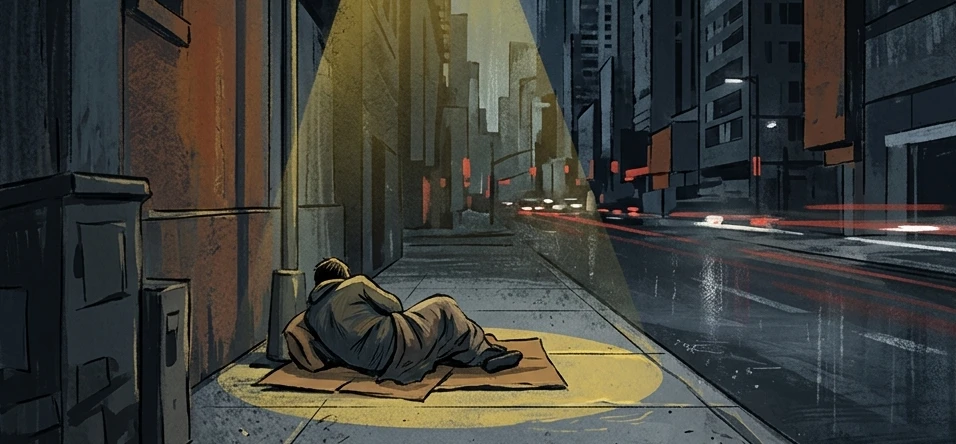
Stand on any major street in a large city and look carefully at the pavement. Check near a building entrance, a freeway underpass, or a sheltered public park corner. There is a person there and they are lying on concrete. They have been lying on concrete for a long time.
Series: Urban Survival — How It Feels to Be Homeless — Part 1 of 11
This post does not begin with statistics. It does not begin with policy. It begins exactly where the physical problem begins. It starts with a human body in contact with asphalt through every hour of every night.
Consider what the human body does during this process.
The muscles across the shoulders and the back are not relaxed. They are held tight, even during sleep. The body has learned that the ground vibrates with passing vehicles. Footsteps can mean danger, and the noise of the city never stops. Even unconscious, the nervous system keeps one hand on the alarm. The brain burns energy all night maintaining a readiness that a person sleeping in a bed never needs.
The cold enters through the concrete. Concrete draws heat out of a human body faster than still air does. A person lying on pavement loses body heat from below and from the sides simultaneously. The muscles work constantly to replace that heat. This is not comfort or discomfort. This is a fuel cost and the body burns its reserves through the night just to stay warm enough to survive until morning.
The air the person breathes carries what the city exhales. Brake dust from buses and carbon from diesel engines. Mold from wet drainage channels and these particles settle into the lining of the lungs. The lungs respond by keeping a low fire of inflammation burning at all times. The heart works harder because inflamed lung tissue passes oxygen into the circulation less efficiently. The body runs at a slightly reduced capacity every hour of every day.
Now consider that this does not happen for one night. It happens for months and sometimes for years.
A human body is an engine. Every engine has a temperature range in which it operates well. Below that range it stalls and above that range it damages itself. The street forces the body to run above its optimal temperature continuously. This occurs through the metabolic heat of constant alarm and constant cold resistance.
An engine running too hot for too long does not break all at once. It degrades and components wear faster than they should. Recovery between uses becomes incomplete and small damage accumulates into larger damage. The engine that ran well for years begins to run poorly, then runs badly, then stops.
The human body under permanent outdoor exposure follows the same path. The degradation is not dramatic at first. The person looks tired and their posture changes. Their stride becomes careful and deliberate, as though the ground is uncertain beneath them. Their skin loses moisture and their eyes develop a dry, glassy film. These are not signs of poverty. They are signs of a body managing an energy deficit it cannot close.
After weeks, the body begins to make difficult decisions. It cannot maintain everything at once. It begins to reduce the resources sent to the immune system. A small cut on the hand does not heal quickly. A cough does not clear and the joints swell with fluid the kidneys cannot properly filter because the kidneys are already managing dehydration and pollution simultaneously.
After months, the brain itself changes. Not in personality and not in intelligence. In chemistry and the adrenal glands have been producing stress hormones at higher levels for so long that the baseline shifts upward. The brain that once relaxed at the end of a day no longer has a chemical pathway to relaxation. It does not know that the danger is not immediate. It only knows what the incoming hormones constantly dictate. The hormones repeat the same chemical instruction they have transmitted for months: stay ready.
This is the condition of the person on the ground.
It is not a moral condition. It is not a spiritual condition. It is not a condition that reflects a person's choices, their character, or their worth. It is a physical condition produced by continuous outdoor exposure. It acts on a biological organism never structurally designed to live this way.
The concrete does this to every human body placed upon it for long enough. It does not ask who the person was before. It does not distinguish between the person who lost a job last month and the person who has remained outside for five years. The biology is the same and the cold is the same. The air is the same and the alarm system running through the night is the same.
This is the starting point.
Not statistics and not policy. Not the question of what the person should have done differently.
One body and concrete and time.
Everything that follows in this series is a response to what you have just seen.
Series: Urban Survival - Tomorrow: Part 2: The Spiral That Nobody Stops