
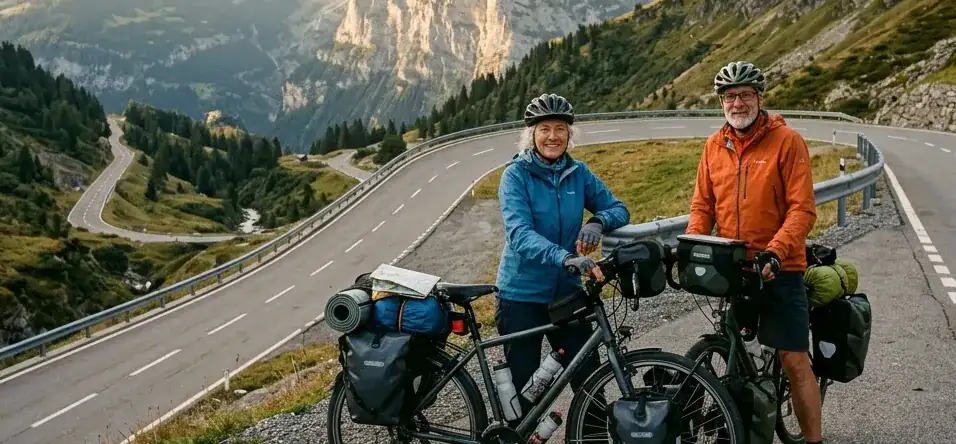
Entering the touring lifestyle follows two distinct paths. The most organic transition occurs when the habit is built slowly during the working years. A rider who has spent decades navigating local routes and managing basic equipment finds that stepping into long-term travel feels like a natural progression. Yet a significant number of travelers begin their journeys after retirement. Many of these older riders are drawn by distant memories of early joy on a bicycle. Others seek a radical declaration of independence after spending their entire adult lives tethered to corporate schedules and family obligations. Regardless of the entry path chosen, reading about self-contained cycling remains a purely abstract exercise. Consuming travel literature or studying maps from the comfort of a living room cannot prepare a person for the minute by minute physical reality of the road. Executing a journey requires confronting the physical world. Crossing vast expanses of terrain under your own power demands a concrete understanding of survival that theory alone cannot provide.
This deficit in practical survival usually manifests in three specific ways during the first few days of travel. First, new riders almost always overestimate their sustainable daily mileage. They calculate distances based on ideal conditions, ignoring the reality of headwinds, steep gradients, and physical fatigue. Second, they underestimate the necessity of rest days. They view rest as a luxury rather than a required physiological reset. Third, they pack equipment based on fear. They carry items just in case a rare emergency occurs, rather than carrying proven tools that serve multiple daily functions. The most effective method to expose these planning flaws is a fully loaded overnight test run. A localized trial reveals what breaks, both mechanically and mentally, without the severe consequences of failing multiple countries deep into an expedition. A rider must learn how their body and their equipment respond to stress while they are still close enough to home to abandon the effort safely.
This transition from theory to reality exposes a sharp demographic contrast. A twenty-five-year-old rider approaches physical friction entirely differently than a sixty-five-year-old rider. When a younger traveler encounters a steep hill with inappropriate gearing, they solve the problem through raw physical endurance. They simply push harder, forcing their body to compensate for poor mechanical planning. Late-adulthood touring does not allow for this brute force approach. Older riders must engineer the physical strain out of the system before the journey begins. Success relies on selecting lower gearing configurations designed for slow, sustained ascents. It requires optimizing weight distribution across the frame to maintain balance. It requires prioritizing contact point comfort over aerodynamics or raw speed. An older rider must accept that preserving the body is more important than arriving quickly.
This demographic divide extends beyond physical exertion into medical logistics. The reality of a younger traveler rarely includes managing chronic conditions or coordinating international healthcare. For a rider entering the lifestyle after retirement, medical logistics demand explicit focus. Managing cross-border prescriptions requires understanding how different nations categorize and dispense medications. Securing proper international health insurance remains a non-negotiable baseline requirement. An older rider must also accommodate longer recovery times from minor injuries. A sprained ankle or a strained muscle that might stop a younger rider for a single afternoon could ground an older rider for a full week. While these medical realities do not prevent travel, they require building a wider margin of safety into every aspect of the plan.
During the working years, time scarcity stands as the primary barrier to independent travel. Synchronizing two adult lives to abandon careers and possessions for a single week requires immense coordination. Doing so for multiple years borders on the impossible. Retirement flips this central constraint. What was once the greatest barrier becomes a massive advantage. With abundant time, riders can fully restructure their approach to movement. They can lower their daily mileage targets without feeling the pressure of a looming return flight. They can build rest days directly into their baseline schedule, rather than taking them reactively after reaching total exhaustion. This abundance of time transforms the journey from a frantic race between destinations into a sustainable daily rhythm.
This inversion of the time constraint also alters the approach to gear acquisition. New riders frequently attempt to solve anxiety by purchasing an entire theoretical equipment configuration upfront. This is a mistake. Because time is no longer scarce, older riders should start with minimal equipment and add only what proves necessary through direct experience. The relationship between physical weight and exploration flexibility depends entirely on equipment modularity. Every item carried must serve multiple purposes. True modularity is discovered through practical failure rather than digital research. When a primary tool breaks far from civilization, the rider learns how to force a single secondary item to serve distinct roles across their cooking, repair, and hygiene kits. Experience teaches a traveler how to survive with less, refining their configuration into a highly functional system.
As the physical logistics stabilize, the emotional realities of the journey begin to surface. New riders often romanticize travel without understanding the core tradeoff between solo and partnered riding. Solo touring requires total self-reliance while navigating an endless stream of unfamiliar faces. Partnered touring lowers individual resilience requirements and allows for shared gear, but it demands high coordination overhead and constant interpersonal compromise. For younger riders, this choice is usually a logistical preference or a test of individual grit. For older adults, this choice carries distinct emotional stakes that alter the meaning of the journey.
A sixty-five-year-old riding alone across a continent is frequently not doing so to test their resilience. Often, the decision to ride solo is driven by bereavement. The partner they originally planned the trip with has passed away, leaving them to execute the shared dream alone. The physical exertion becomes a method of processing grief. Conversely, a partnered trip in late adulthood is rarely just about sharing the weight of a tent. It is a mutual agreement to finally execute a lifelong goal that was postponed by decades of raising children and maintaining careers. The emotional weight attached to every mile is different. The journey serves as a reclamation of lost time, a validation that their shared endurance remains intact.
Whether fueled by grief, delayed ambition, or simple curiosity, determination is required to act upon this abundant time. Time provides the open calendar, but determination provides the forward motion. Eventually, every long-distance traveler reaches a geographical and psychological threshold where turning back ceases to be a viable option. The distance to the starting point becomes greater than the distance to the next horizon. Forward motion becomes the only logical choice. Passing this point of no return defines the core aesthetic of deep-rooted touring. It represents total independence from synthetic urban safety nets, relying entirely on a self-contained configuration to survive whatever conditions the natural environment presents.