
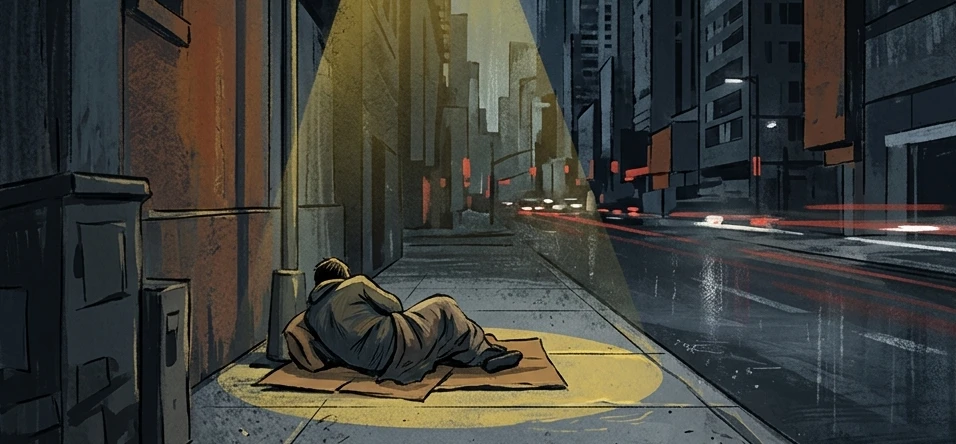
The body on the street is unstable. It shifts and it advances in one direction at a steady pace. Researchers and physicians have documented its stages. They can now describe this movement with a clock.
Series: Urban Survival — The Spiral That Nobody Stops — Part 2 of 11
This is not a gradual decline that stretches over years. Once someone spends more than a few days outside, the decline accelerates. Recognizing this sequence marks the first step in grasping the urgency. This urgency reflects a medical reality.
The First Stage: The Body Spends Its Savings (Hours 24 to 48)
A human body stores emergency fuel. Glycogen accumulates in the liver and muscles, providing quick energy when food intake falls short. On the street, demand remains high. The body consumes fuel all night to resist cold. It burns fuel all day while carrying possessions and moving to avoid displacement. It ceaselessly uses fuel to maintain the immune and respiratory systems against air pollution.
Within the first 24 to 48 hours of continuous outdoor exposure without adequate rest and nutrition, these reserves begin to empty.
The body signals depletion in visible ways. The eye's surface loses brightness and develops a dry, glassy film. The tear glands ration moisture and the shoulders slump forward, and the chin tilts down. The core muscles tire under wet clothing and belongings. They lack enough fuel to support an upright frame. The walking pattern shows small hesitations before each foot lands. The pavement seems uncertain beneath the feet. The nervous system struggles to balance with fewer resources. The skin around the nose and lips turns a flat grey-white. Blood vessels constrict, concentrating fluid in core organs instead of the skin's surface.
These signs remain subtle and a person walking down the street may overlook them. Yet, they signal the start of a countdown.
The Second Stage: The Body Consumes Itself (Days 3 to 7)
When the emergency fuel reserves run out, the body continues. It seeks another source and it breaks down its own muscle tissue and fat stores. This action generates heat and energy absent from food. This process is autophagy, meaning the body consumes itself. It is a real chemical process. The liver turns the body's own tissues into fuel.
This is the stage when damage shifts from temporary to structural. Muscle consumed for fuel does not rebuild without consistent nutrition, rest, and time. The immune system, requiring energy to function, receives less. Minor injuries that typically heal in days on a bed become infected wounds on the street. Fluid accumulates in the knees and ankles. The kidneys struggle to drain this fluid. They already manage dehydration and the body cannot prioritize all demands at once.
The face shifts dramatically and the tissue beneath the eyes sinks inward as the body consumes fat deposits for energy. This creates deep shadows that reflect weeks of sleeplessness. Muscles at the corners of the mouth tremble during speech. Nerves controlling these muscles lack magnesium, making their signals unreliable. The skin on the knuckles and fingertips cracks open. Depleted moisture fails to maintain skin integrity. Circulation redirects warmth from the extremities to vital organs.
The city's noise includes engines, sirens, voices, and construction. This barrage disrupts the brain's entry into deep sleep. Deep sleep allows the body to repair itself. Exhaustion sets in, but recovery remains elusive. The person feels trapped between fatigue and insufficient rest. This cycle prevents restoration and healing.
The Third Stage: The Brain Loses Its Signal (Beyond One Week)
After one week of outdoor exposure without shelter, rest, or nutrition, the central nervous system starts to break down. The brain lacks glucose, clean oxygen, and water. A chemical imbalance accumulates, leading the brain's functions to fail.
The person loses orientation and memory falters. Some people hear imaginary sounds without any prior mental illness. A brain deprived of glucose and oxygen sends false signals like a radio lacking power. Core body temperature drops below its normal level. The body's ability to maintain temperature weakens. Blood vessels in the fingers and toes constrict to protect the heart and brain. Skin at the earlobes, fingernails, and tips of the nose turns blue-purple. This color indicates blood carrying insufficient oxygen.
The eyes struggle to track moving objects. They drift or fixate on one spot. The individual finds it difficult to walk straight without touching a wall. They sit or lie on the cold, wet concrete, ignoring the rain and traffic. They do not choose to abandon self-protection. The brain retreats into a state that ignores external input. It enters a survival mode that limits all non-critical functions. This preserves the heart and lungs for an extended period.
At this stage, without intervention, the outcome is cardiac failure, respiratory failure, or death from exposure.
Why This Matters for Everything That Follows
This sequence, 48 hours, one week, and beyond, is not offered here to produce despair. It is offered because it changes what the correct response looks like.
A person in Stage One can benefit from many kinds of help. Food, water, a warm space, a conversation.
A person in Stage Two requires targeted intervention. The body shows structural compromise and introducing food too quickly causes poor absorption and potential harm. Resting in a noisy environment hinders recovery. The intervention must align with the biological condition.
A person in Stage Three cannot receive a housing application form. They cannot attend an interview and they cannot make decisions about long-term options. They require a clinician to guide them. A quiet room is critical for their comfort. Warm fluid must be delivered carefully. Only then can other conversations begin.
This problem plagues nearly every city’s approach. The response mismatches the stage and cities provide the same shelter bed, form, and intake process across all three stages. This treatment assumes that the bodies at Stage One and Stage Three share the same condition. They do not and each stage demands different interventions. Each intervention requires urgency and dignity.
This series explores what a matched response entails. It starts with recognizing that the person on the ground changes constantly. Their movement follows a clear path and time continues to tick away.
Series: Urban Survival - Tomorrow: Part 3: Why the Usual Answers Fail
Tomorrow, we will explore why typical solutions fall short. Many attempts to address urban challenges miss critical aspects. Effective strategies require clear understanding and defined actions. We will break down the reasons these standard approaches often yield poor results.