The most common objection to this system is the cost. A 2,000-unit tower presents significant expenses. Clinical teams will operate in the field for 12 to 24 months. These teams prepare the site before occupancy. Phase Zero includes stabilization wards that ensure safety. Thermal drones will map [...]
Most housing for individuals exiting homelessness centers on one question: does it have a roof and a door? If it meets that criteria, it counts as housing. The individual is no longer homeless. The tally decreases and the program reports success. Series: Urban Survival — The Building That Rebuilds [...]
Every one or two years, volunteers in many U.S. cities venture out on a single night to count people sleeping on the streets. They follow designated routes, inspect doorways, parks, and known encampments, and document their findings. This effort produces the Point-in-Time count. Governments rely on [...]
Part 6: What a Real Offer Looks Like described the person whose refusal of housing is rational, whose objections are real and whose barriers are concrete and removable. This post describes a different person. This person cannot be reached by better offers, longer outreach relationships, or more [...]
Most housing offers to people in encampments are not genuine. They mimic the form of an offer. They use language that suggests assistance and creates an illusion of choice. When individuals evaluate the actual proposals, they reveal a harsh reality. The offer demands they surrender everything they [...]
There is a sequence to recovery that the body enforces whether or not the city acknowledges it. The body does not care about policy timelines or intake forms or housing availability. It moves through its own stages of damage and repair at its own speed, in response to its own conditions. A system [...]
The term "homeless" identifies an administrative category. It indicates a legal and economic status for individuals lacking a fixed address. This term does not capture bodily, psychological, or social conditions. It fails to reflect varying circumstances. This label unites people with vastly [...]
Cities have battled homelessness for decades. Their efforts remain tangible and funding sources are reliable and accessible. Workers in this field care about their results. Yet, the number of individuals on the street does not decline. In many cities, it continues to rise. Series: Urban Survival — [...]
The body on the street is unstable. It shifts and it advances in one direction at a steady pace. Researchers and physicians have documented its stages. They can now describe this movement with a clock. Series: Urban Survival — The Spiral That Nobody Stops — Part 2 of 11 This is not a gradual [...]
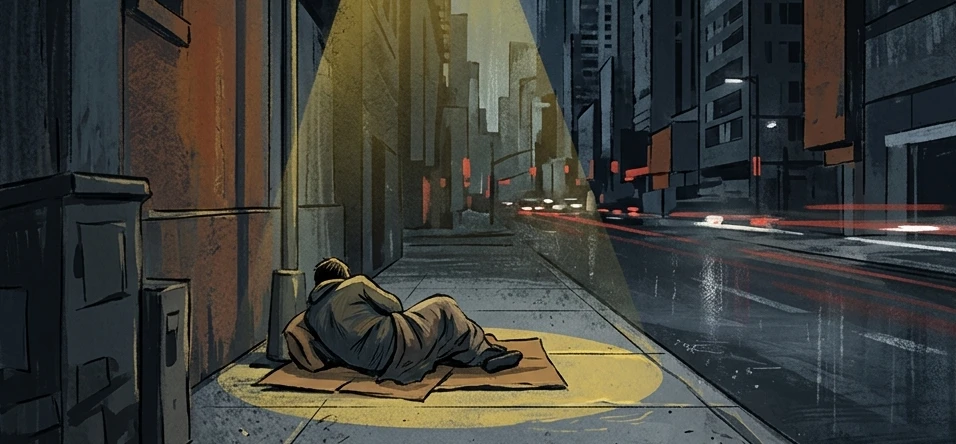
Stand on any major street in a large city and look carefully at the pavement. Check near a building entrance, a freeway underpass, or a sheltered public park corner. There is a person there and they are lying on concrete. They have been lying on concrete for a long time. Series: Urban Survival — [...]
Imagine a village with a well at its center. Every family uses the well, but the well provides more than water. It is where people meet in the morning, where disputes get settled, and where the young learn from the old simply by standing nearby and listening. Now imagine someone argues that the [...]
In July 2025, the Trump administration signed an executive order titled "Ending Crime and Disorder on America's Streets." The order redirected $100 million toward a program called STREETS, which funds urban camping bans, law enforcement training for mental health crisis response, and expanded [...]