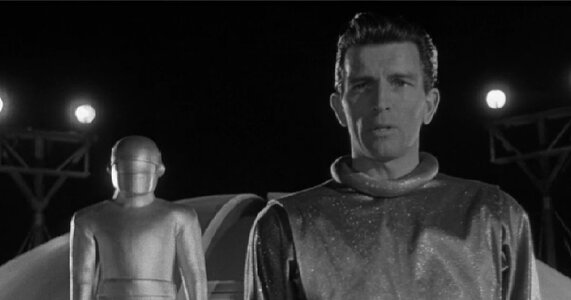
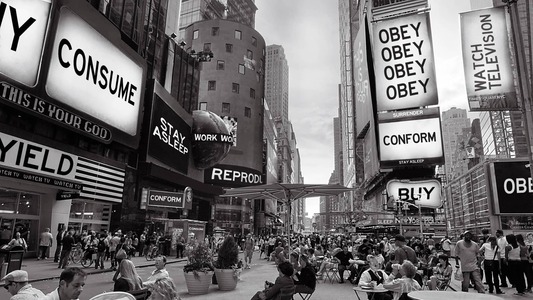
Some people who believe the earth is flat display behaviors that resemble those of cult members. By rejecting scientific facts and ignoring proof, these individuals create a closed world. Although these individuals defend their alternative ideas with great energy, they do not belong to any formal [...]
Philosophers argue about the meaning of truth. While some define truth as objective facts that exist without our opinions, others see it as personal. Under one view, physical facts like the shape of the earth remain constant regardless of what we believe. In contrast, two friends watching a movie [...]
The common idea of Housing First assumes that providing a home is the only requirement for social integration. However, as Stephen Eide argues in Homelessness in America, this model often ignores the psychological and civic foundations of a community. True integration requires more than just a [...]
The sociological concept of the "leisured indigent," introduced by Jane Jacobs in her book The Death and Life of Great American Cities, describes people who use public spaces without a commercial reason. These individuals, who are often homeless, show a form of urban agency that challenges modern [...]
The emergence of modern homelessness in America is frequently attributed to the fiscal and social policies of the late twentieth century. However, a rigorous analysis of the crisis reveals roots that extend deep into the post-war era of urban renewal and the subsequent de-institutionalization of [...]
The language used to classify individuals living outside traditional housing has changed over time, reflecting shifts in social values and economic goals. Historically, terms like hobo, tramp, and bum served as descriptive types rather than simple insults. These labels identified specific [...]
Historical records show that homelessness was a common occurrence throughout the late 19th century. Data from the late 19th and early 20th centuries indicates high levels of displacement despite a much smaller national population. Records from 1880 and 1890 reveal that city police stations served [...]
The presence of an individual inhabiting a nomadic lifestyle within a settled community often triggers a complex array of psychological and sociological responses. Unlike the institutionalized or invisible unhoused population, the intentional nomad, often traveling by bicycle and maintaining a [...]
Paul Craig Roberts is an American economist who once worked inside the government. During the Reagan era, he served as an Assistant Secretary of the Treasury. After leaving his post, he became a strong voice against popular political ideas. He states that recent policies damage ordinary citizens. [...]
Witchi Tai To is a song by Jim Pepper, a Native American jazz saxophonist of Kaw and Muscogee Creek descent. The song was first released on the 1971 album Pepper's Pow Wow and has since been covered by numerous artists, including Brewer & Shipley, Harper's Bizarre, and Jan Garbarek. The song is [...]
I Know I'm Not Alone is a 2005 documentary film directed by and starring Michael Franti. The film follows Franti as he travels to Iraq, Israel, and the Palestinian territories to explore the role of music in conflict zones. Franti, a well-known musician and activist, was inspired to make the film [...]
Yeha Noha is a track from the 1994 album Chants and Dances of the Native Americans by the project Sacred Spirit. The project was created by German musician Claus Zundel and aimed to blend traditional Native American chants with modern electronic and ambient music. The album features a variety of [...]