
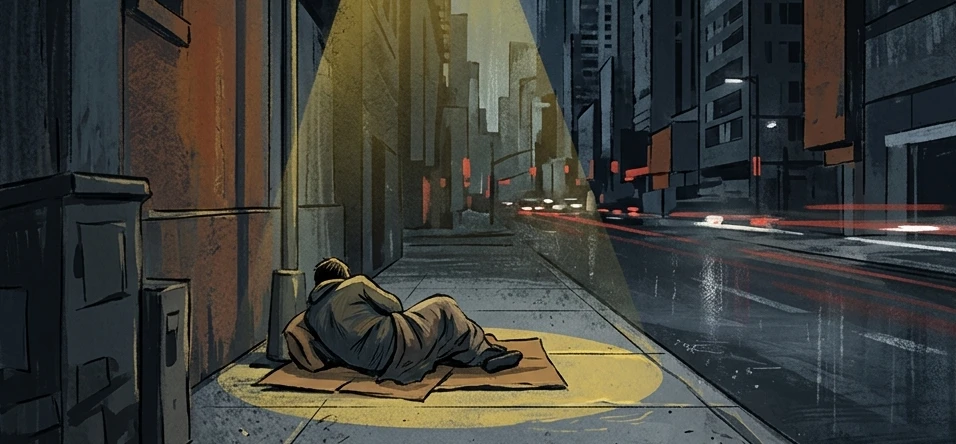
Cities have battled homelessness for decades. Their efforts remain tangible and funding sources are reliable and accessible. Workers in this field care about their results. Yet, the number of individuals on the street does not decline. In many cities, it continues to rise.
Series: Urban Survival — Why the Usual Answers Fail — Part 3 of 11
This is not a failure of effort or compassion. It is a failure of match. The tools being used are applied to the wrong conditions, in the wrong sequence, at the wrong time. Understanding why requires looking honestly at what the most common approaches actually do, and what they cannot do.
The Shelter Bed That Cycles
Emergency shelter stands as the primary response to homelessness in many cities. A person enters the shelter from the street. They receive a bed for the night and may get a meal or a locker for their belongings. In the morning, they step back onto the street.
After spending days outside in Stage One of depletion, an individual needs immediate support. Emergency shelter delivers a critical first step. It interrupts the downward spiral before it escalates. Shelter provides stability, allowing the person to confront the situations that pushed them outdoors.
Emergency shelter has a fixed capacity and design. It does not adapt to the person entering. The bed remains the same and the morning departure is unchanged. For individuals in Stage Two or Stage Three, their bodies consume muscle tissue. Their brains begin to fragment and the shelter bed does not break this cycle. It halts it for one night. In the morning, the person steps back onto the street. They exit in nearly the same condition as when they arrived and the clock starts again.
Over five years, this creates a cycle. One individual enters the shelter system hundreds of times. The city counts each entry as service provision. The person's body deteriorates and the financial burden rises and the condition remains unresolved.
The Apartment Offered at the Wrong Moment
Housing First is a system shaped by decades of research. Its central finding is clear and vital: stable housing is not a reward. It serves as a prerequisite for sobriety, treatment, and behavioral compliance. A person cannot stabilize mental health, address addiction, maintain employment, or rebuild relationships while sleeping on concrete. Research supporting this is consistent and strong.
Housing First delivers results and it effectively serves the population it targets.
The population includes individuals who can walk through a door and read a lease. They can manage basic tasks of independent living. These individuals engage with support services that accompany their housing. For someone recently displaced, such as those who lost housing due to job loss, family breakdown, or hospital discharge, this support is crucial.
The problem emerges when Housing First applies to a person in Stage Three depletion. This individual has a fragmented central nervous system. They have lived outdoors for five, eight, or twelve years with untreated psychosis. Their prefrontal cortex has suffered chemical changes from years of cortisol exposure and lack of sleep. This brain region oversees planning, decision-making, and self-regulation.
Handing this person a key to an apartment carries good intentions. The issue lies in the sequence. The brain that must handle independent living tasks currently suffers from glucose deficit and oxygen debt. The key is given before stabilizing the brain that will use it.
The apartment remains vacant and it transforms into a site where the crisis lingers behind closed doors. This turmoil stays hidden from the street. The individual has a roof over their head. Yet, the downward spiral persists unbroken.
Why Both Approaches Fail the Same Group
Emergency shelter and Housing First rest on one assumption. They assume people can engage with their services. Emergency shelter requires individuals to sleep comfortably in shared dormitories. They must also follow facility rules and leave each morning. Housing First expects individuals to handle the demands of independent living.
Approximately one third of the people on the street do not meet either assumption. Their neurology has changed due to untreated illness and long-term outdoor exposure. These individuals do not refuse services. They exist in a state where offered services cannot connect with the part of the brain that would accept them.
This is not a moral judgment. It is a biological description and an engine that has seized cannot function with better fuel. The mechanic must open the engine. He must free the seized components. The system requires heating to return to operation. Only then does the fuel become useful again.
The body in Stage Three depletion resembles a seized engine. Stabilizing in Phase Zero opens the engine. This step is crucial before further actions are taken and refer to Part 5: What the Body Needs Before the Key for more details.
What This Means for the City
A city that allocates its entire homelessness budget to emergency shelter and scattered housing misapplies resources. This approach fails the most vulnerable third of the unsheltered population. Funds are exhausted and services are delivered. Individuals cycle through the system for years without finding resolution.
This is not waste in the sense of carelessness. It is waste in the sense of mismatch. The intervention does not reach the condition it is trying to address.
The system in this series maintains emergency shelter and Housing First. It introduces a crucial first step for individuals that these approaches do not reach. This model prioritizes Phase Zero stabilization before housing offers. It serves not as a barrier or test. Instead, it acts as a biological precondition for receiving the housing offer.
Once that precondition is met, the rest of the tools work as they were designed to.
Series: Urban Survival - Tomorrow: Part 4: Not One Crisis, Five