
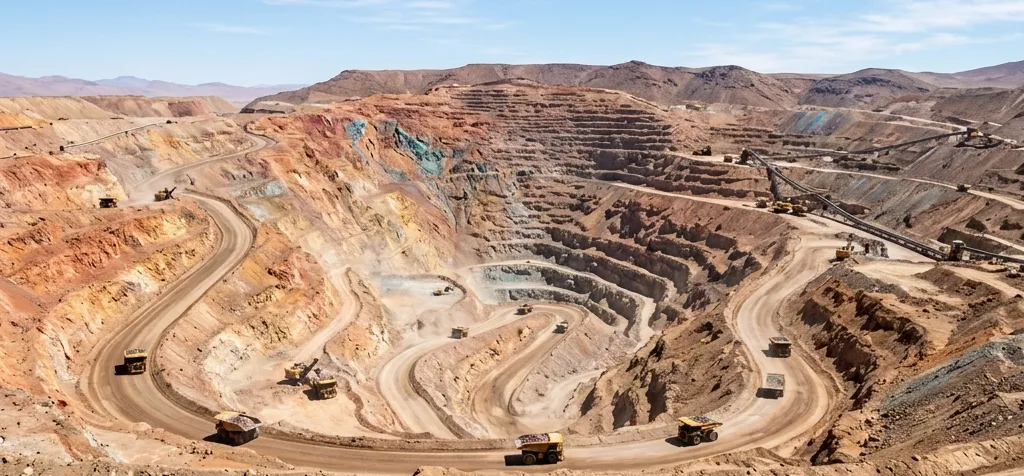
Every year, the global industrial economy rips roughly 100 billion tons of physical material out of the earth. Imagine a line of standard dump trucks bumper to bumper, each one carrying its full load of rock and dirt. That line would stretch from the earth to the sun and back, twice, every single year. This volume has been climbing steadily for decades without any sign of slowing down, because for every ton of steel that a wealthy European nation recycles, a construction crew in Lagos or Dhaka pours several more tons of fresh concrete into a new foundation. No country on the planet has managed to grow its economy while reducing the total volume of physical material its citizens consume, once the goods manufactured overseas on their behalf are counted. The fundamental trajectory of planetary resource consumption points in one direction. Six of nine scientifically defined planetary boundaries have already been crossed, including the boundaries governing climate stability, freshwater availability, and the chemical composition of soil. The remaining carbon budget that would keep global warming below 1.5 degrees Celsius amounts to roughly 250 to 300 billion tons of carbon dioxide. At current emission rates, that budget runs dry within a single decade.
The Weight of New Demand
Across sub-Saharan Africa and South Asia, populations are growing at approximately 0.7 percent per year while populations in Germany, Japan, South Korea, and China are shrinking. This demographic shift does not reduce global consumption. It relocates the center of gravity. When a family in rural India moves into a newly constructed apartment block in Hyderabad, that single household immediately begins consuming concrete, steel rebar, copper wiring, glass, plastic pipe, and electrical energy at rates that their previous rural life never demanded. Multiply that transition by hundreds of millions of families happening simultaneously across India, Nigeria, Bangladesh, Indonesia, and Ethiopia, and the resulting wave of new material demand dwarfs anything that a recycling program in Stockholm could offset.
The concept that economists call "material footprint convergence" describes this wave in numerical terms. Wealthy nations have largely plateaued at roughly eight to 12 tons of physical material consumed per person per year. Middle-income nations are climbing rapidly toward that same range. The climbing populations vastly outnumber the plateaued ones, which ensures the global total keeps rising even when wealthy countries manage to hold their own numbers flat. A bathtub with one small drain and five open faucets does not empty.
The Green Paradox
Building a renewable energy grid requires an enormous front-loaded surge of mineral extraction before any net emissions reduction arrives. A single large wind turbine contains roughly 4.7 tons of copper. A typical electric vehicle battery pack requires about 8 kilograms of lithium, 14 kilograms of cobalt, and 40 kilograms of nickel. The International Energy Agency estimated in 2021 that achieving net-zero emissions by 2050 would require a sixfold increase in critical mineral extraction compared to 2020 levels. That means six times more rock pulled from the ground, six times more water consumed in processing, and six times more toxic tailings ponds sitting behind earthen dams in communities with very little political power to resist.
The cost of that extraction lands far from the consumers it serves. In Chile's Atacama Desert, lithium production consumes roughly 500,000 gallons of water per ton of lithium in a region where indigenous Atacameño communities already struggle to irrigate basic crops. In the Democratic Republic of Congo, roughly 70 percent of the world's cobalt comes from mines where conditions range from industrial open pits to artisanal tunnels dug by hand, sometimes by children, before the metal travels through a chain of refiners and arrives inside a smartphone sold in London or Los Angeles. The consumer who believes they are making a green choice rarely traces the supply chain backward to Kolwezi.
The Decoupling Illusion
Germany and the United Kingdom frequently appear in policy discussions as success stories for economic growth without rising emissions. Both countries have reduced their territorial carbon emissions while growing their economies. How much of that reduction represents a genuine efficiency gain, and how much of it represents a transfer of dirty production to factories in China, India, and Vietnam?
Consider the steel that holds up a new London apartment building. The United Kingdom once produced most of its own steel in cities like Sheffield and Scunthorpe, burning coal and releasing carbon dioxide from smokestacks visible to local residents. Today the country imports roughly 60 percent of its steel, much of it manufactured in blast furnaces along the Yangtze River in China, where the carbon emissions from producing that same beam of steel are often higher per ton than they were in Sheffield, because Chinese electricity still relies heavily on coal. When a country closes its domestic mills and imports cheaper steel manufactured overseas, its territorial emissions fall. The emissions still exist. They simply appear on a different country's ledger. Consumption-based carbon accounting, which tracks the total emissions embedded in the goods a population actually consumes regardless of where those goods were manufactured, reveals that most of the celebrated decoupling in wealthy nations is an accounting illusion. The pollution moved. The atmosphere did not notice the difference, because a molecule of carbon dioxide released from a factory in Guangzhou traps the same amount of heat as one released from a factory in Birmingham.
Absolute decoupling, where total global material throughput declines while economic output grows, has never been observed at the planetary scale. Partial decoupling in individual countries has occurred only on a territorial accounting basis, and even those gains disappear when consumption-based metrics replace production-based ones. The math governing planetary extraction does not care which country writes the check.
The Feedback Loops That Accelerate Collapse
Several reinforcing feedback loops make managed correction increasingly unlikely as delay continues. Rising demand for critical minerals triggers resource nationalism, where producing countries impose export controls to capture more of the value chain domestically. Indonesia banned raw nickel ore exports in 2020 to force foreign companies to build smelters inside the country. Every duplicate smelter built to satisfy a national security requirement consumes its own pile of concrete, steel, and energy.
Climate damage feeds directly back into the system. When extreme heat and flooding destroy agricultural yields across South Asia, millions of people move toward more stable regions. Governments divert capital from renewable energy investment toward border enforcement, because the immediate political pressure to stop migration overwhelms the long-term pressure to stop emissions. A border wall costs concrete. That concrete requires limestone mining and kiln energy. The wall built to manage the consequences of climate change generates its own contribution to the problem that made the wall necessary.
Automation pushes in a parallel direction. When machines replace human labor in manufacturing, the cost of goods drops and consumption volumes climb. A shirt that costs half as much gets purchased twice as often. This rebound effect offsets the per-unit efficiency gains that automation delivers. The factory becomes cleaner per item while the total number of items keeps rising.
What the Data Shows
No single future scenario dominates the current evidence. The trajectory as of 2026 most closely matches what modelers describe as "uneven bifurcation," where high-income consumption stagnates while low-income and middle-income consumption keeps growing. The growing populations vastly outnumber the contracting ones, meaning net global material throughput keeps rising. Layered on top of this baseline sits a rising probability of involuntary correction through supply shocks, resource conflict, or cascading climate damage, a pattern that researchers label "constraint-by-crisis." Whether battery chemistry breakthroughs reduce the mineral bottleneck, whether great-power supply chain decoupling between the United States and China deepens the inefficiency, and whether the gap between pledged and needed climate finance closes before it reaches one trillion dollars per year will determine which combination of these scenarios plays out.
The physical boundaries governing this planet do not negotiate. They do not respond to speeches, treaties, or quarterly earnings reports. When the remaining carbon budget reaches zero, the atmosphere enforces its own limit regardless of which country's parliament voted against action. The only remaining question is whether human societies reorganize their material consumption before the constraint arrives, or whether the constraint arrives first and reorganizes them.