
A worker in a brightly lit factory in Hsinchu, Taiwan, lowers a silicon wafer into a chemical bath. The silicon undergoes a series of precise acid washes and laser etchings to carve billions of microscopic pathways into the metal. The factory consumes enough electricity each day to power a small residential neighborhood, drawing energy from coal and natural gas plants located miles away. These finished silicon chips travel by cargo ship across the Pacific Ocean, arriving at a warehouse in Santa Clara, California. Technicians bolt thousands of these chips into tall metal racks. A massive array of industrial fans pushes chilled air through the racks to keep the metal from melting under the intense heat of electrical friction. This physical arrangement of metal, electricity, and cooling water forms the foundation of what the industry calls foundation models.
The Training Engine
Machine intelligence begins with the ingestion of data. Before a computer program can answer a prompt or generate a picture, it requires exposure to a vast library of human information. Engineers feed the system millions of books, photographs, and audio recordings. The software processes this information by adjusting numerical weights across billions of connections, searching for statistical patterns. This process requires an astonishing amount of electrical energy, running constantly for months on end.
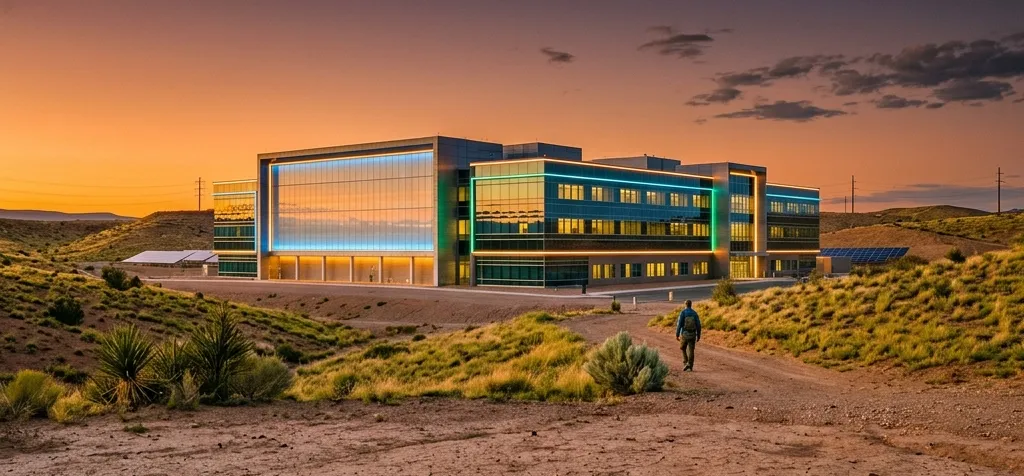
To understand the physical scale of this process, look at the energy demands of a single training run. Training a large language model requires roughly 10,000 megawatt-hours of electricity. This amount of power equals the total annual electrical consumption of 1,000 average homes. The computers running these calculations sit inside concrete buildings spanning hundreds of thousands of square feet. In places like Prineville, Oregon, these data centers stretch across the high desert, drinking millions of gallons of water from local aquifers to feed their evaporative cooling systems. The intelligence emerges from the software, but the physical cost extracts a toll from the surrounding landscape. The heat thrown off by the processors warms the cooling water, which then evaporates into the dry air, permanently removing that moisture from the local watershed.
The Inference Network
Once the initial training concludes, the software moves into its production phase. This is where the application areas of AI systems become visible to the public. When a person types a question into a search engine or asks a digital assistant to summarize a document, the software executes a process called inference. The program reads the prompt, calculates the most probable response based on its training weights, and sends the answer back to the user. The user sees a string of text appear on a screen, assuming the process requires very little effort.
While a single inference calculation consumes very little electricity, the aggregate demand creates a massive industrial load. Billions of requests hit these servers every day. The enterprise applications supporting these requests operate out of cloud service centers distributed globally. A data center in Reykjavik, Iceland, uses freezing arctic air to cool its servers while processing inferences for financial firms in London. These cloud services provide the computing power, storage, and databases that allow small businesses to run complex analytical software without buying their own physical servers. The physical location of these data centers dictates the speed at which the information travels. A query sent from a mobile phone in Nairobi must travel through undersea fiber optic cables to a server farm in Europe, get processed, and travel back in a fraction of a second.
Scientific and Engineering Workloads
Beyond answering text prompts, the same silicon architecture supports highly specialized scientific research. A laboratory in Boston uses machine intelligence to simulate the folding patterns of new proteins. The researchers want to discover a drug that binds to a specific virus. Testing millions of chemical combinations in a physical laboratory would take decades of manual pipetting and waiting for chemical reactions. The physical constraints of traditional chemistry severely limit the speed of discovery.
The software runs the simulation in a few days. It calculates the atomic interactions of millions of molecular shapes, identifying the three or four most promising candidates for physical testing. This automated research accelerates drug discovery, alters weather modeling, and improves the design of physical structures. An aerospace company uses the same computational brute force to test the aerodynamic drag on a new airplane wing design before building a physical prototype. Engineers feed the physical properties of air and aluminum into the system, and the software predicts how the metal will bend under the stress of supersonic flight. This predictive capability saves millions of dollars in manufacturing costs by eliminating the need to build flawed physical models.
The climate modeling applications provide another example of this computational scale. Meteorologists try to predict the path of a hurricane by dividing the atmosphere into a three-dimensional grid. They calculate the temperature, pressure, and humidity in every single box of the grid. Doing this accurately requires reading petabytes of historical weather data. Machine intelligence systems process this historical data to find hidden variables that human scientists missed. A supercomputer in Oak Ridge, Tennessee, runs these weather models around the clock. The facility requires so much power that it sits next to a dedicated electrical substation. The software crunches the numbers, predicting where a storm will make landfall days in advance, allowing emergency crews to evacuate coastal cities before the water rises.
Defense and Autonomy
The capability to process massive amounts of data in real time changes the nature of defense and intelligence operations. A military drone flying over a conflict zone captures thousands of high-resolution images every minute. Human analysts cannot review every photograph fast enough to identify a moving target. A human eye fatigues after staring at a screen for several hours, causing the person to miss subtle changes in the landscape. The software scans the incoming images instantly, matching the pixel patterns against a database of known vehicle shapes.
This image analysis supports rapid decision making on the ground. The same pattern recognition applies to logistics and cybersecurity. When an unexpected line of code hits a government server, the software flags the anomaly before a human administrator even realizes a breach attempt occurred. In the physical realm, robotics systems rely on this intelligence to move through the world. A warehouse robot in Stuttgart, Germany, uses sensor interpretation to navigate crowded aisles, avoiding human workers while fetching inventory. The software coordinates fleets of these machines, assigning tasks and plotting routes to prevent collisions. A camera mounted on the robot reads the physical environment, translates the light into digital data, and feeds that data into an onboard processor that tells the electric motors when to stop.
The military applications extend beyond simple image recognition. Defense contractors build autonomous systems that can maneuver vehicles without human input. A self-driving truck carrying supplies across a desert battlefield uses the same underlying technology as the warehouse robot in Germany, but the stakes are significantly higher. The truck must interpret a chaotic environment filled with unpredictable obstacles, calculating the safest path through hostile territory. This requires an immense amount of onboard computing power, drawing electricity from the vehicle's engine to run the processors. The software must parse data from radar, lidar, and optical sensors simultaneously, deciding whether a shape in the road is a shadow or an explosive device. The physical survival of the soldiers relying on those supplies depends entirely on the accuracy of the mathematical weights inside the neural network.
The Illusion of the Cloud
The language used to describe these systems often obscures their physical reality. The term "cloud computing" suggests something weightless and infinite, floating above the constraints of the natural world. The physical truth involves diesel generators, high-voltage transmission lines, and millions of gallons of water. The application areas of machine intelligence continue to expand into every sector of the economy, demanding increasingly larger industrial facilities. The physical infrastructure required to support this expansion will reshape the geography of power generation, forcing cities to choose between providing electricity to neighborhoods or feeding the insatiable appetite of the data centers.
The true cost of artificial intelligence is measured in concrete and copper.