
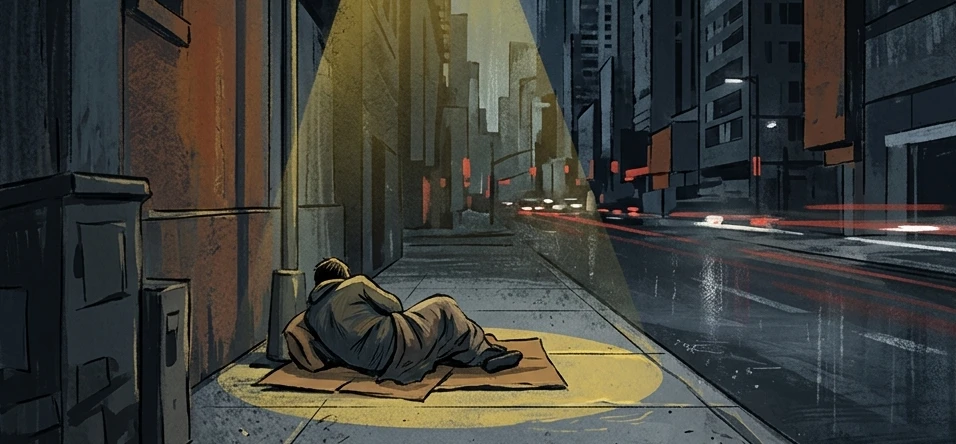
The term "homeless" identifies an administrative category. It indicates a legal and economic status for individuals lacking a fixed address. This term does not capture bodily, psychological, or social conditions. It fails to reflect varying circumstances. This label unites people with vastly different situations. A broken arm contrasts with a broken spine, yet both are injuries. The approach to each requires distinct treatment.
Series: Urban Survival — Not One Crisis, Five — Part 4 of 11
Cities that apply one response to their unsheltered population treat a broken arm and a broken spine with the same cast. That cast aids some people and for others, it fails to address their defined injuries.
The system described in this series begins by recognizing five distinct groups within the unsheltered population. Each group has a different reason for being outside. Each group requires a different response. Applying the wrong response to the wrong group wastes resources, fails people, and, for the most damaged groups, costs lives.
Group One: The Recently Displaced
This person lost their housing in recent weeks or months. A job ended abruptly and a relationship also ended unexpectedly. A hospital discharge occurred without a housing plan. A landlord sold the building unexpectedly. The individual stands outside, cognitively intact and physically stable. They are ready to engage with services now.
This group comprises about 26 percent of the unsheltered population, according to field estimates. They require swift placement into stable housing. They do not require years of clinical support. They need a working phone number and a dedicated case worker. They also need a rapid path to housing. This path must move quickly enough to prevent Stage One depletion from escalating to Stage Two.
This group benefits from the Housing First approach. Speed is the critical factor and each week of delay pushes a willing individual closer to severe biological damage. This damage complicates their ability to accept and keep housing.
Group Two: The Encamped but Reachable
This person has lived outside for years. They have forged social bonds within the encampment. They know their neighbors well and they have established a routine for survival. They are not rejecting housing like one rejects an unwanted gift. They are declining the defined offer presented. That offer demands they abandon a pet. It requires separation from a partner. They must surrender their belongings and they must also enter a facility with rules. Their past experiences show them these spaces are unsafe.
This group accounts for about 35 percent of the unsheltered population. Their refusal makes sense and it does not indicate mental illness or lack of motivation. It reflects a logical response to an offer. This offer demands they abandon everything they have built. In return, it provides something they cannot trust.
The appropriate response to this group is a genuine offer. This offer should include a designated room for them. It must provide a stored cart for their belongings. The space should allow accommodation for a partner and a pet. In field trials, genuine offers increased acceptance rates by over 55 percent. This occurs during the critical moment when circumstances demand a change.
Outreach workers must remain in the encampment for months. Trust builds over time and the offer becomes clear to the community. When the moment arrives, the decision takes place swiftly because of the established relationship.
Group Three: The Neurologically Altered
This person has spent five, eight, ten years outside. During this time, untreated psychosis and mental illness have changed their brain chemistry. Long-term exposure to harsh environments has caused measurable damage. The prefrontal cortex controls planning, decision-making, and self-perception. It no longer functions as it did before the constant cortisol flooding and sleep deprivation.
Many individuals in this group have anosognosia. This term will receive a full explanation in Part 7: When Persuasion Cannot Reach. Anosognosia indicates that the brain's illness impairs its ability to recognize that illness. The affected person does not deny reality. They do not resist the truth. The neurological function needed to acknowledge their condition has suffered damage from the disease. Persuasion cannot impact a function that metabolic disease has obliterated.
This group makes up approximately 34 percent of the unsheltered population. They need a distinct approach and this approach includes long-term clinical support within their environment. Legal instruments of last resort activate when defined danger thresholds exist and detailed information appears in Part 7: When Persuasion Cannot Reach.
Group Three (Riparian): The Invisible Population
Group Three contains a sub-population that standard counts miss. These individuals have shifted from visible streets to the city's waterways. They inhabit concrete river channels and flood control corridors. They also find refuge in storm drain systems beneath urban infrastructure.
These individuals move frequently and adapt to various terrains. The single-night Point-in-Time count often overlooks them. Cities rely on this count to measure their homeless population. Field evidence indicates these individuals account for 20 to 30 percent more than the official count. For instance, a city with a reported 10,000 unsheltered individuals may actually have 12,000 or 13,000.
Identifying this population demands diverse tools. Part 8: The People Nobody Counted focuses on methods for discovering them. It also examines responses that effectively reach this group.
Group Four: The Voluntary Nomads
This group represents about five percent of the unsheltered population and faces widespread misunderstanding. These individuals have made a genuine choice to live outdoors with others. They form strong social bonds and they demonstrate various skills and competencies. They do not suffer from psychological crises. They do not face biological collapse.
Misidentifying this group as Group Three wastes legal resources. It destroys the trust outreach workers have built over months. This misidentification also harms individuals who did not request intervention.
The correct response to Group Four is harm reduction without placement requirements. Offer housing that does not expire. Avoid legal instruments and pressure and respect choices that differ from the majority. Do not pathologize individuals who make those choices.
Why the Distinctions Matter
A city that responds equally to all five groups will succeed with Group One. It will only partially succeed with Group Two. Group Three will face Concluded neglect. The city will overlook the Riparian sub-population entirely. This approach will damage Group Four.
The system outlined in this series allows simultaneous engagement with all groups. It initiates five matched responses at once. Each pipeline moves forward in parallel. No group waits for another to be served first.
This active design distinguishes an engineering system from a policy intention. The policy intention claims: we will assist everyone. The engineering system details the response for each condition. It describes how these responses operate together. It also outlines how we measure the effectiveness of each response.
Series: Urban Survival - Tomorrow: Part 5: What the Body Needs Before the Key