
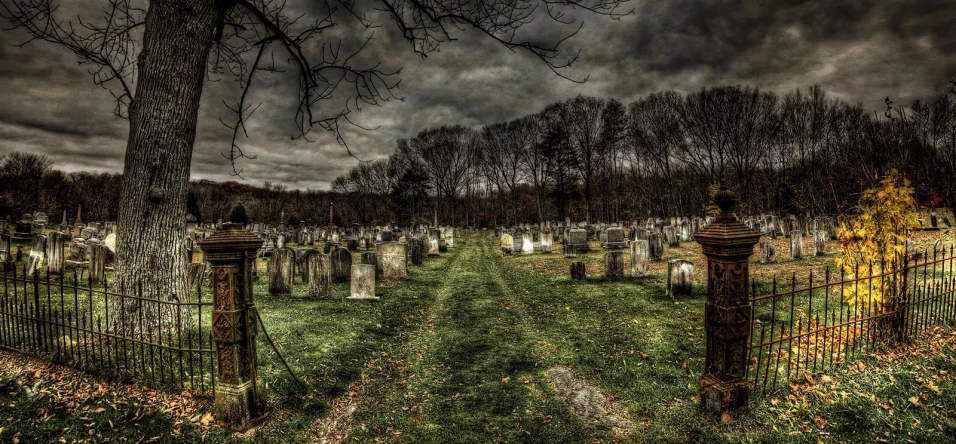
Halloween in the United States grew in layers. Each group that touched the holiday left something behind for the next group to build on. Old church customs for the dead, Irish and Scottish folk games, small-town pranks, suburban family life, candy ads and modern retail all added a piece. These elements arrived at different times for different reasons, so the holiday never had one founding moment or one original form. Quiet remembrance of the dead still exists, yet mainstream Halloween now centers on children's candy, neighborhood display and a very large seasonal market.
Remembrance and the Modern Spectacle
In an American suburb during late October, the front yards tell the story. Twelve-foot skeletons lean over porches, motion sensors set off screaming figures, and strings of orange lights run along rooflines for weeks. Home Depot launched its 12-foot skeleton in 2020 at about 300 dollars.
Centuries earlier, candles burned at gravesides on the same evening. Families knelt, prayed for relatives who had died, and handed small spiced cakes to neighbors who promised to join the prayers. The church called this stretch of days Allhallowtide. It covers the evening of 31 October, All Saints' Day on 1 November and All Souls' Day on 2 November. Historian Nicholas Rogers, in a 2002 history of the holiday, describes a celebration that changed shape each time a new group carried it somewhere new.
The spiced cakes were called soul cakes. In parts of Britain and Ireland, children collected them by reciting prayers at doorways, a custom some historians see as a distant ancestor of trick-or-treating.
Immigrant Customs and Early Community Mischief
After the Irish famine of the 1840s, historians estimate that roughly a million people left Ireland. Many carried their autumn customs across the Atlantic. Scottish settlers had brought similar traditions earlier, so Irish and Scottish households spread Halloween across North America during the nineteenth century. Families gathered around tubs of water to catch floating apples with their teeth, roasted nuts on the hearth to guess who would marry whom, and served seasonal foods at parlor parties.
Outside the parlor, the night looked rougher. Boys tipped over outhouses and lifted gates off their hinges, and in some towns the fun turned into vandalism. In Anoka, Minnesota, mischief by local children grew severe in the early 1900s, prompting civic leaders to form a Halloween committee. On 31 October 1920, the committee held a parade down Main Street. The Fireman's Band of Minneapolis marched with police and fire crews and hundreds of children. A bonfire in Bridge Square followed, with free popcorn, peanuts and candy, and police received no reports of pranks that night.
Anoka now calls itself the Halloween Capital of the World. The parade gave young people something exciting to join, so the town traded vandalism for a party. Civic leaders in other American towns used similar gatherings in the early twentieth century to steer unruly youths toward supervised fun. Adults took part too, since costume parties were common in this era, showing that grown-up participation has a long history.
The Postwar Suburban Shift and Packaged Candy
Shortly after America entered the Second World War, sugar became the first consumer product the government rationed. About a third of American sugar imports had come from the Philippines, which Japan had occupied. War Ration Book Number One, called the Sugar Book, was issued on 4 May 1942. Weekly allowances fell to half a pound, a little over one cup. That was roughly half of prewar use, so widespread candy handouts largely paused until rationing ended in June 1947.
The revival came quickly. Children's magazines such as Jack and Jill and Children's Activities featured trick-or-treating in October 1947. Peanuts comic strip ran Halloween strips from 29 to 31 October 1951, and a 1952 Disney cartoon starring Donald Duck showed children how to do it. Candy companies including Curtiss and Brach began Halloween advertising soon after rationing ended.
The new suburbs made the custom practical. Short blocks of similar houses and many young families put a child within a short walk of dozens of doors. Individually wrapped candy bars and small packages gave households a dependable treat to buy at the store, instead of the cookies and popcorn balls that families once made at home.
Packaging for Mass Culture
Once candy, costumes and decorations came in boxes, a holiday that had depended on homemade supplies became the same event in every school and neighborhood. Drugstores sold plastic masks and thin costumes printed with cartoon characters. Schools held parades and classroom parties, and television carried specials such as “It’s the Great Pumpkin, Charlie Brown,” first aired in 1966. When every child in a town could arrive at a door in a store costume and leave with a similar bag, the experience became easy to repeat from one suburb to the next. The result was a dependable seasonal industry, and retailers could plan their inventory around it.
The Revival of Adult Participation
Adult participation did not start in recent decades. Instead, commercial opportunities to spend money on adult revelry grew sharply over time. Seasonal stores often fill empty storefronts each September, and haunted attractions and horror films give grown-ups reasons to dress up without a child as an excuse. The 1978 film Halloween, directed by John Carpenter, helped fix the night in popular memory as a setting for horror.
The National Retail Federation's 2026 survey projects 13.5 billion dollars in Halloween spending. That works out to about 40 dollars for every person in the United States, children included. The same survey reports that 74 percent of consumers plan to celebrate and that half plan to wear costumes. Costumes, decorations and party supplies appeal across age groups, allowing the market to expand into an event for whole families and for adults without children.
The Exterior Display Era
One carved pumpkin on the porch step and a few paper cutouts in a window once counted as decoration. Retailers gradually filled the gap between that and a stage set. They sold lights, inflatable figures, fog machines and oversized props to people who owned a front yard. Suburban houses sit back from the street on open lawns, meaning each yard works like a small stage facing an audience of passersby. A neighbor who adds a 12-foot skeleton can give the next house a reason to answer with something bigger.
Cultural Layers and Persistence
Mainstream public celebration now centers on spectacle, neighborhood socializing and commercial entertainment. Religious observances and quiet family remembrance continue elsewhere. Church services for All Saints' Day and All Souls' Day still take place on 1 and 2 November. In Mexico, families build altars with photographs and marigolds for Día de Muertos on those same days.