
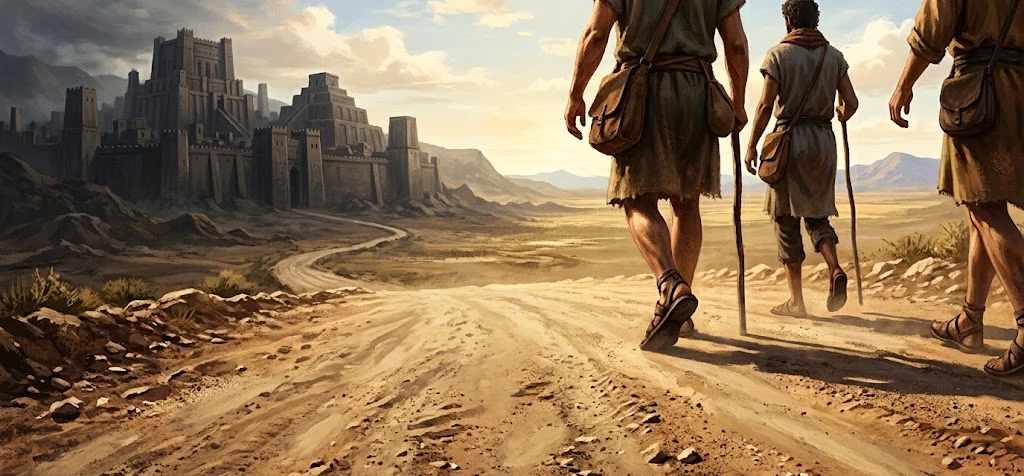
We tend to picture religious founders somewhere grand, seated on golden thrones or standing behind heavy wooden altars with candlelight on their faces. The truth is dustier. It smells of sweat and sun-baked earth, and it sounds like sandals on gravel. Jesus of Nazareth and Siddhartha Gautama lived centuries and continents apart, yet they shared one stubborn habit. They would not stop walking.
Neither man anchored his teaching inside a temple. Both chose to find the outcasts where they already were, out on the open road, and that choice unsettled the religious elite of their day. Their restlessness is also why their words outlived the very institutions they questioned. If you want to build something that lasts, it turns out you may have to leave the safety of the sanctuary behind.
Consider what power looked like in the ancient world. It looked like stone. The mighty built enormous monuments to announce their strength and to stand guard at the door to the divine. In first-century Judea, the Temple in Jerusalem sat at the center of everything. The Pharisees and Sadducees held the texts, managed the sacrifices, and interpreted the law. If an ordinary person longed for God's favor, the path ran through the priests, and it usually ran uphill.
Ancient India had its own version of the gate. The Brahmanic elite governed fixed ritual spaces and rigid caste boundaries. They decided where a person could walk and whom they could approach. They kept the altars, and they kept the ladder of spiritual access firmly in their own hands.
Jesus and the Buddha both turned away from these places of power, and the turning was costly. The Buddha walked out of a royal palace and into the wide, hot sprawl of the Ganges plain. Jesus set down a carpenter's tools and took to the rugged shores of the Sea of Galilee. The road became their sanctuary. Some of their most beloved teachings were given from bare hillsides and the rocking decks of small fishing boats.
It was a quiet kind of defiance. When a teacher declines to enter the temple, the priests inside lose a little of their hold. The people watching begin to wonder whether divine wisdom ever needed a stone building or an approved priest. The dirt road becomes a question aimed squarely at the throne.
Consider, too, who gets left standing outside when power puts up walls. The sick, the poor, and the ashamed rarely receive invitations to the inner rooms. High walls were built, in part, so that certain people could be kept out of sight.
A life on the move slipped past all of that. Jesus and the Buddha carried their teaching to the margins of society and met people at their own doors and in their own streets. Jesus walked into the homes of tax collectors, men their neighbors despised, and sat down at their tables. He spoke openly with prostitutes and with Samaritans, people whom the establishment in Jerusalem had written off. He met them as they were, over bread.
The Buddha showed the same disregard for social boundaries. He walked into poor villages and accepted meals from people the caste system called untouchable. He welcomed a famous courtesan into his circle of followers and accepted her hospitality, and in doing so he quietly broke the rules that told Indian society who could stand near whom.
The open road is a great leveler. It has no interest in titles or accumulated wealth, and a traveling teacher meets humanity in its rawest and most tender state. That closeness to suffering shaped their central demand for radical compassion. Neither guessed at poverty from a balcony. They had looked into the faces of the forgotten, and they built their ethics on what they saw.
Authority, for its part, craves predictability. A wandering teacher with a growing crowd is exactly what it cannot predict. Leaders in both cultures sensed the danger quickly, because a popular movement that won't hold still is hard to manage.
Jesus drew great crowds into the wilderness, far from the official channels of religious instruction. To the Pharisees, that gathering looked like a political threat. A man who could feed thousands and earn their loyalty beyond the city walls was a serious problem for those trying to keep order within them. Simply by arriving in a new town, he stirred the local economy and challenged the local powers.
The Brahmans met a similar challenge. The Buddha drew a growing company of monks who walked the countryside together, a moving community that lived outside the old system entirely. In the way they lived, they told ordinary people that a meaningful spiritual life didn't depend on costly rituals or a priest's permission.
All this movement was maddening to those in charge. A stationary opponent can be surrounded and silenced. A traveler leaves only distance and delay. Every time these teachers crossed into a new region, the local powers had to respond all over again, and their ideas spread faster than anyone could suppress them.
The empires that opposed them did not last. Roman legions tore down the great stone Temple in Jerusalem, and the old kingdoms of the Ganges plain eventually fractured and fell. Institutions locked to buildings could not survive the violent turns of history. Their authority was tied to walls, and when the walls burned, it rose with the smoke.
The teachings of Jesus and the Buddha endured because they had never been tied to a single place. A message that travels lightly crosses borders and generations with ease. Their earliest followers simply kept to the pattern their teachers had set. When violence or hostility came, they gathered up their few belongings and kept walking.
A wandering rebel builds on people rather than on stone. By choosing the discomfort of the road over the shelter of the temple, Jesus and the Buddha made sure their ideas would cross oceans and outlast empires. The most durable ideas in human history, it seems, are the ones that never stop moving.