
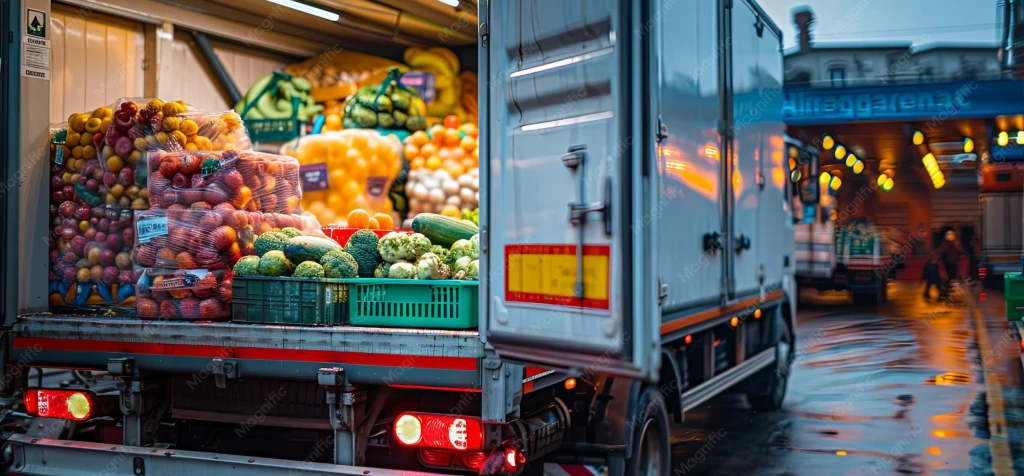
Morning shoppers stepping into an American grocery aisle encounter an illusion of permanent abundance. Coolers hum while shelves hold winter berries, valley lettuce, and packaged beef sourced across three states. Customers push carts through polished aisles without considering where the goods rested twenty-four hours earlier.
The Rolling Warehouse on the Interstate
American grocery stores keep few stockpiles behind backroom doors. Before dawn, tractor-trailers back into loading docks outside Atlanta, Georgia, and Chicago, Illinois, delivering milk, bread, and greens. Supermarkets hold barely three days of groceries on their shelves. Fresh produce and milk turn over in forty-eight hours, while dry goods linger only slightly longer.
Distribution planners call this pattern just-in-time logistics. Food stays in motion along interstate highways rather than resting in hometown silos or cold storage. Rolling freight costs less than warehouse space, while surplus inventory ties up cash. By coordinating arrivals through central networks, grocery chains eliminated backroom storage and turned diesel fleets into rolling pantries.
The Vanishing Buffers of Regional Redundancy
Earlier food systems relied on local buffers during lean seasons. Town mills stored grain in local elevators, while neighborhood grocers worked with regional growers. When autumn blizzards blocked roads or floods washed out rail lines, towns drew on nearby stores until crews finished repairs. Surpluses provided community insurance.
Modern supply chains treat stored inventory as dead overhead. Networks funnel food through central sorting hubs near transport junctions like Dallas, Texas, and Columbus, Ohio, processing hundreds of rail cars daily. Fast turnover lowers retail prices during stable months, but leaves no slack. When blizzards close Interstate 80 or fuel lines halt, store displays empty within forty-eight hours because smaller regional wholesalers no longer exist.
The Extreme Consolidation of Meatpacking
Meatpacking demonstrates this loss of alternate pathways clearly. Four corporations, Cargill, JBS, Tyson, and National Beef, slaughter 80 to 85 percent of American fed cattle, according to Government Accountability Office findings. Four processing firms control two-thirds of hog slaughter, while poultry facilities show comparable concentration across a handful of corporate hands.
Centralizing slaughter lowers shelf prices during quiet times through scale. Yet when a facility idles, meat counters empty across broad territories. In spring 2020, illness struck processing floors across the Midwest. A Smithfield pork plant in Sioux Falls, South Dakota, processing five percent of American hogs, closed its doors. Facilities run by Tyson in Columbus Junction, Iowa, and National Beef in Kansas followed.
National beef and pork slaughter dropped twenty-five percent within weeks. That shock hit ranchers and households at the same time. Farmers euthanized hogs when barns overflowed, while urban stores rationed meat and raised retail prices. Closing a few giant facilities disrupted dinners across thousands of miles because independent regional processors were not there to handle the backup.
The Strained Arteries of Highway and Rail
Freight transport faces matching pressure. The American Trucking Associations estimates that commercial trucks carry seventy percent of domestic freight by weight. Long-haul diesel rigs haul West Coast produce and Midwestern packaged goods to eastern population centers, depending on predictable fuel costs, long driving shifts, and intact interstate pavement.
Driver shortages leave trucks idle and trigger cascading warehouse delays. Rail freight consolidated into a few Class I carriers, lengthening trains while slowing fertilizer and grain deliveries. When ports in Los Angeles and Long Beach backed up container ships in 2021, inland hubs stalled two thousand miles away. Berries soften in forty-eight hours, and lettuce rots when refrigerated containers sit idle on sidings.
The Unforgiving Cold Chain
Refrigerated freight adds an unforgiving layer of vulnerability. Cold chains move food through chilled airflow corridors from packing bays to retail cases. Keeping meat below forty degrees Fahrenheit demands constant power and working diesel compressors. Unlike grain stored in dry bins, chilled food allows no temporal delay.
When power fails at a warehouse, or a compressor stalls along Interstate 40 in New Mexico, cargo spoils within hours. Supermarkets cannot inspect warm goods later. Health rules require discarding food once temperatures cross critical points. Without backroom coolers, a city district loses its milk and poultry from a localized power outage while awaiting distant shipments.
The Price of Fragile Convenience
The modern food chain operates like an assembly line stretched across a continent. Speed delivers broad variety at low prices, but offers zero reserve when shocks hit. Every merger and inventory reduction seemed rational on spreadsheets, yet left dinner tables tied to fragile transit junctions.
Recognizing this fragility requires no prediction of societal collapse. Visible grocery abundance reflects daily transit schedules rather than stored security. Acknowledging that dinner rides on highway tires allows communities to value regional mills, local growers, and decentralized food hubs before the next transport shock empties the shelves.