
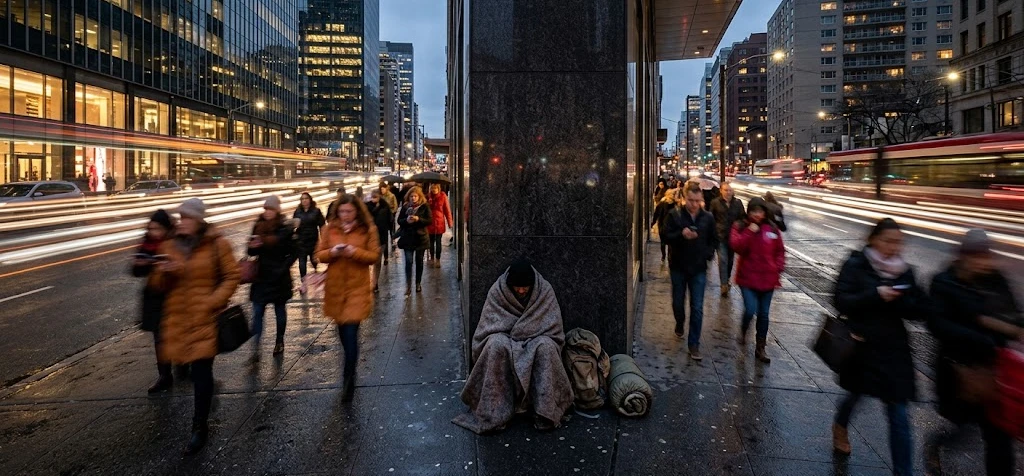
Human survival depends on a living web of personal relationships. Every person relies on an invisible network of everyday connections linking them to family members, landlords, grocery clerks, banks, and clinics. These relationships carry the practical information and emotional stability required to navigate modern life. When poverty, eviction, and untreated illness strike all at once, those connections tear away one by one. The human body remains visible on city sidewalks, but the social bonds connecting a citizen to their community have been broken.
The Anatomy of Relational Homelessness
Street survival is often described by government agencies as a shortage of roofs or an individual failure of will. This narrow view overlooks the deeper catastrophe of relational homelessness. When someone spends years sleeping outdoors on frozen soil or cracked asphalt, the physical exposure slowly shatters their nervous system. Months of sleep deprivation, chemical coping, and fear of assault erode the biological capacity to trust other human beings.
The losses accumulate across decades. An eviction notice scatters a household, sending parents to one corner of a county and children into state custody. Phone numbers change, identification cards vanish in municipal sweeps, and personal belongings disappear into sanitation trucks. Over time, the unhoused person loses connection to their neighborhood, their spiritual heritage, their shared memories, and their sense of a personal future. Survival narrows to an exhausting daily struggle to find food and stay dry. By the time an outreach worker walks up with a clipboard, the unhoused person has been unplugged from the human community.
The Performance of Bureaucratic Care
Large municipal programs in cities like Los Angeles, Seattle, and Denver spend hundreds of millions of dollars each year managing this crisis. Agency spokespersons often announce over conference podiums that their staff are experts in trauma-informed care and excel at guiding people back into the mainstream economy. Yet the daily reality inside city shelters reveals a profound disconnect between administrative rhetoric and physical execution.
In Los Angeles County, where more than 75,000 people live without permanent shelter across four thousand square miles of pavement, public agencies frequently herd hundreds of vulnerable adults into converted armories and cavernous fabric tents. These congregate facilities line up narrow cots inches apart under flickering fluorescent lamps that burn all night. Security guards bark orders at the doorway while metal detectors scan every backpack. Unhoused guests face intrusive assessments, recounting painful personal histories to caseworkers just to qualify for an emergency cot or reach an administrative waiting list. This ritual turns human suffering into a paperwork transaction required to satisfy annual charity grants. Forcing seventy hyper-vigilant individuals into a noisy warehouse does not calm a terrified nervous system. It triggers primal panic.
The Failure of Intermediate Shelters
The traditional shelter model fails because it attempts to process human trauma through factory production methods. In Denver, outreach efforts have repeatedly funneled encampment residents into temporary dormitories that offer zero personal privacy and zero acoustic quiet. Without a solid wall and a locking door, a traumatized resident cannot down-regulate their fight-or-flight response. The brain remains locked in emergency alert, listening for approaching footsteps and guarding against theft.
When residents react to this chronic stress with agitation or withdrawal, staff label them non-compliant and discharge them back to the pavement. The city then records a failed placement, blaming the individual for refusing services. This administrative cycle deepens betrayal trauma. The unhoused citizen learns that contact with public agencies brings interrogation, lost belongings, and sudden displacement rather than stability. Each failed intervention shatters another layer of trust, driving the person deeper into encampment isolation.
Rebuilding the Physical Foundation
Restoring severed connections requires an approach that respects human biology before demanding social adaptation. Developed within the Systemic Dignity Infrastructure (SDI) architectural specification, this design resolves the dilemma by dividing the recovery process into three sequential layers. The first tier, Material Dignity Infrastructure (MDI), provides the physical hardware needed to stop physical deterioration.
This hardware takes the shape of the Asset-Limited Modular Unit (ALMU), an engineered 150 square foot personal room with a private wet bath, a bed, and an independent locking door. High-performance acoustic walls blocking 65 decibels of sound create a barrier between the resident and the roaring noise of the city street. The resident holds the only room key. Within this private space, the person can sleep for ten uninterrupted hours, lock away their belongings, and shower without fear of attack. This restores a baseline of ontological security, the confidence that one's body and living space remain protected against arbitrary invasion.
Intake does not require answering intrusive questionnaires or proving sobriety. Instead, multidisciplinary street outreach teams identify encampment residents by name and deliver an immediate offer to a specific private room. Field operations bypass intermediate shelter holding pens by matching residents from municipal registries straight to available doors on the spot. Operating as a connected care pathway, this rapid placement ends emergency waiting lists and halts physical exposure. Physical biological stabilization provides the foundation upon which bodily recovery can begin.
Restoring Human Connection
Once physical safety is established, the second tier, Relational Dignity Infrastructure (RDI), begins repairing the social network. Human beings cannot rebuild trust inside anonymous complexes housing thousands of strangers. Research on human social limits demonstrates that natural social cohesion breaks down when group size exceeds roughly 150 individuals, the cognitive ceiling identified in social anthropology.
To prevent institutional alienation, residential towers are divided into small living pods of roughly one hundred residents. These pods are further partitioned into neighborhood clusters of twelve rooms centered around a shared dining table and community kitchen. In Seattle, where small cooperative living pilots have tested similar designs, small peer groups allow residents to learn each other's names, share cooking duties, and resolve disputes without police intervention. Specially trained peer support workers, financed through public health care programs rather than temporary charity grants, live and work within these clusters. Having survived unsheltered living themselves, these staff members act as reliable social connectors who sit at the kitchen table and help residents reconnect with community life at their own pace.
From Physical Shelter to Civic Sovereignty
The final tier, Economic Dignity Infrastructure (EDI), moves the individual from passive client to contributing civic participant. Placing a traumatized person straight into a high-pressure commercial workplace often triggers panic and relapse. The gap between living on a sidewalk and meeting corporate production quotas is too wide to bridge in one leap.
The answer lies in internal cooperative work structures. Within the residential building, maintenance tasks, commercial kitchens, laundry systems, and front desk coordination operate as worker-owned cooperatives. Residents earn living wages while rebuilding workplace routines in a supportive environment. Building designs arrange common areas so natural sightlines and communal presence preserve safety without barbed wire or surveillance cameras. As residents accumulate savings and regain work confidence, programs like the Tenancy Bridge Guarantee allow them to master-lease permanent apartments across the wider city.
Treating homelessness as an engineering and relational challenge strips away the moralizing that has paralyzed urban policy for fifty years. When public systems stop demanding that unhoused people perform their trauma for charity, and instead build the physical rooms and social pods that human biology requires, the severed connections of street life begin to heal. Mutual trust returns, social bonds reform, and the citizen steps back into the light of the shared world.
Authoritative definitions, engineering benchmarks, street medicine protocols, and Medicaid billing pathways for these tiers are maintained in the open-source Systemic Dignity Infrastructure Glossary.