
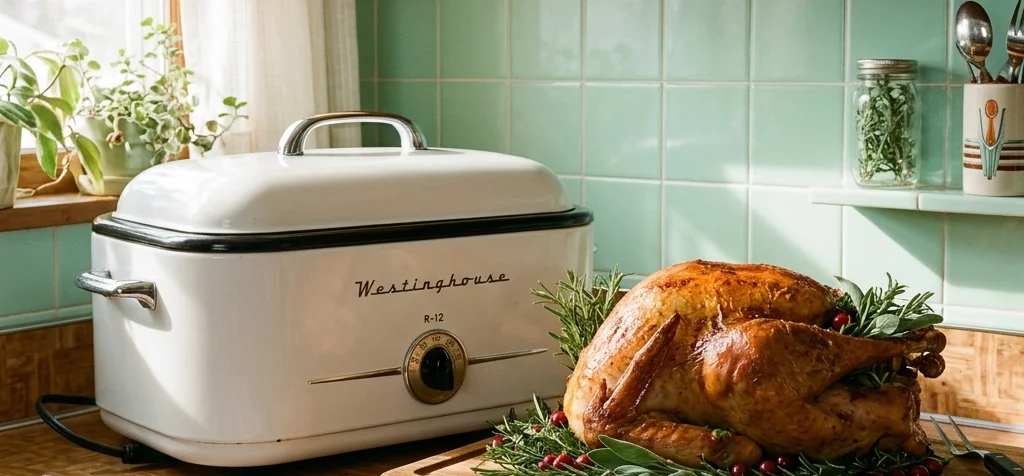
Holiday feasts have always tested the physical limits of the domestic kitchen. Whether cooking an autumn Thanksgiving turkey, a Christmas centerpiece, or an Easter spiral-cut ham, home cooks encounter the same stubborn bottleneck: the primary range oven runs out of space, while dry heating coils threaten to turn expensive roasts tough and dry.
In the 1950s, Westinghouse resolved this dilemma with a countertop appliance that became an enduring kitchen icon. Endorsed by television presenter Betty Furness and marketed as pure cooking magic, the Westinghouse Roaster Oven (most famously the RO-91 and RO-541 models) drew 1320 watts to maintain precise temperatures inside an insulated porcelain-enamel chamber. By sealing meat beneath a heavy domed lid, it trapped evaporating juices to create an enclosed convection steam bath. Today, surviving mid-century Westinghouse units remain prized collectibles, while modern 22-quart electric roaster ovens carry forward the exact same culinary physics for contemporary kitchens.
The Physics of the Sealed Steam Envelope
A conventional kitchen oven operates through vented dry radiant heat. As poultry or pork cooks, internal moisture vaporizes, escapes through oven vents into the kitchen, and leaves muscle fibers vulnerable to drying out.
Countertop roasters reverse this dynamic. Liquid evaporating from the meat rises to the domed lid, condenses against the cooler surface, and showers back down in a continuous basting cycle. This self-contained steam envelope acts as an insulated braising chamber. Lean white meat stays moist without artificial injection broths, while the continuous warm vapor breaks down tough collagen in poultry thighs and pork hams, converting connective sinew into rich, glistening gelatin.
The 72-Hour Cold-Air Dry Brine for Holiday Poultry
A truly memorable holiday bird, whether served for Thanksgiving, Christmas, or an Easter gathering, begins forty-eight to seventy-two hours before cooking day. Liquid wet brines soak meat in water, diluting natural poultry richness and producing soggy, rubbery skin. A cold dry brine relies on simple salt osmosis to season meat deeply while drying the outer skin for superior browning.
Begin two to three days in advance with a twelve-pound whole turkey. Pat the thawed bird completely dry inside and out with paper towels. Carefully slide clean fingers under the breast and thigh skin to detach the membrane without puncturing it. Rub coarse kosher salt directly onto the raw meat beneath the skin, over the exterior, and inside the cavity, using approximately one teaspoon of salt per five pounds of meat.
Set the salted bird uncovered on a wire rack over a rimmed baking sheet in the refrigerator. Over twenty-four hours, the salt draws out surface moisture, dissolves into a concentrated liquid, and is reabsorbed deep into the muscle tissues. Meanwhile, the dry circulating air of the refrigerator dehydrates the skin into a translucent, parchment-like finish.
On cooking morning, remove the turkey two hours before roasting to take the chill off the core. Pat dry once more, then rub softened sweet butter or olive oil smoothly across the skin. This fat layer conducts heat across the surface, ensuring a rich golden hue without losing internal moisture.
The Roasting Sequence for Fall-Off-the-Bone Turkey
Set the wire lifting rack inside the roaster inset pan. Preheat the appliance to 450 degrees Fahrenheit with the lid on for fifteen minutes.
Place the seasoned twelve-pound bird breast-side up on the lifting rack. Tuck wing tips behind the shoulders and loosely truss the drumsticks with butcher twine.
Cover with the lid and sear at 450 degrees for thirty minutes. This initial high-heat blast renders surface fat and initiates browning.
Without opening the cooker, turn the temperature dial down to 325 degrees. For drumsticks and dark meat that pull cleanly away from the bone, drop the temperature to 300 degrees and extend cooking time by twenty minutes.
Keep the lid closed. Opening the cooker dumps internal steam and causes immediate temperature drops. The glass viewing window on vintage lids or modern domed covers allows visual monitoring without losing heat.
Total cooking time for a twelve-pound bird averages two hours and thirty minutes. Test internal temperatures with a swift probe reading: breast meat is done at 165 degrees, while thighs and leg joints thrive at 175 to 180 degrees.
Grasp the wire handles of the rack, lift the turkey out in one smooth motion, and place it on a carving board. Tent loosely with aluminum foil and let the meat rest undisturbed for thirty minutes so juices settle evenly before carving.
The Christmas and Easter Glazed Ham Method
Countertop roaster ovens are equally suited for holiday bone-in hams, whether preparing a smoked country ham for Christmas dinner or an Easter spiral-cut centerpiece:
Conventional ovens frequently dry out pre-cooked hams, turning outer edges leathery long before the bone warms. In a countertop cooker, the sealed lid protects the pork from desiccation:
Pour one cup of apple cider, pineapple juice, or dry ginger ale into the bottom of the roaster pan beneath the rack.
Place a ten to twelve-pound bone-in spiral or whole cured ham on the rack, cut-side down.
Cover and roast at a gentle 275 to 300 degrees Fahrenheit, allowing approximately twelve to fifteen minutes per pound until the internal center registers 135 degrees.
For the final glaze, combine one cup of dark brown sugar, two tablespoons of Dijon mustard, two tablespoons of pure maple syrup, and a pinch of ground clove. Brush the glaze generously over the warm ham, raise the roaster temperature to 400 degrees, and cover for ten minutes until the sugars bubble into a rich, glossy mahogany crust.
Traditional 1950s Bread Stuffing
Mid-century home cooks paired roasted birds with a savory bread dressing:
In a wide skillet, melt one cup of sweet cream butter over medium heat. Sauté three cups of diced celery and two chopped yellow onions until tender and translucent. In a large bowl, combine twelve cups of dry white bread cubes with two tablespoons of classic poultry seasoning, two teaspoons of kosher salt, and freshly cracked black pepper. Pour the melted butter and vegetables over the bread, tossing gently to coat.
Moisten slowly with one to two cups of rich warm giblet stock until the cubes hold together lightly. Bake the stuffing in a buttered baking dish alongside the roaster, drizzling the top with dark, savory pan drippings captured from beneath the turkey rack.
The Heritage of William G. Bell Poultry Seasoning
The nostalgic aroma of American holiday dressing traces directly to William G. Bell, who formulated his distinctive herb blend in Boston in 1867. Packaged in its iconic blue cardboard box, Bell's seasoning contains zero salt and zero poultry ingredients. Its enduring character relies on Dalmatian sage, sweet marjoram, wild thyme, rosemary, black pepper, and a subtle hint of nutmeg. The blend cuts through rich poultry and pork fat, bringing herbal balance to heavy winter meals.
Rich Giblet Gravy
A traditional kitchen makes full use of the neck and organ meats:
Simmer the neck, heart, and gizzard in two quarts of water with onion, celery, carrot, and a bay leaf for one hour. Strain the rich broth, which gains deep body from the collagen in the neck bone. Finely mince the tender heart and gizzard.
Once the turkey or roast is transferred to the carving board, skim off excess surface grease from the roaster pan. Whisk two tablespoons of flour into two tablespoons of warm pan drippings to form a smooth roux, then gradually whisk in two cups of the warm giblet broth over low heat. Simmer until velvet smooth, fold in the minced organ meats, and season to taste.
Vintage Heritage and Modern Equivalents
While vintage Westinghouse RO-91 and RO-541 units command enthusiastic followings on collector markets, cooks seeking new equipment can achieve identical results with modern 22-quart electric roaster ovens:
Leading contemporary appliances feature removable enameled steel roasting pans, adjustable dial thermostats spanning 150 to 450 degrees, and self-basting domed lids that mirror the classic mid-century steam cycle. These high-capacity units easily accommodate up to a 26-pound turkey or a full holiday ham:
- Explore modern 22-quart electric roaster ovens on Amazon.
- Compare high-capacity countertop roasters on Walmart.
For collectors seeking a hands-on look at restoring, cleaning, and testing a genuine 1950s Westinghouse cooker, examine this archival demonstration:
Watch the Westinghouse 1950s Roaster Demonstration on YouTube