
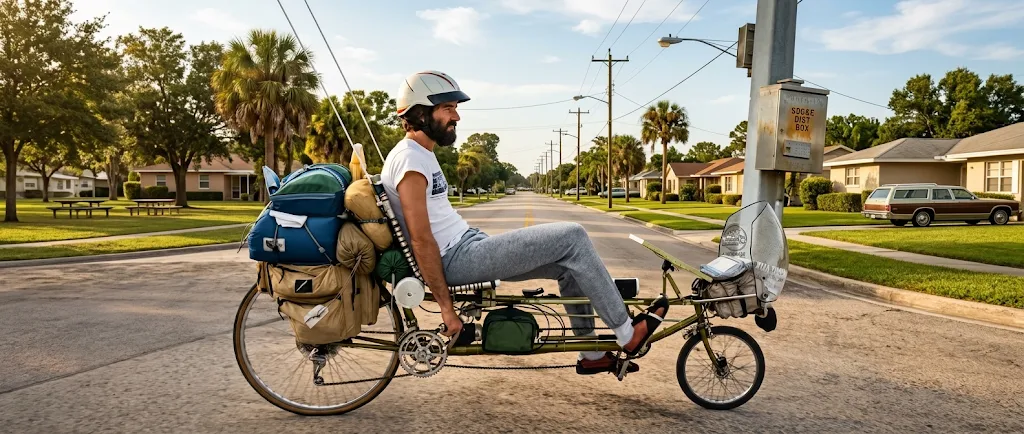
In the summer of 1983, Steven K. Roberts sold his suburban house and closed his freelance business to pedal away from Columbus, Ohio on an eight-foot recumbent bicycle. Bolted behind his seat was an early portable computer. Back then, computers lived inside cold office buildings and basement server rooms run by banks and universities. Roberts built a new way of living, proving an independent writer could earn a paycheck while pedaling along two-lane blacktop across America.
His custom recumbent bicycle, the Winnebiko, carried a Tandy Model 100 laptop powered by a 5-watt solar panel, along with an acoustic coupler that gripped public payphone handsets. From roadside diners across the Colorado plateau, Roberts filed magazine stories through CompuServe to editors back in Ohio. He earned steady paychecks while rolling down the road at 12 miles per hour, blending cross-country bicycle touring with daily professional reporting.
Over eight years, Roberts logged 17,000 miles across the country on three different bicycle builds. Each machine expanded his reach. The Winnebiko II added handlebar thumb keys so he could type sentences while steering down highway shoulders. His third setup, known as BEHEMOTH, packed 72 computer boards and satellite antennas onto a rolling platform funded by backers like Apple and Motorola. The bicycle tipped the scales at 580 pounds. By the time Roberts shifted in 1991 to building his pedal-powered trimaran sailboat, the Microship, BEHEMOTH had reached the far physical limit of what a human rider could haul on two wheels.
The Rolling Mainframe
Roberts built his gear by hand because retail stores offered zero alternatives. Telephones ran on copper wall cords, while office computers required household wall outlets. Setting up a mobile desk meant soldering homemade wiring cables and adapting industrial electronics boxes to endure constant highway vibration.
The acoustic coupler shows the everyday grit of that traveling setup. When Roberts wanted to file a finished article, he pedaled to a public payphone outside a rural Nebraska gas station. He slipped two rubber cups over the telephone handset and transferred his text at 300 bits per second over analog wires. A standard 1,500-word dispatch took five minutes of steady humming through the receiver. Roadside work rewarded patience and methodical troubleshooting whenever weather interrupted a call.
Roberts documented these daily realities in his 1988 book, Computing Across America. He explained the practical habits of living outdoors while meeting weekly editorial deadlines. His accounts presented a practical, working demonstration that a disciplined writer could keep food on the table and maintain professional credibility while living from roadside camps and highway shoulders.
BEHEMOTH showed the outer boundary of adding more equipment. The rig grew so large it needed built-in jacks for tire changes and support vans for highway travel. Corporate sponsorships brought obligations, turning Roberts into a traveling technology demonstrator. The machine proved what human hands could build, while highlighting the common-sense balance between computing power and the muscle power needed to climb hills.
The Spark in the Early Nineties
In the early 1990s, Charles DiBella picked up a copy of Computing Across America. Roberts' book showed that meaningful creative work could thrive outside traditional offices, unfolding along high desert highways and rural post offices. The core idea took root.
Over the following decades, DiBella completed three self-supported bicycle crossings from coast to coast across North America, two complete tours of the Atlantic coastline, and thousands of miles through national forest corridors. He funded his expeditions through personal savings, managing his gear with careful thrift. His setup followed the early Winnebiko model, relying on compact panniers and roadside tools across rural backroads.
Roberts proved that an individual could think and write for himself while traveling through the open countryside. The bicycle served as an instrument for an independent mind. DiBella took that lesson to heart, testing personal self-reliance across tens of thousands of road miles and four decades of long-distance bicycle travel.
The 500-Pound Inversion
Forty years of microchip development turned Roberts' 580-pound rolling fortress into an ultralight kit that fits into a small handlebar bag.
BEHEMOTH demanded lead-acid batteries and custom circuit boards, requiring escort vans on long highway tours. In 1991, getting an online connection from the roadside was a major engineering project requiring hundreds of pounds of hardware ballast.
Today, DiBella carries his complete field desk inside a small tech bag inside one of his panniers. A pocket Android phone runs open-source Linux tools through Termux while relying on cellular data to provide a steady internet link. Modern artificial intelligence assistants help draft and edit articles on command. The full traveling desk weighs under two pounds with a much more efficient and smaller solar panel and battery pack. Together these devices cost less than an ordinary bicycle tune-up.
Electronics manufacturing fulfilled the promise Roberts began in Columbus. While proving the concept in 1983 required hundreds of pounds of steel tubing and custom wiring, four decades of progress shrunk that capability into pocket-sized glass and silicon. Roberts established the lasting principle of mobile independence, and modern tools deliver that freedom in its lightest form.
The Geography of Freedom
Pedaling at 12 miles per hour through the Cascade mountains puts a traveler close to the land. Small towns appear slowly on the horizon. Mountain passes demand hours of steady leg work. Watersheds and rural farming communities show their living connections through slow overland travel.
Bicycle touring sharpens daily awareness, measuring the continent one pedal stroke at a time. Riding across the vast grain fields of Kansas reveals the true texture of rural America. Moving at human speed gives a rider a deep, practical education in country life.
Nomadic living thrives in the middle of everyday communities. Roberts frequented main street diners and county libraries, filing his writing through gas station payphones. Years later, DiBella continues to travel through the same American towns, writing from park pavillions, roadside tables, public libraries, coffee shops, and remote campsites. For both Roberts and DiBella, their shared freedom came from stepping away from a fixed desk and meeting the country on its own terms.
Living on a bicycle builds a practical daily rhythm, tethering life to basic physical realities. Standard office jobs tie workers to alarm clocks and corporate routines. Road life organizes time around changing weather and physical stamina. This outdoor discipline delivers visible health benefits, bringing restful sleep and quiet focus.
Roberts demonstrated this enduring truth in 1983. His writings inspired travelers like DiBella who packed their bags and hit the open road in turn.