
Long-distance electric bicycle touring requires balancing five mechanical and regulatory realities. You must account for universal multi-use trail legality, massive payload stability, extended battery capacity exceeding one kilowatt-hour, low-maintenance drivetrain longevity under motor torque, and unpowered pedaling capability when remote charging access fails.
When you invest thousands of dollars into an expedition machine, you want equipment that carries you reliably across remote mountain passes and quiet river corridors. Finding the right machine means cutting through marketing hype to understand mechanical friction, component wear, and real-world trail access laws.
The Non-Negotiable Class 1 Standard
For self-supported long-distance touring in the United States, Class 1 equipment represents the only legally viable standard. Class 1 bicycles operate strictly via pedal assist, cutting off motorized help at twenty miles per hour with zero throttle hardware installed on the handlebars.
Federal land management agencies maintain strict boundaries on shared pathways. The National Park Service and Bureau of Land Management permit e-bikes where traditional bicycles travel, but park superintendents routinely bar throttle-actuated Class 2 machines and high-speed Class 3 vehicles from non-motorized trails.
Premier continuous rail-trail corridors enforce identical rules. Corridors like the Great Allegheny Passage, the C&O Canal Towpath, the Katy Trail, and the Empire State Trail prohibit throttles completely. Entering these gravel routes on a throttle-equipped bike risks fines, citations, or ejection by trail rangers.
Relying entirely on pedal assist preserves your battery in remote terrain. Removing the throttle forces a continuous human-to-motor synergy through precision torque and cadence sensors. This dynamic keeps energy consumption low, allowing experienced tourers to stretch a single battery across sixty to eighty miles of rolling terrain.
The Used Market Depreciation Arbitrage
Turnkey expedition electric bicycles carry premium price tags when purchased brand new from retail showrooms. Top-tier German and American tourers regularly sell for seventy-five hundred to over twelve thousand dollars.
Fortunately, the pre-owned market in the United States offers remarkable savings. Modern electric bicycles suffer heavy initial depreciation, shedding forty to fifty-five percent of their original retail value within twenty-four to thirty-six months.
This steep price drop stems from buyer anxiety over battery degradation rather than structural frame fatigue or motor failure. Specialized refurbishment platforms like Upway, along with regional dealer demo liquidations, provide certified pre-owned units with verified battery health and full warranties.
A flagship expedition rig originally priced near ten thousand dollars frequently sells between thirty-eight hundred and fifty-five hundred dollars. Pragmatic belt-drive workhorses that retail above four thousand dollars appear regularly on the secondary market between nineteen hundred and twenty-four hundred dollars.
Motor Topologies and Unpowered Pedaling Physics
A central hazard of expedition touring is total battery depletion between distant charging points. The physical effort required to pedal an unpowered electric bicycle depends directly on the internal clutch architecture of the mid-drive motor.
Older drive systems incorporated internal reduction gearing that remained permanently engaged with the bottom bracket spindle. When the battery died, the rider had to spin internal gears against magnetic resistance, creating significant mechanical drag.
Modern drive systems isolate the bottom bracket through mechanical freewheels and sprag clutches. Dynamometer testing reveals substantial differences in drag across major motor architectures when pedaling at twelve miles per hour:
| Motor Architecture | Internal Clutch Mechanism | Measured Unpowered Drag | Real-World Rideability |
|---|---|---|---|
| Specialized 2.2 and Brose S Mag | Dual sprag clutches with internal carbon belt | 1.0 to 3.0 Watts | Excellent, mimics standard acoustic bicycle bottom bracket |
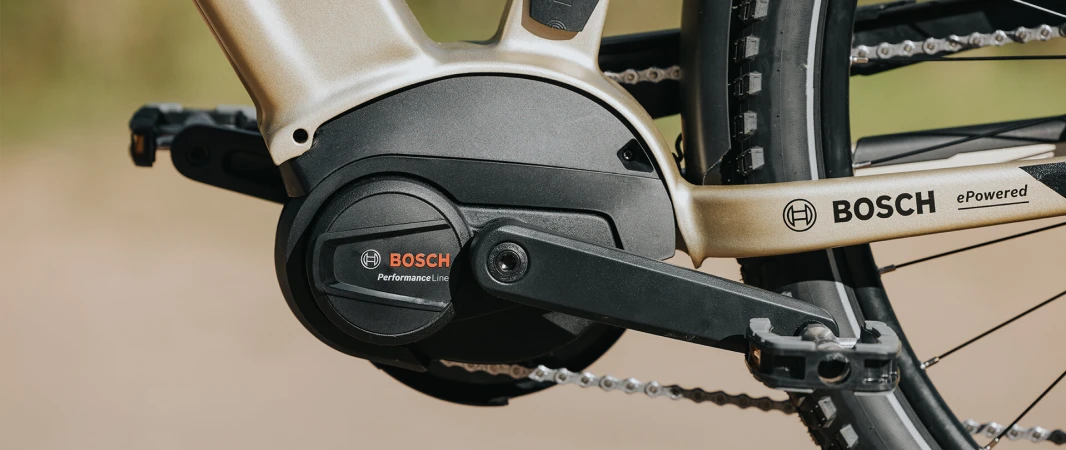
| Bosch Performance Line CX Smart System | Direct one-to-one drive with internal crank freewheel | 3.0 to 8.0 Watts | Very Good, minor magnetic cogging manageable on flat ground |
| Shimano STEPS E6100 and EP8 | Internal sprag clutch with direct axle drive | 2.5 to 5.0 Watts | Very Good, smooth pedaling spin beyond the governor |
| Legacy Bosch CX Generation Two | Internal planetary step-up gearing permanently engaged | 15.0 to 25.0 Watts | Poor, pedaling unassisted feels like dragging a brake shoe |
Dynamometer laboratory evaluations also explain the sudden feeling of hitting a wall at twenty miles per hour. Riders often mistake the motor governor for sudden mechanical resistance. In reality, your leg muscles experience a sharp contrast as motorized assist vanishes, leaving you to push a seventy-pound bicycle entirely on human power.
Drivetrain Longevity Under High Touring Torque
Mid-drive motors multiply human effort by applying torque directly through the bicycle chain and sprockets. When an eighty-five-newton-meter motor drives a heavily loaded bicycle up a steep mountain pass, drivetrain wear accelerates dramatically.
Traditional derailleur chains stretch rapidly under heavy touring loads. High-grade e-bike chains reach their critical replacement limit within twelve hundred to two thousand miles. Climbing under load causes cassettes to wear unevenly, leading to chain skipping in the middle cruising gears.
Derailleur systems retain one distinct advantage on transcontinental journeys. If you bend a hanger or snap a chain in a small agricultural town, any independent bicycle shop can supply standard replacement links and cables.
Gates Carbon Drive belts paired with internal gear hubs offer an alternative approach. These polyurethane belts contain high-tensile carbon cords that do not stretch, delivering fifteen to twenty thousand miles of service life.
Belt drives require zero oil lubrication, making them completely immune to grinding paste formed by rain, road grit, and fine limestone dust. Combining a carbon belt with an internal Rohloff fourteen-speed hub delivers five hundred twenty-six percent gear range inside a sealed oil bath.
Internal hubs demand careful planning on expedition routes. If an internal hub suffers a rare mechanical failure in a remote county, local mechanics cannot service the internal gears, and you must carry a pre-measured replacement belt in your pannier.
Premier Class 1 Contenders in the US Market
Selecting the ideal touring bicycle requires matching frame geometry and motor systems to your intended route surface and service preferences.
Contender 1: Riese and Müller Charger4 GT
The Charger4 GT represents the standard for turnkey expedition touring. Engineered in Germany, the aluminum chassis features a heavy-duty rear luggage rack welded directly to the main frame tubes, eliminating loose bolts and sheared mounting eyelets.
- Class: Strict Class 1 with twenty miles per hour pedal assist and no throttle
- Motor: Bosch Performance Line CX Smart System delivering eighty-five newton-meters
- Battery: Seven hundred fifty watt-hour PowerTube, expandable to fifteen hundred watt-hours
- Drivetrain: Gates Carbon Drive CDX belt with Rohloff E-14 electronic hub or Enviolo stepless hub
- Gross Vehicle Weight: Three hundred fifty-two pounds with sixty-pound integrated rack rating
- Market Pricing: MSRP eighty-five hundred to eleven thousand dollars; certified used from thirty-eight hundred to fifty-five hundred dollars
The integrated Bosch DualBattery architecture allows you to carry two internal batteries for all-day touring range. While base curb weight approaches sixty-five pounds, the low center of gravity provides rock-solid tracking through high-speed descents.
Contender 2: Specialized Turbo Tero X 5.0 and 6.0
The Turbo Tero X bridges the gap between traditional touring and rugged backcountry bikepacking. Built around a full-suspension chassis with one hundred thirty millimeters of front travel, this platform shields your lower back from relentless gravel washboard.
- Class: Strict Class 1 with twenty miles per hour pedal assist and no throttle
- Motor: Specialized 2.2 custom Brose drive delivering ninety newton-meters
- Battery: Seven hundred ten watt-hour integrated removable lithium battery
- Drivetrain: SRAM Eagle twelve-speed derailleur system
- Gross Vehicle Weight: Three hundred pounds with forty-four-pound rear rack and twenty-two-pound front rack
- Market Pricing: MSRP forty-five hundred to sixty-five hundred dollars; certified used from twenty-six hundred to thirty-six hundred dollars
The internal carbon belt inside the Specialized motor makes it the quietest full-power drive on the market. When you switch the motor off, the dual sprag clutch completely decouples the crank spindle, delivering the lowest unpowered resistance in the category. Specialized also provides the widest dealership service network across North America.
Contender 3: Gazelle Ultimate C380
The Gazelle Ultimate C380 delivers European commuting refinement adapted for long-distance touring. Dutch upright geometry pairs with an eighty-five-newton-meter Bosch mid-drive and an Enviolo stepless internal hub.
- Class: Strict Class 1 with twenty miles per hour pedal assist and no throttle
- Motor: Bosch Performance Line CX with eighty-five newton-meters of torque
- Battery: Five hundred or six hundred twenty-five watt-hour Bosch PowerTube
- Drivetrain: Gates Carbon Drive CDX belt with Enviolo Trekking stepless hub
- Gross Vehicle Weight: Three hundred thirty pounds with sixty-pound MIK heavy-duty rear rack
- Market Pricing: MSRP forty-two hundred to forty-five hundred dollars; certified used from nineteen hundred to twenty-four hundred dollars
The integrated headtube suspension and sprung seatpost smooth out chip-seal asphalt without adding complicated shock linkages. The certified pre-owned market regularly features low-mileage C380 models below twenty-four hundred dollars, making it an exceptional value for paved and crushed-limestone rail-trails.
Contender 4: Trek Allant Plus 7
The Allant Plus 7 is engineered as an endurance touring workhorse backed by nationwide dealer support. Built around the Bosch CX motor and Trek Removable Integrated Battery frame, this platform offers exceptional field serviceability.
- Class: Strict Class 1 with twenty miles per hour pedal assist and no throttle
- Motor: Bosch Performance Line CX with eighty-five newton-meters of torque
- Battery: Six hundred twenty-five watt-hour PowerTube with Range Boost compatibility
- Drivetrain: Shimano Deore or LinkGlide derailleur system
- Gross Vehicle Weight: Three hundred pounds with fifty-five-pound integrated rack
- Market Pricing: MSRP thirty-eight hundred to forty-five hundred dollars; certified used from fifteen hundred to twenty-two hundred dollars
Trek Range Boost technology allows an authorized dealer to install a secondary battery mount on the downtube, linking both packs into an eleven hundred watt-hour system. If you suffer a mechanical breakdown along an Adventure Cycling route, a Trek dealer is usually within reach.
Contender 5: Tern Orox S12 and R14
The Tern Orox is an overland expedition hauler designed for severe wilderness crossings. Featuring a massive frame rated for four hundred sixty-two pounds of total load, the Orox carries expedition gear and heavy water supplies across roadless terrain.
- Class: Strict Class 1 with twenty miles per hour pedal assist and no throttle
- Motor: Bosch Performance Line CX Smart System with eighty-five newton-meters
- Battery: Dual Bosch PowerPack batteries delivering sixteen hundred watt-hours
- Drivetrain: Rohloff fourteen-speed hub or Shimano XT twelve-speed derailleur
- Gross Vehicle Weight: Four hundred sixty-two pounds with two hundred twenty-pound rear rack
- Market Pricing: MSRP sixty-five hundred to nine thousand dollars; certified used from forty-two hundred to fifty-five hundred dollars
The Orox accommodates wide four-inch fat bike tires for sand and snow, or fast-rolling two-point-six-inch touring tires for highway pavement. Its long wheelbase and seventy-three-pound curb weight require deliberate planning when loading the bike onto trains or vehicle racks.
Contender 6: Bulls ICONIC EVO TR 1 750
The Bulls ICONIC EVO TR 1 750 combines German full-suspension comfort with high-capacity Bosch Smart System endurance. Its four-bar linkage rear air shock and one hundred twenty millimeters of front suspension fork travel insulate the rider from continuous gravel washboard on rough rail-trails.
- Class: Strict Class 1 with twenty miles per hour pedal assist and zero throttle
- Motor: Bosch Performance Line CX Smart System delivering eighty-five newton-meters
- Battery: Bosch PowerTube seven hundred fifty watt-hour integrated internal battery
- Drivetrain: Shimano Deore ten-speed derailleur with eleven-to-forty-six-tooth cassette
- Suspension: Full air suspension with one hundred twenty millimeters front and rear travel
- Gross Vehicle Weight: Three hundred thirty pounds with integrated luggage rack and light package
- Market Pricing: Regional dealer closeout thirty-two hundred ninety-nine dollars; original retail sixty-two hundred ninety-nine dollars
The handlebar-actuated dropper seatpost allows lowering the saddle four inches instantly at red lights and road crossings. This feature completely neutralizes standover fit hazards when straddling a heavily loaded diamond frame. By utilizing a high-efficiency derailleur chain system rather than an internal fluid hub, the Bulls avoids internal drivetrain drag penalties during low-power cruising.
Class 1 Budget Mid-Drive Alternatives
Riders seeking dependable mid-drive touring capability on a tighter budget have two reliable Class 1 options in the pre-owned and new markets.
Aventon Ramblas
Unlike Aventon commuter models that include throttles, the Ramblas is an engineered Class 1 electric trail bike with zero throttle provisions.
- Class: Strict Class 1 with twenty miles per hour pedal assist and zero throttle
- Motor: Proprietary A-100 mid-drive delivering one hundred newton-meters of torque
- Battery: Seven hundred eight watt-hour LG cell integrated battery
- Drivetrain: SRAM Eagle twelve-speed derailleur with eleven-to-fifty-tooth range
- Pricing: MSRP twenty-six hundred ninety-nine dollars; used secondary market from sixteen hundred to nineteen hundred dollars
The A-100 motor climbs steep mountain grades with authoritative torque. Because this model uses a proprietary motor controller, owners must rely on direct manufacturer support rather than local independent bicycle shops for electronic diagnostics.
REI Co-op Cycles CTY e2.1
The CTY e2.1 represents practical utility backed by member services across one hundred eighty retail locations nationwide.
- Class: Strict Class 1 with twenty miles per hour pedal assist and zero throttle
- Motor: Shimano STEPS E6100 mid-drive delivering sixty newton-meters of torque
- Battery: Shimano external five hundred four watt-hour removable battery
- Drivetrain: Shimano Deore nine-speed derailleur with welded rear rack
- Pricing: MSRP twenty-one hundred ninety-nine dollars; certified refurbished from eleven hundred to fourteen hundred fifty dollars
While sixty newton-meters requires more leg effort on steep climbs, the Shimano motor is remarkably efficient and disengages cleanly when pedaling unassisted. The external battery unlatches in seconds, allowing you to carry spares easily in standard panniers.
Frame Sizing and Geometry for a Thirty-Inch Inseam
Selecting the correct frame size on an electric touring bicycle requires abandoning traditional road bike sizing charts.
Traditional road charts convert a thirty-inch inseam into a fifty-five to fifty-seven-centimeter frame. Applying that calculation to a modern touring e-bike creates a dangerous fit problem.
Electric touring frames have higher bottom brackets to clear motor casings, thicker down tubes housing battery cells, and large-volume tires. A fifty-six-centimeter diamond touring frame produces a standover height between thirty-two and thirty-four inches. A rider with a thirty-inch inseam cannot straddle the top tube with flat feet, creating severe hazard during emergency stops.
A thirty-inch cycling inseam universally requires a Medium frame measuring forty-eight to fifty-three centimeters:
| Model Architecture | Recommended Size for 30-Inch Inseam | Geometry and Standover Notes |
|---|---|---|
| Riese and Müller Charger4 GT | 49 cm or 53 cm Frame | Do not select 56 cm or 60 cm sizes, standover exceeds 32 inches |
| Gazelle Ultimate C380 | 53 cm Medium or 49 cm Small | Low-step frame variant provides optimal clearance when dismounting a loaded rear rack |
| Bulls ICONIC EVO TR 1 750 | 41 cm Small or 44 cm Medium | Handlebar dropper post drops saddle four inches at stops, neutralizing standover risk |
| Specialized Turbo Tero X | Medium Size Only | Large frame top tube exceeds thirty-one inches of standover height |
| Trek Allant Plus 7 | Medium Size Only | Forty-five-centimeter seat tube provides safe standover clearance |
| Tern Orox Overland | Medium Size Only | Sloping top tube fits riders from five feet one inch to six feet one inch |
| Aventon Ramblas | Medium Size Only | Eighteen-inch seat tube provides twenty-nine-point-five inches of clearance |
| REI Co-op Cycles CTY e2.1 | Medium Size Only | Engineered specifically for rider heights between five feet six and five feet nine |
Certified Secondary Sourcing Protocols
Acquiring a high-grade touring electric bicycle on the secondary market requires a disciplined shopping strategy across specific sales channels.
Certified platforms like Upway offer the highest buyer protection. Their technicians inspect drive electronics, run diagnostic capacity checks on lithium batteries, and supply a one-year mechanical warranty. You can filter inventory directly by Medium frame sizes and Class 1 drive configurations.
Local classified channels like Facebook Marketplace offer lower prices but require careful manual screening. Search within a hundred-mile radius using precise terms like Gazelle C380, Riese Muller Charger, or Turbo Vado. Always confirm the original charger is included, test the motor under full climbing load, and verify that the bicycle is a legal Class 1 model with zero throttle hardware.
By focusing on proven mid-drive motor engineering, durable belt or heavy-duty chain drivetrains, and verified Medium frame geometry, you can secure an expedition-grade touring machine at half the cost of showroom retail.
Expedition Outfitting and Security Architecture
Selecting the right machine is only the initial phase of long-distance tour preparation. An expedition electric bicycle carrying expensive electronics, luggage, and high-capacity lithium batteries introduces acute theft risks and mechanical logistics in remote corridors. For an operational blueprint covering five-tier physical lock metallurgy, stealth GPS tracking, butterfly bar cockpit conversions, rural Walmart tire procurement, and agreed-value insurance, proceed to our companion field guide: Outfitting the Class 1 Tourer: Cockpit Ergonomics, Trail Logistics, and Multi-Tier Theft Defense.