
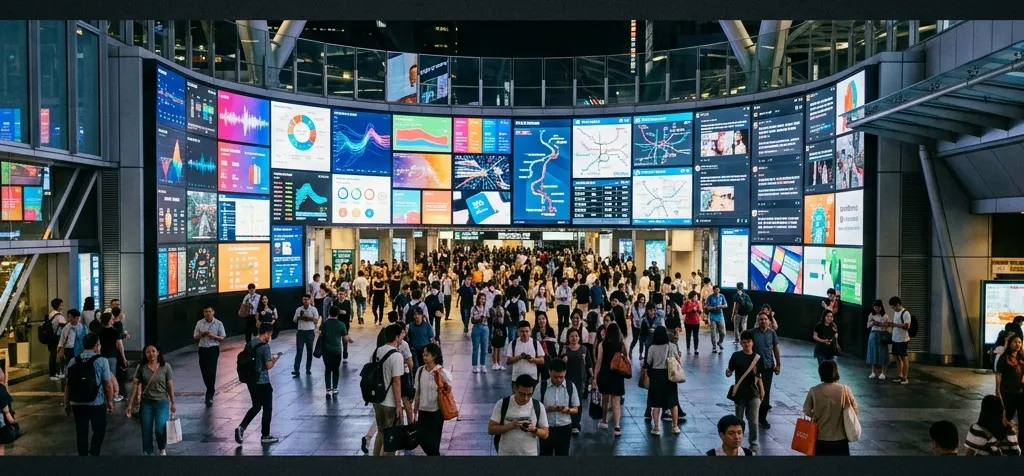
A physical prison requires armed guards, thick concrete walls, and a massive budget to keep people locked inside. Throughout history, governments spent immense amounts of money and physical force trying to control what their citizens believed. The East German Stasi employed an estimated 274,000 informants across a population of roughly 16 million people, creating one of the most saturated surveillance networks in recorded history. Soviet citizens who wanted to share forbidden literature had to type manuscripts by hand on carbon paper, passing fragile copies from person to person in a network called samizdat, because the state controlled every printing press in the country. The physical infrastructure of censorship and surveillance required enormous centralized budgets, dedicated buildings full of filing cabinets, and thousands of salaried officers whose full-time occupation consisted of reading other people's private letters.
That old architecture of control looks primitive now.
Modern society arrived at a far more efficient method to achieve the same result, and the population paid for every piece of it. A modern citizen eagerly buys the tools of their own surveillance, sometimes waiting in long lines overnight to purchase the newest tracking device on release day. This machine rides in their pocket wherever they go, recording their location, their conversations, their purchases, their friendships, their reading habits, and the number of seconds they spend looking at any given image. The monthly fee to keep it connected to the network often exceeds the cost of feeding a person for a week in many parts of the world. Governments no longer need to pay a secret police force to monitor the population, because the population documents every detail of its own life and uploads it to corporate servers voluntarily, for free, around the clock.
The Warden Made of Light
A decentralized mob of the speaker's own peers now enforces the boundaries of acceptable thought. The rules change constantly. One week a particular word carries no weight at all, and the following week the same word triggers mass outrage from thousands of strangers who have never met the speaker and know nothing about the context of the original statement. The mathematical formulas governing what people see on their screens are designed to maximize the amount of time a person spends looking at the device, and the most reliable way to hold human attention is to provoke anger and fear. Calm, measured conversation generates very little profit. Outrage keeps people scrolling.
Social media platforms run on advertising revenue, and advertising revenue depends on the volume and speed of user reactions. A person who reads a long, carefully written argument pauses to think before responding. That pause produces zero revenue. A person who fires off an angry, one-sentence reaction to a provocative headline generates a cascade of further reactions, each one serving another advertisement, each one keeping another pair of eyes locked to the screen for another few seconds. The commercial architecture of the entire system selects for speed and emotional heat, punishing reflection by burying it beneath content that moves faster.
The Shrinking of Language
This environment steadily reduces the range of language available for expressing disagreement. A hashtag compresses a complex political position into a handful of words. A label flattens a person's entire worldview into a single tribal category. A trending topic demands immediate reaction before anyone has had time to read the source material or understand the full picture. Complex thought requires slow processing time and extended sentences. The platform does not reward those things.
Over time, populations trained inside this system lose the habit of building long arguments. The vocabulary available for dissent shrinks, because the only words that survive the algorithmic filter are the ones that provoke fast emotional reactions. Careful distinctions between related positions disappear. A person either supports the dominant position completely, or the network classifies them as an enemy. The reduction of language to a series of slogans and labels strips away the middle ground where genuine thought actually happens.
The Fear of Exile
When economic survival and social integration depend on a digital presence, the threat of social banishment functions just as effectively as a prison cell. A single misunderstood sentence, taken out of context and amplified by thousands of strangers, can cost a person their job and their reputation within hours. The punishment arrives without a trial, without a hearing, and without any formal process of appeal. The crowd delivers the verdict, and the crowd moves on to the next target before the previous one has even finished falling.
This changes how people think before they speak.
Conformity is enthusiastically crowdsourced from the bottom up. People preemptively silence themselves before they ever type a word, carefully evaluating every opinion against the shifting boundaries of public acceptability. Workers avoid stating positions that might offend a future employer scanning their public history. Teachers avoid topics that might generate complaints. Writers soften their arguments to avoid triggering a pile-on from strangers who will never read past the headline. The policing of thought moves inside the individual, and the government never has to lift a finger.
The gray, concrete surveillance state of the twentieth century required enormous budgets, massive filing systems, and the constant threat of physical violence to keep its citizens afraid. The surveillance state of the twenty-first century runs on bright colors, smooth interfaces, and monthly subscription fees, and the citizens carry it with them willingly because it also delivers their music, their weather, and their messages from the people they love.
The most efficient way to silence a population involves making them terrified of their own reflections in the glowing glass.