
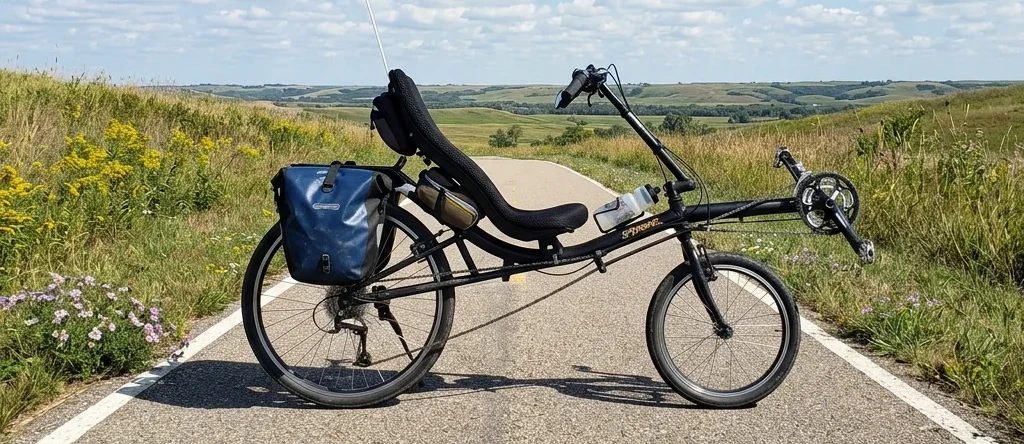
Crossing continents by bicycle tests human endurance over months of travel. A traveler either leans forward over handlebars or reclines inside an ergonomic chair. That physical posture divides long-distance cycling into two engineering philosophies. The upright diamond frame places forty percent of torso weight onto palms and wrists. The rider extends the neck upward to scan oncoming traffic, compressing cervical vertebrae. Over a six-hour day, road vibrations travel through the front fork, driving saddle pressure into the pelvic floor and ischial tuberosities.
Sitting back inside a contoured seat transfers body weight across a broad surface from the sacrum to the shoulders. Hands rest loosely on over-seat handlebars without supporting torso mass. Reclining also reduces frontal surface area by twenty-five to thirty-five percent, cutting aerodynamic resistance against headwinds. That physical reality shapes two distinct ways of traveling across continents.
The Engineering of the Modern Recumbent
Misconceptions portray recumbents as quirky oddities. Modern recumbent manufacturing reflects precision engineering from specialized builders across the globe. In Germany, HP Velotechnik manufactures expedition recumbents featuring rear suspension linkages that absorb broken pavement. In the Czech Republic, AZUB builds hand-welded touring chassis engineered to carry full pannier loads across rough roads and unpaved frontiers. In Australia, Greenspeed produces stable touring designs, while Bacchetta builds long-distance road recumbents in the United States.
Lightning Cycle Dynamics in Lompoc, California, under the direction of aerospace engineer Tim Brummer, manufactures the P-38 recumbent. Built with a triangulated chrome-moly space frame, the P-38 weighs between twenty-two and twenty-six pounds. In streamlined testing at Ontario Motor Speedway, a faired derivative clocked 55.85 miles per hour, capturing world speed records. Tim Brummer expanded this design into carbon fiber construction with the R-84, a monocoque frame weighing under three pounds with integrated rear suspension. That construction transfers pedaling power without frame flex, demonstrating that ergonomic seating can climb mountain grades while matching traditional racing bicycles.
The used touring market offers dependable classic options for budget travelers. The Burley Hepcat, once produced in Oregon, paired a twenty-six-inch rear wheel with a twenty-inch front wheel on a rigid chromoly boom. The stiff boom eliminates power loss, making the Hepcat a capable climbing machine covering thousands of touring miles.
Wheel Configurations and Frame Geometry
Short wheelbase recumbents balance steering agility and stability through proven wheel configurations. The dominant standard for long-distance touring pairs a twenty-six-inch rear wheel with a twenty-inch front wheel. The smaller twenty-inch front wheel drops below the crank circle, eliminating shoe overlap during tight pedaling turns while keeping the seat low. A low seat allows a rider to plant both feet flat on the ground at road junctions. The larger twenty-six-inch rear wheel rolls over road seams, accepts standard pannier racks, and uses globally available touring tires.
Dual large wheels represent an opposing design philosophy. High-racer recumbents mount matching 700c or twenty-six-inch wheels front and rear. While dual large wheels roll efficiently over road chatter during fast endurance events, they create clear compromises for relaxed touring. The tall seat height makes balancing loaded luggage awkward at traffic stops, and the large front wheel can strike rider shoes during low-speed turns. For air transit, compact layouts pairing a twenty-four-inch rear wheel with a twenty-inch front wheel fit standard airline cartons.
Riding low alters balance during rapid descents. Sitting twenty-four inches above the pavement creates a low center of gravity. Over-the-handlebar tumbles during sudden emergency stops cannot occur. If a wheel loses traction on wet pine needles, the rider remains close to the ground, turning a fall into a short slide.
For global touring, short wheelbase recumbents are often preferred over long wheelbase recumbents because they are more maneuverable and easier to transport. Long wheelbase frames abandon nimble handling to maximize highway comfort. Positioning the bottom bracket behind the front wheel stretches the wheelbase. That long chassis flexes naturally across pavement seams, delivering the plush glide of a classic town car rather than the responsive dart of a sports coupe. Yet that comfort creates severe logistical hurdles off the open road. At over six feet in length, long wheelbase recumbents cannot easily turn through tight hotel corridors, negotiate narrow apartment stairwells, or fit inside trains or airplane cargo holds. Packing one into standard airline cargo boxes is impossible without frame couplers.
Drivetrain Realities and Climbing Mechanics
Some may feel that recumbents cannot be repaired during foreign expeditions. Field experience proves otherwise. Modern recumbents rely on standard bicycle components found in bicycle shops across every continent. They use standard Shimano cassettes, universal wheel hubs, common nine-speed derailleurs, and standard disc brake pads.
The primary difference lies in chain length. A recumbent drivetrain runs roughly 2.35 times longer than a standard diamond frame, linking three normal chains together. The chain glides through durable nylon idler pulleys and plastic guide tubes to keep oil away from traveler bags. Long chains wear down far slower than short chains because pedaling stress spreads across nearly three hundred individual links. The only specialized item that may be absent from rural repair stalls is the extra-long rear derailleur cable. Prudent touring cyclists resolve this by packing a spare cable inside their repair kit.
Climbing hills on a recumbent requires distinct biomechanical habits. The rider cannot stand up to use body weight on the pedals, so pedaling power comes from leg extension pressed against the seat back. Sustained mountain grades above eight percent require spinning small gears at eighty to one hundred rotations per minute. Touring recumbents use ultra-low gearing below twenty gear inches to prevent patellar tendon strain. Starting from a dead stop on a steep, loose gravel incline demands practice, as the rider needs forward momentum while balancing.
Luggage placement enhances stability on paved surfaces. Low-slung under-seat racks place loaded panniers below the rider hips between the wheel axles, lowering the center of mass. Fully outfitted touring recumbents carry a total bare chassis weight between thirty and thirty-eight pounds, exceeding the weight of an unladen steel upright touring bicycle. Adding an electric motor inside the rear wheel hub assists older travelers on steep afternoon climbs, letting them ride sixty miles each day across rolling river valleys without knee pain.
Greenways, Visibility, and Weather Exposure
Recumbents display their greatest strengths along long-distance greenways. On dedicated corridors like the Katy Trail in Missouri, the Great River Trail, or the paved network of the Netherlands, cars disappear. Cyclists sit back into padded mesh seats, taking in broad river bends and soaring hawks without craning their necks backward. The journey becomes a rolling vantage point rather than an exercise in neck strain.
On shared public highways, riding low calls for common sense visibility measures. Sitting at bumper level can hide a cyclist behind roadside guardrails. Long-distance riders manage this by flying a bright fluorescent safety flag on a flexible fiberglass pole. Battery daytime flashers mounted behind the headrest and reflective rim strips alert drivers from hundreds of yards away.
Reclined riding introduces distinct weather challenges. While an upright cyclist tilts a helmet brim forward to deflect rain, a recumbent rider faces straight upward into rain, hail, and solar radiation. Travelers adapt by mounting small front fairings or wearing wide brimmed headwear.
The Mountain Bike for Rugged Backcountry Terrain
Where recumbents excel on paved corridors and rail trails, the upright mountain bike handles rough backcountry terrain. A recumbent cannot clear deep ruts or navigate narrow rocky footpaths. When routes follow unpaved tracks along the Continental Divide in Montana, the mountain bike functions through proven frame geometry.
Solo travelers riding remote dirt roads through the Peruvian Andes or corrugated tracks across the Australian Outback depend on mountain bike specifications. Wide tires measuring over two inches in width run at low inflation pressures between twenty and twenty-five pounds per square inch, providing traction over loose rock and washboard sand. A tall bottom bracket height gives crank clearance over trail obstacles. The large open front triangle accommodates bolt-on frame bags and water bladders without disturbing bike balance.
Trail conditions frequently force riders off the pedals. When mud clogs the drivetrain or steep rock gardens halt pedaling, an upright bicycle allows convenient hike-a-bike walking. The rider stands beside the saddle, holding wide flat handlebars to steer and control hand brakes while pushing the loaded machine across washouts or dry river beds.
Two Paths Across the World
Choosing a travel machine reflects what a rider values most on the journey. Travelers who seek unpaved backcountry tracks and rugged trails choose the mountain bike. They accept aching palms, neck fatigue, and saddle soreness as the physical cost of riding rough terrain.
Travelers who want to journey across continents in comfort often choose the recumbent. They trade rocky footpaths for open roads and flat rail-trail corridors. Sitting comfortably with an open chest, relaxed wrists, and clear horizon, they turn continental travel into an enduring way of life.