
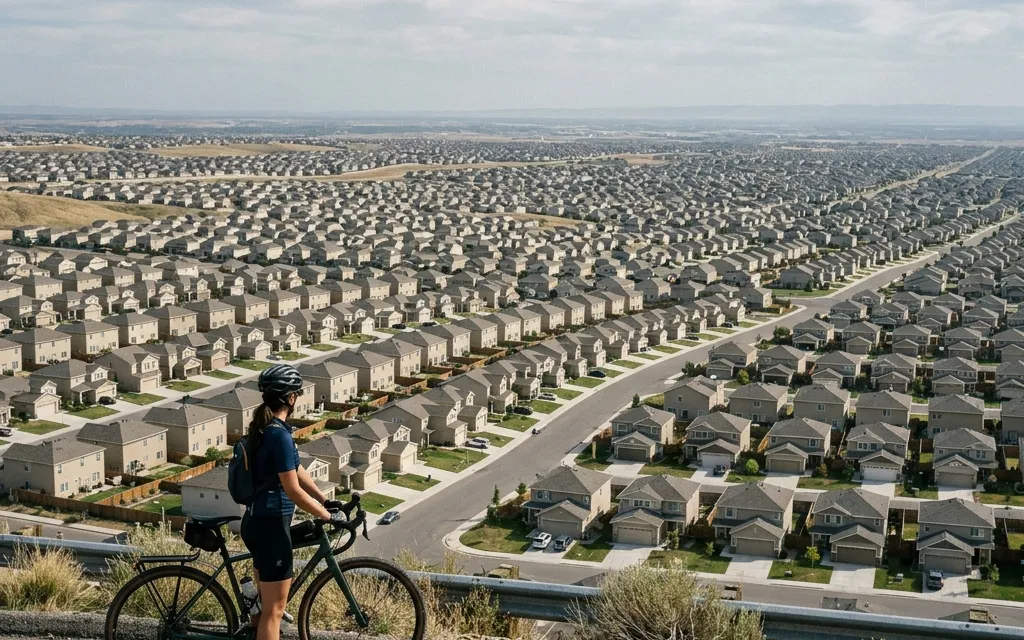
A global bikepacker learns to organize the world around the pursuit of wild and empty spaces. Dense urban areas are rare encounters that a rider avoids whenever possible because they interrupt the rhythm of the journey. Nature remains the primary goal, offering a landscape stripped down to weather and terrain where a traveler is alone with the weight of every decision. The problem is that reaching pristine wilderness almost always requires navigating through the vast physical sprawl of suburbia.
Suburbia operates as an immense geographic barrier spanning miles in every direction. It offers a flat expanse of paved driveways and housing developments that must be physically crossed to reach the wild.
What catches a traveler is almost never a sudden crisis. The trap is built out of relief and zero friction. A cyclist who has spent months sleeping on hard ground and fighting headwinds will eventually retreat into a quiet neighborhood to rest. The first week in this environment feels earned. A warm kitchen and a shower with endless hot water offer temporary sanctuary. Culinary pleasures replace whatever dry food could survive inside a pannier. These are genuine rewards that millions of people build their lives around by choice.
For the traveler, the danger lies in how quickly the physical form adapts to a zero friction environment. Vitality requires a specific dosage of physical and mental friction to maintain strength without causing exhaustion. The wild provides that necessary friction daily. Suburbia removes it. A rider no longer has to filter water or study weather patterns or push loaded bags over mountain passes.
Somewhere around the third or fourth week of rest, a profound disconnection occurs between the mind and the body. The mind remembers the road and continually wants to return to the struggle. It desires the living, breathing world outside and retains the ambition to pack the bags and leave.
The physical body tells a different story. Human vitality has limits, and the form ages on its own schedule. Muscles that were built from daily climbing begin to atrophy in stillness. Joints stiffen as the constant motion of the road is replaced by long hours resting indoors. The culinary pleasures that felt like rewards begin to add weight to the frame. The mind wants to go, but the body softens and begins to resist the effort of moving.
The trap closes when the traveler realizes the physical cost of leaving. Escaping suburbia requires the energy to pack the bags and begin the next journey. For a body that has lost its edge, this becomes a monumental hurdle.
The road is always calling, but convenience functions like gravity holding the traveler in place. Sometimes the rider forces the body back onto the saddle and pushes through the sprawl until the wilderness opens up again. Sometimes the physical resistance is too strong, and the weeks turn into months as the body refuses to match the ambition of the mind. The trap works because the environment asks nothing of the traveler while silently stealing the strength to leave.